Granary by Shri Chandra Satryotomo
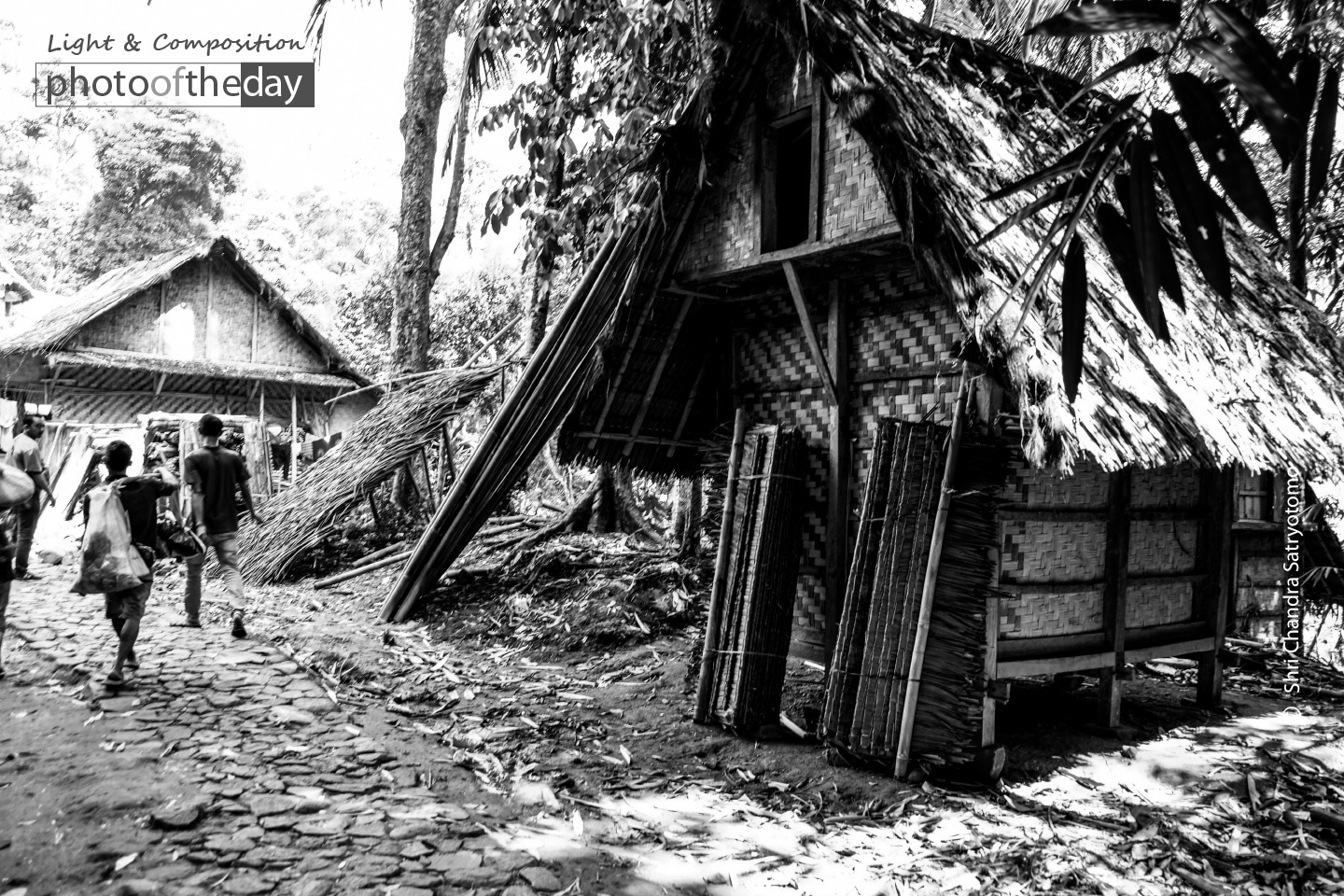
Captured in the remote Ciboleger village of Banten, Indonesia, this photograph documents the traditional lifestyle of the Baduy tribe. The image focuses on their unique rice barns, constructed from woven bamboo with elevated entryways, reflecting a culture that intentionally remains detached from modern technology and electricity. The photographer was drawn to the naive, timeless simplicity of this architectural form. By choosing a black-and-white medium, the artist emphasizes the textures and structural integrity of the barns, creating a compelling visual narrative that honors a vanishing way of life and highlights the profound connection between the tribe and their ancestral agricultural practices.
Shri Chandra Satryotomo
Born and raised in Jakarta, Indonesia, Shri Chandra Satryotomo has been an avid photographer since 1983. Drawing upon a professional background in architecture, he brings a refined understanding of scale, proportion, and composition to his work. Now based in Saint-Petersburg, Russia, he maintains a deep obsession with black-and-white photography, utilizing the medium to strip away distractions and present the world in its most honest, essential form.
Resonance Score Breakdown
Transparency Note: The resonance score (8.4/20) is calculated based on social engagement metrics collected before the award announcement.
Expert Photography Reviews · 8
The Weight of Empty Vessels
There is a specific silence that lives inside a container meant for harvest. It is not the silence of a room where someone has just left, but the hollow, echoing quiet of a vessel that has fulfilled its purpose and now waits for a season that feels increasingly distant.
Read the reflection →The Weight of Silence
I am generally wary of anything that presents itself as a relic of a simpler time. We have a tendency to romanticize the primitive, to project our own exhaustion with the modern world onto structures that were built for survival, not for our aesthetic pleasure.
Read the reflection →Reviews & Comments
Share your thoughts about this award-winning photograph. Your reviews contribute to the community engagement score.
Of the thousands of cultural studies I’ve reviewed, most rely on exoticism to hide a lack of substance. This succeeds because the tight framing of the woven bamboo forces us to confront the architecture’s raw utility rather than the tribe’s mystery. It’s a quiet, sturdy document. I find myself wanting to touch those rough, hand-woven walls. It’s that tactile honesty that ensures this will still matter in thirty years, long after the modern world encroaches.
The light here doesn’t demand; it waits. Shri Chandra Satryotomo caught the bamboo textures in that soft, diffused glow that only exists when the world is holding its breath. I’ve stood in similar silence, feeling the weight of a culture that refuses the rush of our century. Looking at these elevated barns, I feel a strange, quiet ache in my chest. It’s a reminder that some things are meant to be kept, not captured.
The woven bamboo texture evokes the ethnographic precision of early twentieth-century surveys, yet it avoids the sterile detachment of those archives. It’s a quiet study in structural rhythm that recalls the formalist rigor of Paul Strand’s Mexican portfolios. While the subject risks falling into the trap of the “vanishing culture” trope, the interplay of light on the elevated stilts feels remarkably fresh. I’m genuinely moved by how the geometry transcends mere documentation to become pure, tactile poetry.
The Baduy barns are beautiful, but where’s the pulse? I’m looking for the human friction, the blur of a hand or a footfall. Cartier-Bresson would’ve waited for a shadow to slice that bamboo. It’s technically sharp, sure, but it feels static. I want to feel the heat of the village. One tenth of a second later and the light might have danced. It’s a quiet study, but I’m still waiting for the street to wake up.
We look at these woven bamboo barns and we’re hearing the quiet rhythm of the Baduy harvest. It’s not just architecture; it’s a conversation between a people and their earth. I feel a strange, aching peace when I trace those textures, as if the wood itself is whispering secrets of a life lived apart from our noise. It’s a portrait of a culture’s soul, and honestly, it makes me want to sit in that silence forever.
The frame breathes. It’s a quiet, rhythmic sequence held in bamboo and shadow. I’m struck by the texture of the weave; it feels like a tactile memory of a place that refuses to rush. The elevated entryways create a perfect, jagged horizon line that anchors the eye. It’s a still shot that doesn’t need a pan to tell its story. I’d keep this frame exactly as it is. It’s a beautiful, frozen cut of time.
Before the eye identifies the woven bamboo, something in the chest tightens. It’s the stillness of the granary that pulls at me; I feel a sudden, sharp urge to lower my voice. The elevated entryways suggest a threshold I’m not meant to cross. Returning to this a year later, the texture of the grain feels like a memory I haven’t lived. It’s quiet, heavy, and it follows me into the dark of sleep.
The vertical axis here is anchored by the rhythmic repetition of bamboo slats, creating a precise 1:1 ratio between the barn’s facade and the negative space. I’m struck by how the diagonal stilts disrupt the horizontal stability, forcing the eye into a calculated ascent. It’s a beautifully solved spatial equation. The geometry isn’t just structural; it’s a rigorous, tactile logic. I’ve rarely seen such a clean, mathematical resolution of traditional form against a stark, monochromatic background.