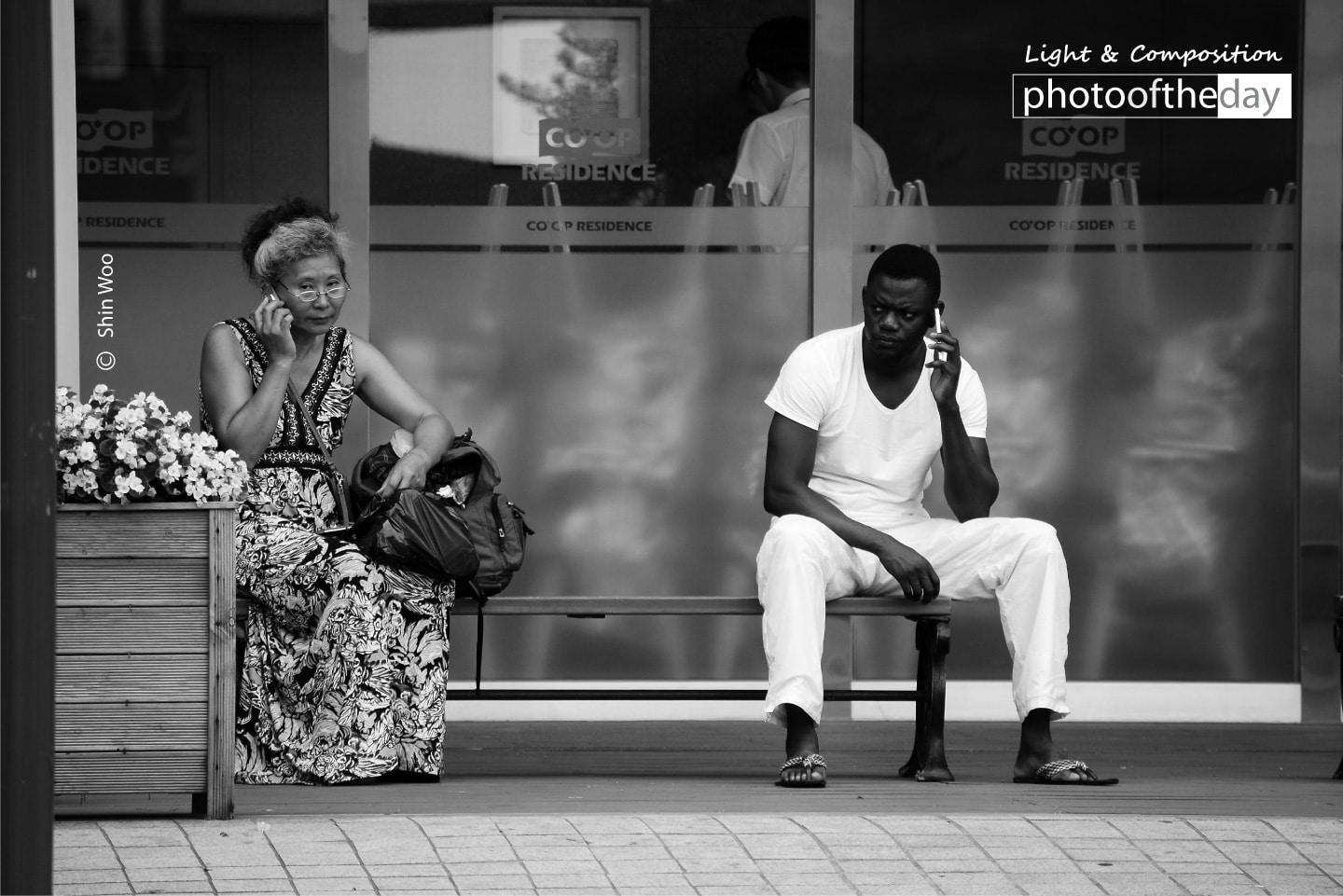
Phone Call by Shin Woo
Captured on the bustling streets of Dongdaemun, this candid moment highlights a serendipitous encounter between an elderly woman and a young man. The photographer was struck by the humorous coincidence of both subjects engaging in phone conversations simultaneously, creating a rhythmic, synchronized scene amidst the urban flow. By isolating this fleeting interaction, the image transforms an ordinary daily occurrence into a poignant study of human connection in the digital age. Its award-worthy quality lies in the photographer's keen observational timing and the ability to find narrative depth within the mundane patterns of city life.
Shin Woo
Born and based in Seoul, South Korea, Shin Woo discovered her passion for photography through her first Pentax camera. She views the medium as a philosophical pursuit, describing the act of capturing images as a way of watching the world. Favoring the timeless aesthetic of black and white photography, she draws inspiration from the philosophical concept of the world as will and representation, consistently seeking to uncover deeper meaning within the frame.
Resonance Score Breakdown
Transparency Note: The resonance score (10.4/20) is calculated based on social engagement metrics collected before the award announcement.
Expert Photography Reviews · 8
The Weight of a Voice
We carry our own private worlds in our pockets. A thin wire, a signal, a voice from somewhere else. It is a strange thing to stand in a crowd and yet be entirely elsewhere, tethered to a ghost who speaks from a distance.
Read the reflection →The Weight of Invisible Wires
There is a specific, heavy stillness that descends during the transition between a humid afternoon and the first grey bruise of dusk.
Read the reflection →Reviews & Comments
Share your thoughts about this award-winning photograph. Your reviews contribute to the community engagement score.
The city’s harsh, flat light doesn’t usually invite stillness, yet here it reveals a quiet geometry. I find myself holding my breath, watching these two souls tethered to invisible voices amidst the Dongdaemun rush. It’s a strange, lonely synchronicity. Shin Woo waited for the exact pulse of the street to align, and I feel a sudden, sharp ache for the solitude hidden within their shared, digital distance. It’s a beautiful, fleeting prayer in the concrete.
Seoul’s neon glow drowns out the stars, yet here, the light is just as ancient. These two souls in Dongdaemun, tethered by invisible signals, are drifting through a city that’s merely a flicker in time. I’ve spent my life chasing photons from dying suns, but there’s something deeply fragile about these human connections. It’s a quiet, fleeting resonance. I find myself holding my breath, watching them talk across the void, just like distant galaxies.
It’s jarring to see such crisp, unfiltered light. Down here, we’re constantly battling the refractive index and the relentless theft of the red spectrum. These two figures in Dongdaemun exist in a world where photons travel freely, unscattered by suspended particulate or the murky blue veil I’m used to. I find myself jealous of their clarity. It’s a strange, dry rhythm, but there’s a beautiful, sharp precision to their isolation that I rarely get to witness.
Street photography often feels like a raid, doesn’t it? I’m used to waiting days for a bird to trust my presence, yet here, the subjects are just props in a quick grab. It’s technically sharp, but it feels extracted, not earned. There’s no patience in this rhythm, just a hunter’s reflex. I find myself wishing the photographer had lingered, becoming part of the street’s pulse instead of just another person passing through with a camera.
The Pentax optics here struggle with the diffraction limit, yet that slight softness across the focal plane feels honest. It’s a fascinating optical compromise; the lens doesn’t resolve every pore, but it captures the rhythmic geometry of these two souls perfectly. I’m genuinely moved by how the light catches the elderly woman’s profile against the urban blur. It’s a beautiful, imperfect slice of physics that makes me feel like I’m standing right there in Dongdaemun.
It’s a rhythmic echo of Cartier-Bresson’s decisive moment, yet filtered through the frantic, neon-soaked density of Seoul. Woo captures a synchronicity that recalls the urban isolation found in Frank’s The Americans, but with a lighter, digital-age irony. I’ve spent decades tracking this specific geometry of human disconnection, and honestly, the way those two phones mirror each other makes me smile. It’s a sharp, fleeting observation that manages to feel fresh despite the heavy lineage it inherits.
You caught a rhythm here that most people walk right past. It’s funny, seeing them both tethered to their phones in the middle of that Seoul rush. I’ve spent enough time on those streets to know how lonely they can feel, but you found a strange, synchronized grace in the noise. And honestly? It made me smile. You waited for the alignment, and it paid off. There’s something truly honest happening here. Good eye.
Before the eye identifies the subjects, a strange stillness settles in the chest. It’s the rhythm of two lives suspended in digital isolation, yet perfectly mirrored. I feel a sudden, sharp ache for their shared solitude. When I return to this frame, the bustling Seoul background fades, leaving only the synchronized tilt of their heads. It’s a quiet, haunting reminder that we’re all just ghosts tethered to invisible voices, drifting through the same crowded, lonely streets.