A Mahabad Farmer by Bahar Rismani
Captured under the soft, diffused light of a cloudy day near Mahabad, this portrait documents an elderly farmer traversing the rural landscape. The photographer observed the man walking toward his village, a scene that epitomizes the traditional agricultural lifestyle of the region. By focusing on the subject against the backdrop of his ancestral home, the image serves as a poignant cultural record. Its award-worthy quality lies in the photographer’s ability to blend environmental storytelling with a respectful, intimate gaze, highlighting the dignity of the subject and the enduring connection between the people of Mahabad and their land.
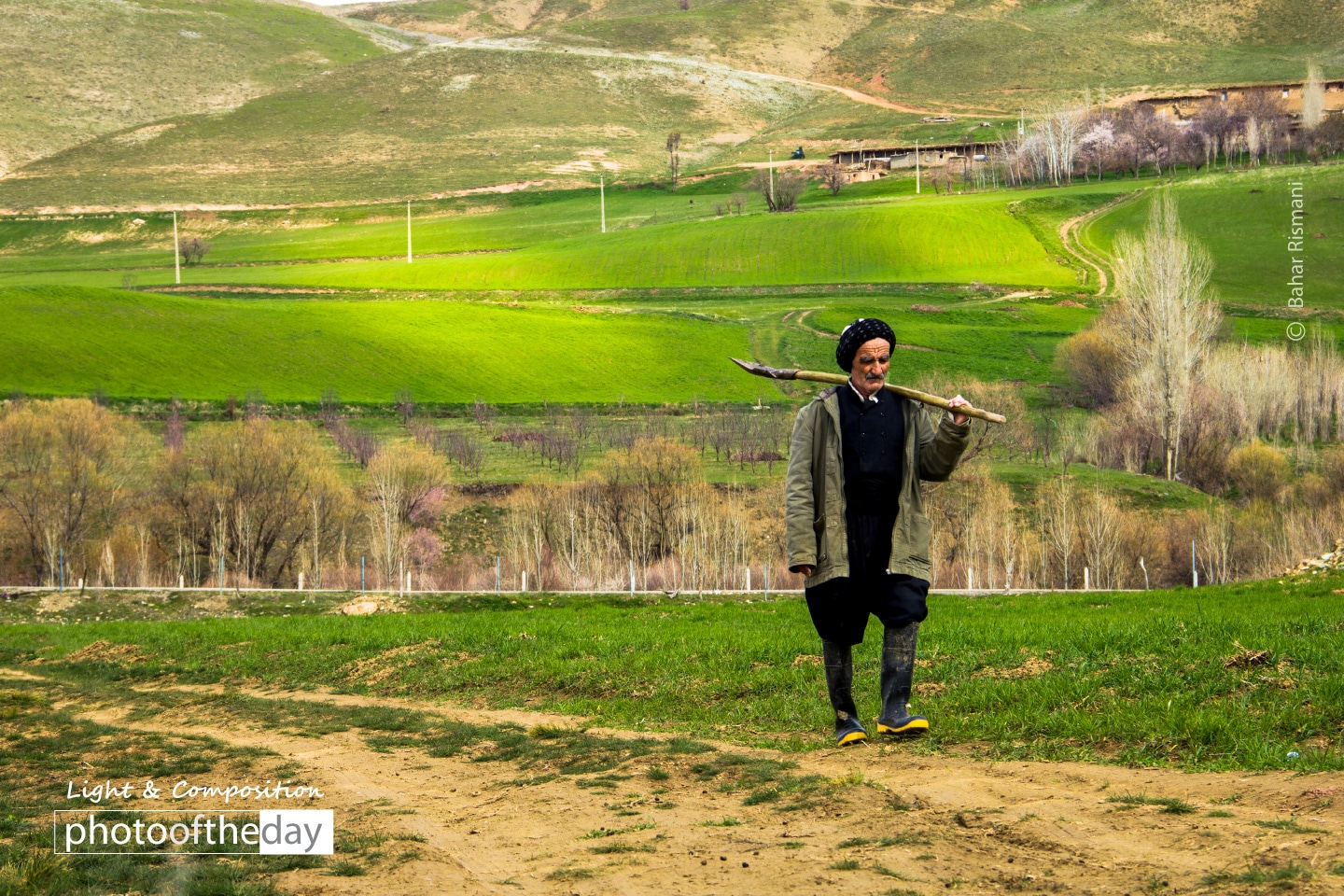
Exposure 1/200sec @ f/8 | ISO 100 | Focal Length 64mm
Bahar Rismani
Born in 1982 in the Kurdish city of Mahabad, Iran, Bahar Rismani is a dedicated portrait photographer with seven years of professional experience. Holding a degree in accounting, she balances her career with a deep commitment to documenting the cultural heritage of Kurdish women, particularly through the preservation of traditional clothing. Her work serves as a visual archive of ancient customs, capturing the intersection of history and modern village life with a sensitive and observant eye.
Resonance Score Breakdown
Transparency Note: The resonance score (9.2/20) is calculated based on social engagement metrics collected before the award announcement.
Expert Photography Reviews · 5
The Weight of the Soil
It is 3:14 am. The house is holding its breath, and I am staring at the wall, wondering how much of a life can be measured by the lines on a face. We spend our days trying to smooth things over, to hide the wear, to pretend that time hasn't been carving us into something else.
Read the reflection →The Rooted Persistence
In the high alpine meadows, the perennial bunchgrass does not fight the wind; it bends, its deep, fibrous root system anchoring it firmly into the scree while the blades above sway in rhythmic surrender. This is not weakness, but a profound form of endurance.
Read the reflection →Reviews & Comments
Share your thoughts about this award-winning photograph. Your reviews contribute to the community engagement score.
The way Rismani frames this farmer against the Oraman hills evokes the stark, unvarnished humanity of August Sander’s portraits, yet it’s softened by a tonal delicacy reminiscent of early Pictorialist landscapes. I’m genuinely moved by the texture of his coat; it’s a tactile history of labor. While the 64mm focal length creates a compression that feels a bit conventional, the subject’s gaze carries a weight that transcends the lens. It’s a quiet, necessary conversation with tradition.
The jury’s obsession with clarity here feels stifling. Rismani’s portrait of the Mahabad farmer is technically competent, but it’s far too safe. Why resolve every wrinkle and blade of grass? I’d trade that f/8 sharpness for a deliberate motion blur, something to evoke the kinetic exhaustion of his walk. It’s a missed opportunity to move beyond mere documentation. I’m genuinely craving a bit of visual friction; perfection is just so terribly, predictably quiet.
Before the eye identifies the farmer, a sudden stillness settles in the chest. It’s the weight of the Oraman landscape, that heavy, ancient silence. I find my own breath syncing with his slow, rhythmic gait. When I return to this portrait, I don’t see a record; I feel the grit of the soil under his boots. It’s a quiet, aching reminder of endurance. I’ve caught myself staring at his hands, wondering what they’ve held.
The farmer’s weathered face pulls me in, but I’m troubled by the framing. Why does he look like a relic of a vanishing past rather than a man living in the present? It’s a beautiful composition, yet it feels curated for an outsider’s gaze. Does this portrait grant him agency, or does it merely aestheticize his struggle? I find myself wanting to know his name, not just his occupation. Is he a person or a prop?
You waited for him to step into that frame, and I can feel the weight of his years in the way he carries himself. It’s not just a portrait; it’s a quiet conversation with a life lived close to the earth. I’ve spent enough time in the field to know when someone is truly present. You didn’t rush him. There’s something honest happening here. You caught the dignity of a man who belongs to that land.