Mirror by Fidan Nazim Qizi
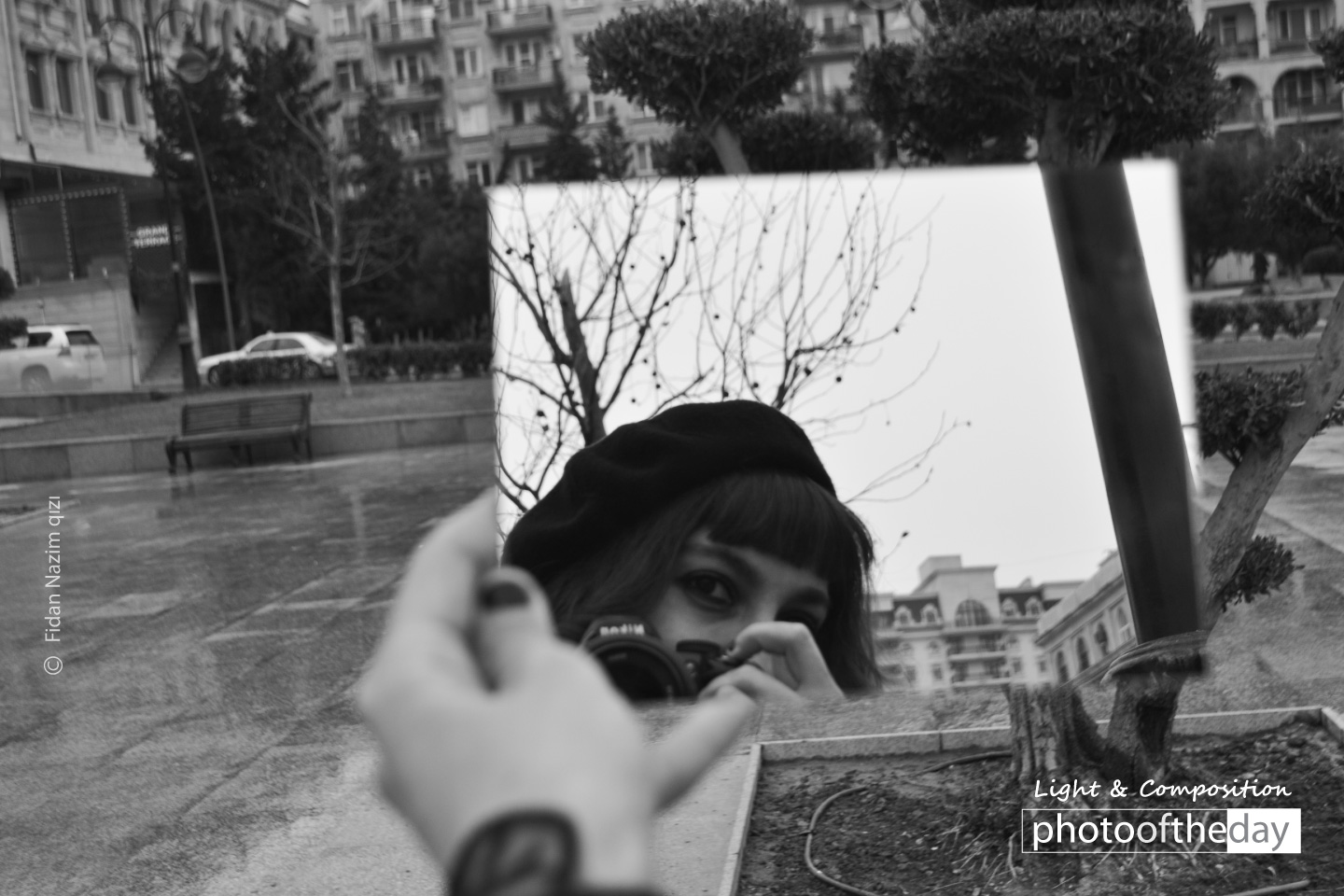
Mirror captures a profound moment of self-reflection, exploring the interplay between light and identity. By focusing on the concept of specular reflection, the photographer transforms a simple mirror into a medium that preserves the intricate physical characteristics of light, rather than merely diffusing it. This technical and philosophical approach elevates the image beyond a standard portrait, inviting the viewer to contemplate the nature of perception. The composition is masterfully executed, utilizing the stark contrast of black and white to emphasize the clarity and depth of the subject, ultimately earning its place as a compelling, award-worthy study of form and introspection.
Fidan Nazim Qizi
Born and based in Baku, Azerbaijan, Fidan Nazim Qizi is a dedicated photographer who balances her life in the city with frequent travels to explore nature and mountainous landscapes. Heavily influenced by the iconic work of Vivian Maier, she specializes in black and white photography, viewing the medium as a powerful source of energy and inspiration. Her artistic practice is driven by a deep desire to capture feelings and human experiences, consistently seeking to translate the beauty of the world into evocative, monochromatic imagery.
Resonance Score Breakdown
Transparency Note: The resonance score (10.0/20) is calculated based on social engagement metrics collected before the award announcement.
Expert Photography Reviews · 6
The Cold Edge of Knowing
The smell of rain on hot pavement always brings me back to the hallway of my childhood home. There was a tall, silver-backed glass that hung by the door, its surface cool enough to steal the heat from your fingertips if you pressed them against it.
Read the reflection →The Stranger in the Glass
If you were to meet yourself in a crowded room, would you recognize the person staring back? We spend our lives curating a version of ourselves for the world, a mask polished by habit and necessity, until the original features begin to blur.
Read the reflection →Reviews & Comments
Share your thoughts about this award-winning photograph. Your reviews contribute to the community engagement score.
We look at this face and we understand something—the mirror isn’t just glass, it’s a conversation. Fidan Nazim Qizi has listened to the silence between the subject and her reflection. It’s a quiet, heavy intimacy. I find myself holding my breath, waiting for the woman in the frame to finally look back at us. It’s a photograph that asks to be returned to, because it’s not just capturing light; it’s capturing a soul’s long, searching gaze.
Stripping away the chromatic spectrum reveals a haunting, silver-grey silence, reminiscent of Morandi’s dust-choked still lifes, where the absence of hue forces one to confront the raw, shivering temperature of light itself. It’s a stark, monochromatic meditation that makes my heart ache with its brittle, crystalline clarity. One finds that by abandoning the riot of colour, the photographer has captured the very ghost of a reflection, suspended in a cold, liquid, and utterly timeless void.
The subject’s gaze isn’t quite locked. In athletics, if you aren’t fully committed to the focal point, you’ve already missed the play. The reflection is static, lacking the tension of a true peak moment. It’s a clean composition, sure, but it feels like a practice drill rather than the game itself. I’ve spent my life chasing that one perfect millisecond of total exertion; this doesn’t have it. It’s technically sound, but it’s just not alive.
f/2.8 at 50mm, 1/125s, ISO 400. A standard portrait configuration, yet it’s precise. The shallow depth of field isolates the reflection, forcing the viewer into the subject’s gaze. It’s a calculated risk that pays off; the focus on the eye is razor-sharp. I’ve seen enough soft mirrors to know this isn’t luck. It’s a cold, clinical execution of light. Honestly, it’s the first time in months I’ve actually felt unsettled by a print.
Baku’s light hits that glass and suddenly, it’s not just a reflection; it’s a collision. I love how the frame traps the subject’s gaze right before the world shifts. Cartier-Bresson would’ve tipped his hat to this geometry. One tenth of a second later and the shadow has moved, the frame has collapsed. You caught the ghost in the machine. It’s sharp, it’s hungry, and it’s exactly where it needs to be. Pure, unrepeatable tension.
Reflections have haunted the medium since Daguerre’s silvered plates, yet Qizi’s approach feels startlingly fresh. The way she handles the specular highlight recalls the precision of Moholy-Nagy’s photograms, stripping identity down to pure geometry. It’s a rigorous study of form that avoids the trap of mere vanity. I’ve spent decades staring into these glass portals, but the sharp, clinical tension here genuinely made me catch my breath. It’s a rare, quiet triumph of modern introspection.