Proof of Light by Jay Haria
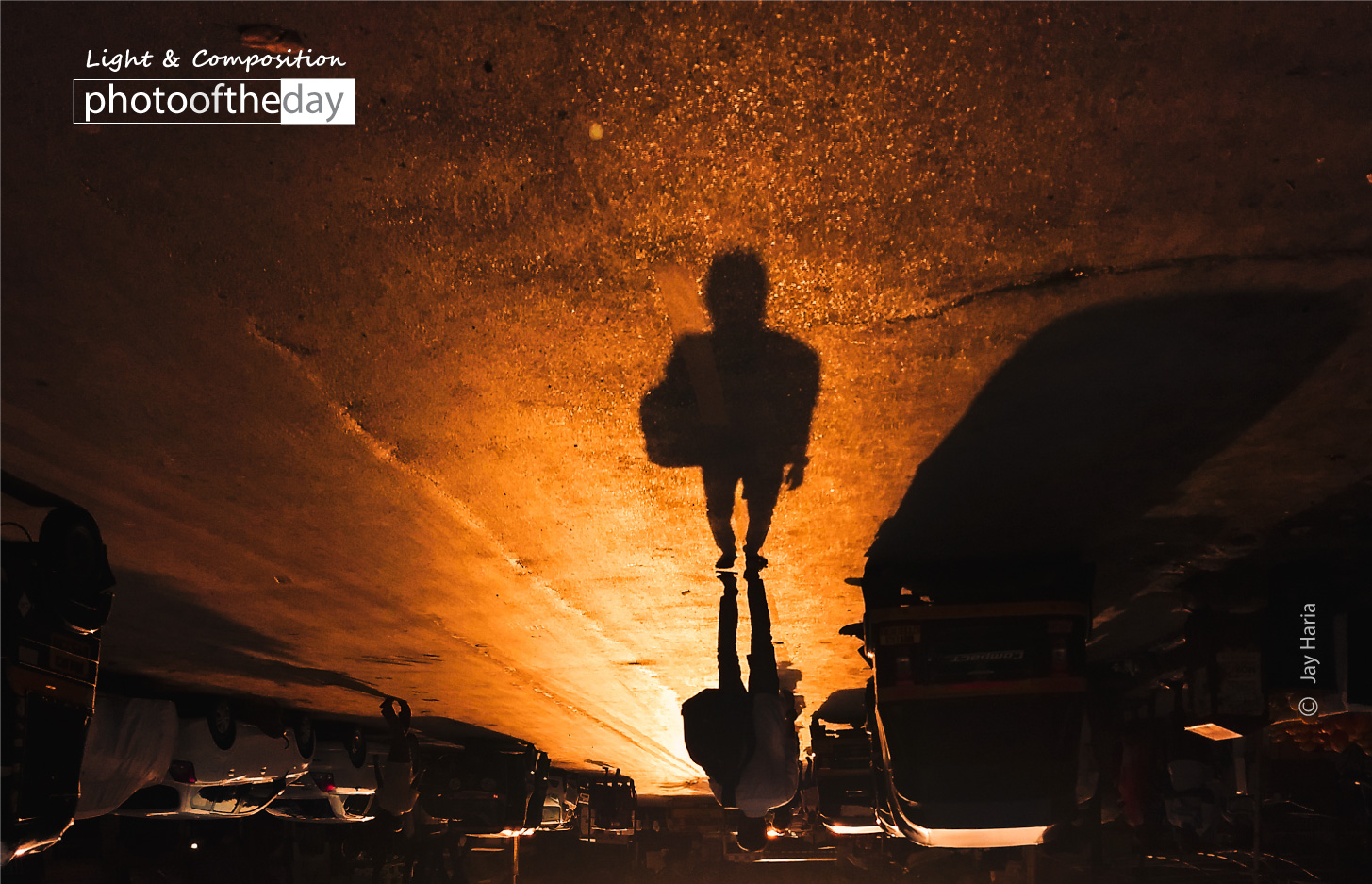
Proof of Light captures the ephemeral nature of shadows, drawing inspiration from the ancient camera obscura technique where light and projection define our perception of reality. The photographer utilizes the stark contrast of bright sunlight to transform mundane surroundings into a reversed, inverted narrative of the self. By focusing on the interplay between light and darkness, the image explores the philosophical concept that we only ever truly witness our own projections upon others. This evocative composition stands out for its intellectual depth and its ability to turn a simple technical capture into a profound meditation on human perspective.
Jay Haria
Born and based in Mumbai, India, Jay Haria discovered his passion for photography while pursuing his engineering degree. His early talent led him to serve as a lead photographer and videographer for TEDx Vidyavihar, eventually expanding his creative horizons into street, portrait, and nature photography. Now transitioning into a professional career as a cinematographer, Haria continues to refine his visual storytelling through both still photography and film production for digital media channels.
Resonance Score Breakdown
Transparency Note: The resonance score (10.9/20) is calculated based on social engagement metrics collected before the award announcement.
Expert Photography Reviews · 5
The Shape of a Shadow
The blue ceramic mug that sat on my father’s desk for twenty years is gone. It was chipped at the rim, a jagged little bite taken out of the porcelain, and it always smelled faintly of stale coffee and old paper.
Read the reflection →The Shadow’s Weight
We spend our lives trying to stand in the sun, believing that to be seen is to be known. We turn our faces toward the warmth, ignoring the dark shape that follows us across the pavement. It is a faithful companion, this shadow.
Read the reflection →Reviews & Comments
Share your thoughts about this award-winning photograph. Your reviews contribute to the community engagement score.
Most entries I see today are technically perfect but emotionally hollow. They’ll be forgotten by Tuesday. Jay’s work is different. By using a humble Moto G5 to capture these inverted shadows, he forces us to confront the fragility of our own perceptions. It’s haunting. I actually felt a shiver looking at how the harsh Mumbai sun turns a mundane wall into a philosophical void. It’s the kind of raw, intellectual honesty that’ll still matter in thirty years.
Most photographers would obsess over the Moto G5’s sensor limits, but Haria ignores the digital noise to chase the ghost of a shadow. It’s a raw, inverted meditation that feels closer to a camera obscura’s flickering projection than a standard Mumbai street snap. I’m genuinely struck by the deliberate lack of resolution here. Why resolve the world when you can dissolve it? He’s chosen to prioritize the light’s architecture over the subject’s identity. It’s brilliant.
The frame operates on a strict binary, bisected by a sharp diagonal that forces the eye into the negative quadrant. It’s a classic spatial equation where the inverted projection acts as a counterweight to the sun-drenched concrete. I’m genuinely thrilled by how the shadow’s geometry destabilizes the vertical axis, turning a mundane Mumbai surface into a precise, inverted coordinate system. It’s a rare moment where the math doesn’t just hold the frame; it defines the reality.
We look at this inverted world and feel the weight of a silent conversation. Jay didn’t just capture a shadow; he listened to the light until it revealed a secret. It’s a haunting, upside-down mirror of a Mumbai street, where the subject’s projection becomes their true face. I’m moved by how the darkness holds the story here. It’s a photograph that asks to be returned to, because it’s really a map of our own hidden selves.
Before the eye identifies the inverted geometry of Mumbai, something in my chest tightens. It’s a sudden, visceral disorientation. Haria’s light doesn’t just illuminate; it demands a physiological recalibration. When I return to this, I’m struck by how the shadows feel like phantom limbs. It’s unsettling, the way my own pulse quickens trying to reconcile the upside-down world. I’ve spent weeks haunted by that sliver of sun, feeling like I’m finally seeing my own projection.