Fly High by Shubham Katiya
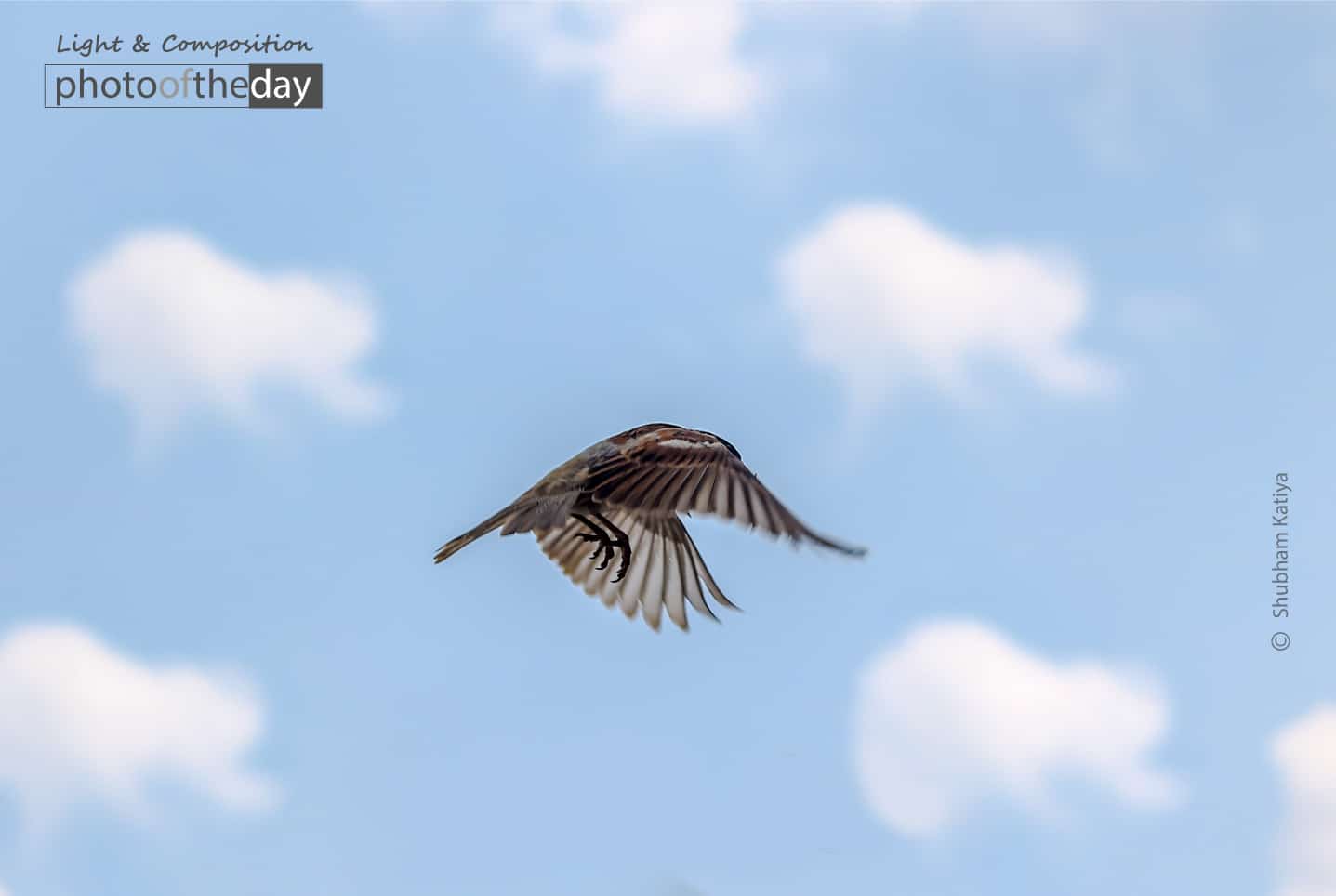
In 'Fly High,' Shubham Katiya captures the boundless ambition of nature, drawing a poignant parallel between the relentless drive of birds and the human pursuit of dreams. Taken with a 50mm lens, the image freezes a moment of avian grace, emphasizing the subject's upward trajectory against the vast sky. The photographer’s technical choices—a swift shutter speed of 1/1000sec—perfectly isolate the bird in flight, highlighting its determination. This photograph is award-worthy for its ability to transform a simple wildlife observation into a powerful metaphor for persistence, reminding viewers that, like the bird, one must always strive to ascend toward their goals.
Shubham Katiya
Based in Pune, India, Shubham Katiya is a dedicated photographer who views the lens as a tool for philosophical reflection. Since beginning his journey in 2016, he has cultivated a deep passion for portrait and street photography, constantly refining his craft through a learner's mindset. Katiya draws inspiration from the parallels between photography and life, viewing every frame as a lesson in perspective and resilience. His work is defined by a thoughtful approach to capturing the human and natural experience, reflecting his belief that every image serves as a unique opportunity for growth.
Resonance Score Breakdown
Transparency Note: The resonance score (10.1/20) is calculated based on social engagement metrics collected before the award announcement.
Expert Photography Reviews · 6
The Weight of the Sky
I keep a small, rusted key in a velvet pouch, though I have long since forgotten which door it once opened. It is heavy for its size, a cold piece of iron that feels like a promise made by someone who is no longer here to keep it.
Read the reflection →The Architecture of Ascent
In the quiet hours of the morning, I often watch the sparrows that congregate near the eaves of my porch. They do not seem to possess a map, nor do they appear burdened by the weight of a destination. They simply rise.
Read the reflection →Reviews & Comments
Share your thoughts about this award-winning photograph. Your reviews contribute to the community engagement score.
It’s a crisp, terrestrial capture, but I can’t help but crave the resistance of water. Up here, light travels through air with ease, ignoring the refractive index shifts I battle daily. There’s no backscatter to ruin that clean sky, no strobe angle to manage, and the colours haven’t been stripped by depth. It’s strangely liberating to see such clarity. I’d love to see this bird dive; the physics of its plunge would be truly extraordinary.
1/1000sec at f/4.5, 50mm. A standard kit lens approach to a high-speed subject. The shutter speed is sufficient to freeze motion, but f/4.5 on a 50mm prime is lazy glass work. It’s a soft compromise that lacks the necessary separation for a wildlife shot. I’ve seen this exact technical profile a thousand times. It’s technically functional, yet it doesn’t push the sensor. Honestly, it’s frustratingly safe. Katiya settled for adequacy when he needed precision.
We look at this bird and we don’t just see wings; we see a soul mid-ascent. Shubham didn’t just snap a shutter; he listened to the silence of the Dewas sky until the bird’s ambition became his own. It’s a portrait of pure, unadulterated longing. I feel a sudden, sharp ache in my own chest watching it climb. It’s a photograph that asks to be returned to, reminding us that we’re all just trying to fly.
The frame’s geometry is precarious. A 50mm lens forces a claustrophobic proximity, yet the subject lacks the necessary spatial tension to anchor the void. It’s a study in imbalance. The bird’s trajectory cuts the picture plane with erratic force, failing to resolve the negative space. I’m exhausted by the lack of structural discipline here. It doesn’t hold. The composition demands a more rigorous fulcrum, but it’s just drifting into the ether. It’s technically sharp, but structurally hollow.
Why do we insist on projecting human ambition onto a bird? Katiya’s 50mm lens isolates this creature against a void, stripping away the context of Dewas. It’s a clean, clinical capture, but it feels hollow. Does the bird’s flight actually mirror our own dreams, or are we just using its struggle to validate our own restlessness? I find the sentimentality here exhausting. We’ve turned a wild, living thing into a mere prop for our personal narratives.
Most wildlife shots are just trophies, but this one sticks. Using a 50mm lens for flight is a gutsy, restrictive choice that forces the bird into a wider, more vulnerable context. It’s not just a bird; it’s a tiny, defiant speck against an indifferent void. I’ve seen thousands of telephoto close-ups, but they’re forgettable. This frame’s raw, unvarnished scale makes me feel small. It’s the kind of quiet persistence that will still matter in thirty years.