Dramatic Skies by Subhas Nayak
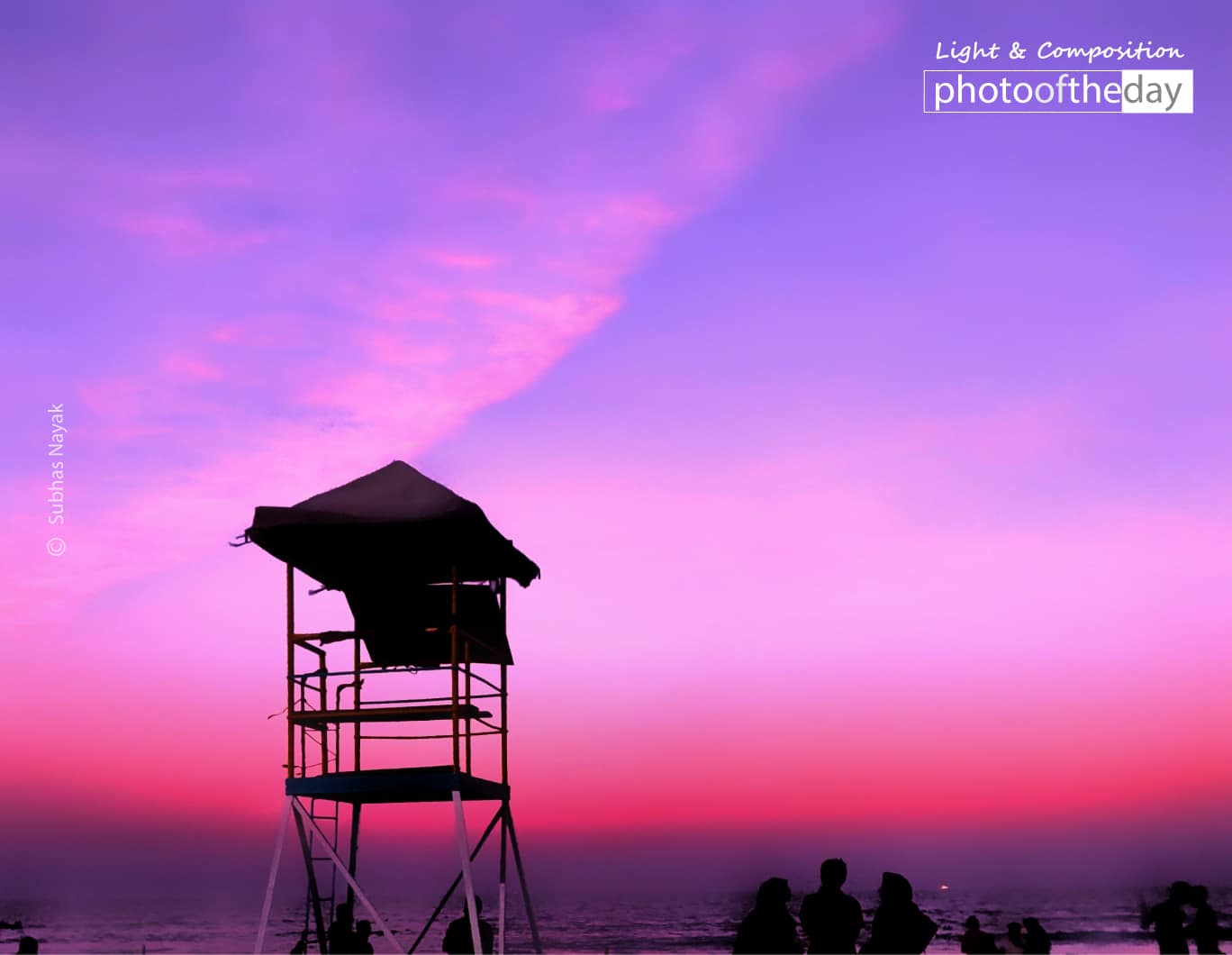
Dramatic Skies captures a rare atmospheric phenomenon where the sky shifts into deep, vibrant hues of violet and purple. The photographer seized this fleeting moment by framing a solitary security stand against the expansive, color-saturated backdrop, creating a striking contrast between the man-made structure and the celestial display. This composition elevates a simple landscape into a compelling narrative of light and perspective. The image is award-worthy for its technical precision in low-light conditions and the photographer's keen eye for finding beauty in spontaneous, unplanned moments, effectively turning a common beach scene into a dramatic, ethereal experience.
Subhas Nayak
Born in Karnataka, India, Subhas Nayak currently resides in Abu Dhabi, where he balances a professional career in the pharmaceutical industry with a dedicated passion for mobile photography. He specializes in spontaneous, unplanned captures, frequently utilizing a OnePlus device equipped with Moment wide-angle lenses to document his travels. His work is defined by an observant approach to his surroundings, finding artistic potential in everyday environments and the natural world during his leisure time.
Resonance Score Breakdown
Transparency Note: The resonance score (11.6/20) is calculated based on social engagement metrics collected before the award announcement.
Expert Photography Reviews · 6
The Breath of the Horizon
There is a rhythm to the world that reveals itself only when we stop trying to name what we see. We often look at the sky and search for patterns, for omens, or for the familiar shapes of our own making.
Read the reflection →The Breath Before the Storm
We often mistake the horizon for a boundary, a line drawn in the sand to tell us where our world ends and the unknown begins. But there are evenings when the atmosphere grows heavy, thick with the scent of ozone and the promise of a sudden, cleansing release.
Read the reflection →Reviews & Comments
Share your thoughts about this award-winning photograph. Your reviews contribute to the community engagement score.
At f/1.7, the OnePlus 6 sensor struggles against the diffraction limit, yet the violet hues here are haunting. It’s a fascinating collision of high ISO noise and atmospheric scattering. While the lens lacks the micro-contrast I’d crave for such a sky, the way the light bleeds around that solitary structure is genuinely moving. It’s not perfect optics, but the physics of that purple light hitting the sensor creates an ethereal, almost alien, sense of place.
Violet light bleeds into the sand. A solitary structure anchors the frame. It’s quiet here. I’ve spent minutes watching that small, dark silhouette against the vast, bruised sky. It doesn’t demand attention. It simply exists. The space around the stand isn’t empty; it’s heavy with the weight of the coming night. Nothing here is accidental. The empty corner is not empty. It’s a breath held in the dark. I feel a sudden, sharp peace.
The violet sky bleeds into the sand, turning that lonely security stand into a sentinel of the twilight. It’s a haunting, geometric anchor against the celestial chaos. I’m genuinely moved by how the structure’s rigid lines define the vastness of the Karnataka coast. The man-made frame doesn’t just sit there; it claims the space, forcing us to reconcile human solitude with the infinite. It’s a quiet, beautiful dialogue between the ephemeral atmosphere and our own small, constructed worlds.
Most entries in this category rely on oversaturated sunsets, but this one earns its place by anchoring that violet chaos against the stark, lonely geometry of the security stand. It’s the tension between the ephemeral sky and that rigid, man-made box that makes me stop. I’ve seen thousands of beach shots, yet this one lingers because it captures a specific, quiet isolation. It’s not just a pretty sky; it’s a moment of genuine, haunting stillness.
The vertical axis of the security stand anchors a 1:3 ratio between the rigid, man-made structure and the expansive, violet-saturated sky. It’s a perfect exercise in spatial tension. The diagonal sweep of the shoreline creates a secondary vector that pulls the eye toward the negative quadrant, balancing the heavy mass of the tower. I’m genuinely struck by how the geometry tames such chaotic light. It’s a beautifully solved equation of form against the infinite.
Violet skies don’t invite us; they interrogate our insignificance. That solitary security stand, anchored in the violet gloom of Tannir Bhavi, isn’t just architecture—it’s a sentinel of the void. I’ve stared at its rigid silhouette until my eyes ached, feeling the crushing weight of the infinite pressing against the man-made. It’s a cold, lonely confrontation. When the light dies, the truth begins. Nayak doesn’t capture a sunset; he captures the silence that follows.