Leading Lines and Childrens by Shahzaib Ahmed
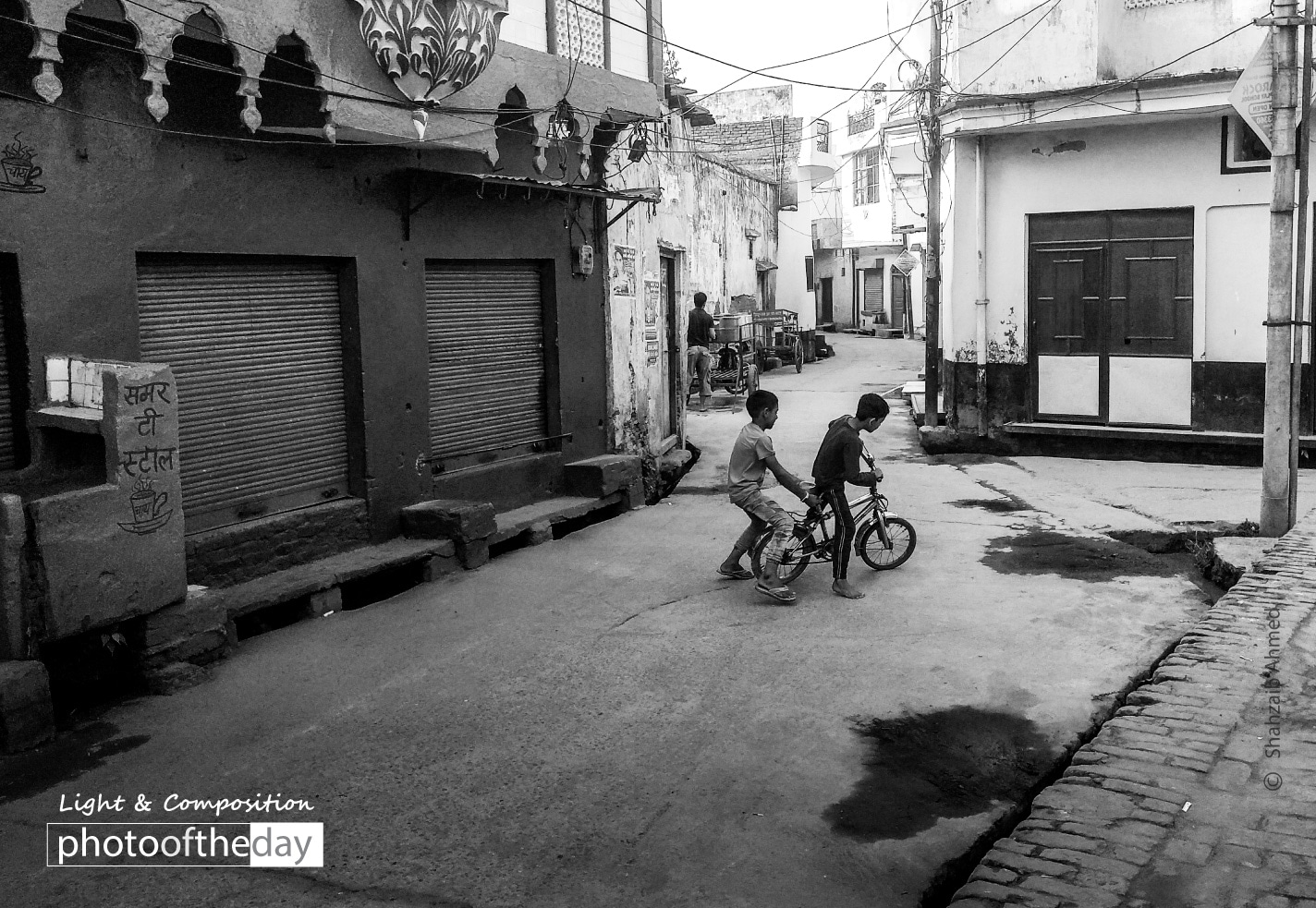
After observing the scene for over thirty minutes, the photographer captured this spontaneous moment as a group of children entered the frame. The composition masterfully utilizes leading lines to draw the viewer’s eye through the environment, highlighting the candid energy of the subjects. This image stands out for its ability to transform an ordinary street scene into a compelling narrative of childhood and urban life. The photographer’s patience and keen sense of timing allowed for a perfectly framed shot that captures the essence of the location, earning recognition for its strong compositional structure and authentic storytelling.
Shahzaib Ahmed
Born in India and based in Delhi, Shahzaib Ahmed is a dedicated photographer with a profound passion for documenting the world through street photography. He frequently travels to capture fleeting moments, utilizing a diverse range of equipment to experiment with unique perspectives and compositions. His work is defined by a commitment to authentic storytelling, seeking to find beauty and narrative depth in the everyday scenes he encounters during his global travels.
Resonance Score Breakdown
Transparency Note: The resonance score (10.9/20) is calculated based on social engagement metrics collected before the award announcement.
Expert Photography Reviews · 8
The Geometry of Unseen Paths
There is a particular stillness in the air just before the sun reaches its zenith, when the shadows are pulled tight against the walls, sharp and unforgiving.
Read the reflection →The Architecture of Becoming
Why do we assume that the path is meant to lead us somewhere other than where we already stand? We spend our lives tracing lines on maps and pavements, convinced that if we follow the geometry of the street, we will eventually arrive at a destination that explains our existence.
Read the reflection →Reviews & Comments
Share your thoughts about this award-winning photograph. Your reviews contribute to the community engagement score.
The frame snaps open. Dust, light, and the kinetic rush of Amroha. It’s a tracking shot frozen in amber. Those leading lines pull the eye like a dolly zoom, dragging us straight into the chaos of youth. I’ve spent hours on sets waiting for this exact rhythm, that split second where the geometry aligns perfectly. It’s breathless. The cut would’ve been a mistake; this is the frame the editor keeps to anchor the entire film.
The weathered brick walls of Amroha create a rhythmic, tactile corridor that pulls me right into the frame. It’s the texture of the masonry, catching that sharp, dusty light, that truly anchors these children. They aren’t just passing through; they belong to this architecture. I love how the converging lines frame their movement, turning a simple street into a stage. It’s a beautiful, gritty dialogue where the city’s history breathes life into their fleeting, joyful energy.
Most street photography is noise, but here, the converging alley walls act like a funnel, forcing our focus onto the children’s kinetic energy. It’s a rare moment where geometry doesn’t suffocate the humanity. I’ve seen thousands of shots of kids running, yet this one sticks because the shadows don’t just frame them; they anchor the chaos. It makes me miss the unscripted joy of my own childhood. In thirty years, this will still feel honest.
The geometry here echoes Cartier-Bresson’s decisive moments, yet the Xiaomi’s sensor renders the Amroha light with a digital flatness that lacks the tactile depth of a Leica’s silver halide. While the leading lines pull us toward the children, it’s the raw, unvarnished spontaneity that genuinely caught me off guard. It’s a familiar street trope, sure, but there’s a kinetic, dusty vitality here that feels like a fresh chapter in the long, storied lineage of Indian street reportage.
Thirty minutes of waiting pays off here. You’ve got the geometry of Amroha pulling the eye deep, but it’s the kids that make it breathe. I love that burst of movement against the static walls. If you’d clicked a fraction later, the energy would’ve bled out of the frame. It’s that razor-thin margin Winogrand lived for. You caught the rhythm of the street perfectly. It’s honest, it’s alive, and it’s exactly where it belongs.
The geometry of these Amroha walls doesn’t just guide the eye; it traps the soul. I’ve spent hours staring at how the light clings to the brick, yet it’s the encroaching darkness that truly breathes. It’s haunting, really. These children aren’t merely playing; they’re navigating a void that threatens to swallow their innocence whole. When I look at how the shadows bleed into the frame, I feel a sudden, cold ache for their fleeting, fragile existence.
It’s refreshing to see such crisp, unfiltered light. Down here, we’re constantly battling the refractive index of water and the relentless loss of the red spectrum; we fight for every bit of warmth. Here, the sun hits the dust and stone with a clarity that feels almost alien to me. I’m genuinely envious of how easily these children move through that dry, vibrant air. It’s a beautifully sharp, honest moment captured without a single particle of backscatter.
The light here doesn’t demand attention; it settles into the dust of Amroha, softening the edges of these children’s laughter. I’ve spent enough hours waiting for the sun to hit a wall just right to know Shahzaib stood here long before the frame filled. It’s quiet, isn’t it? The way the lines pull us forward feels like a prayer. I find myself wanting to walk down that path, just to see what they’re chasing.