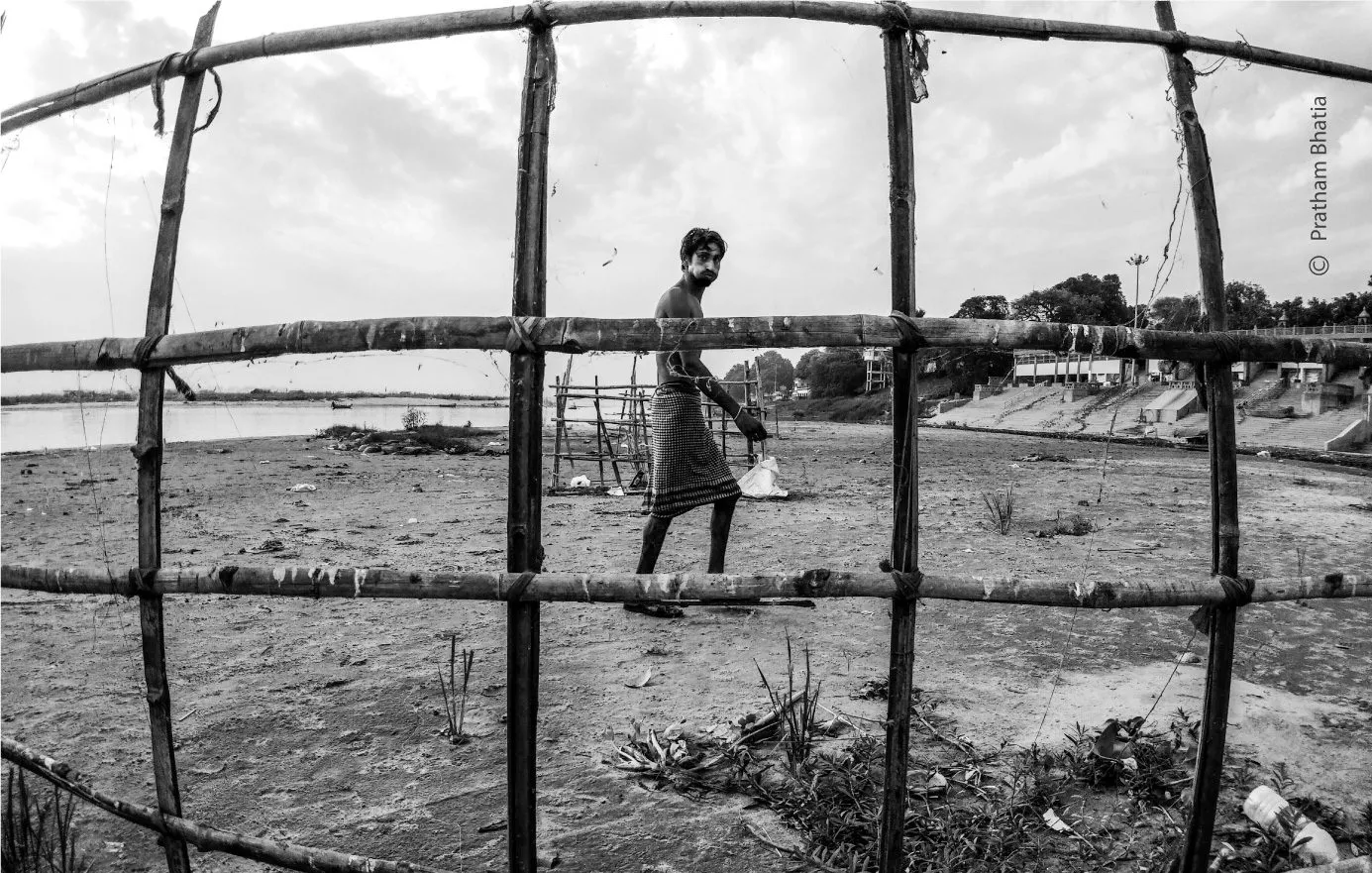
Encaged by Pratham Bhatia
Captured on a cloudy morning in May 2019 at the Sarsaiya Ghat dockyard in Kanpur, this image serves as a poignant commentary on the environmental challenges facing the photographer's hometown. By waiting patiently for a subject to traverse the frame, the photographer successfully juxtaposed the human element against the backdrop of a polluted sky. The resulting composition is both haunting and evocative, transforming a local scene into a powerful visual narrative. This work is award-worthy for its ability to find profound, storytelling beauty within the stark reality of urban environmental decay.
Pratham Bhatia
Born and raised in India, Pratham Bhatia is a Kanpur-based photographer driven by a deep curiosity for his local environment. He is dedicated to documenting the stories and ways of life that define his surroundings, often venturing out to capture fleeting moments of human experience. Beyond his photographic pursuits, Bhatia maintains an active lifestyle, balancing his creative passion with interests in swimming and skating. His work reflects a social and interactive personality, constantly seeking new perspectives within the familiar landscapes of his home.
Resonance Score Breakdown
Transparency Note: The resonance score (11.7/20) is calculated based on social engagement metrics collected before the award announcement.
Expert Photography Reviews · 8
The Weight of Our Making
Seneca once observed that we are not given a short life, but we make it short, and we are not ill-supplied but wasteful of what we have.
Read the reflection →The Weight of Gray
The air tastes of wet iron and old soot, a metallic film that settles on the back of the tongue before you even realize you are breathing it in.
Read the reflection →Reviews & Comments
Share your thoughts about this award-winning photograph. Your reviews contribute to the community engagement score.
1/617sec at f/2.0, ISO 126, 35mm. The wide aperture on a mobile sensor is a gamble that rarely pays off. Here, it creates a shallow plane that isolates the subject but leaves the background textures muddy. It’s technically lazy. I’ve seen enough of these forced bokeh attempts to know when a lens is struggling. The optics aren’t sharp enough to justify the choice. It’s frustrating to see such potential wasted on poor glass.
Sarsaiya Ghat’s decay isn’t just a backdrop; it’s a cage. Why does the subject feel like a prop for the photographer’s environmental narrative? I’m genuinely unsettled by how the composition aestheticizes the smog, turning a local crisis into a tidy, haunting frame. Does the human figure have agency here, or are they merely a tool for visual impact? It’s a slick shot, but I can’t shake the feeling that the photographer is using someone else’s reality.
The heavy, bruised sky at Sarsaiya Ghat doesn’t just hang there; it suffocates the frame, pressing down on the rusted metal cage like a leaden shroud. It’s a claustrophobic geometry that makes my chest tighten. When I finally look at the man, he’s merely a ghost trapped within this industrial decay. The environment has swallowed his identity, turning his solitary figure into a tragic footnote to the pollution that defines his world. It’s hauntingly, devastatingly beautiful.
The frame breathes. It’s a wide, suffocating expanse of grey, a sky that refuses to clear. I’m struck by the stillness; it’s the kind of silence you find right before a tragedy hits the screen. Bhatia waited for the movement, the human anchor in that industrial rot. He didn’t cut away. He held the shot until the composition locked into place. It’s a haunting sequence, frozen in a single, heavy, perfect breath.
We look at this man walking through the haze of Sarsaiya Ghat and we feel the weight of the air he breathes. Pratham didn’t just capture a scene; he listened to the silence of the dockyard. It’s a haunting portrait of endurance. I find myself holding my breath, worried for his lungs, yet moved by his steady pace. It’s a photograph that asks to be returned to, reminding us that every story is etched in the atmosphere.
Looking at this, I’m struck by the suffocating opacity of the Ganges. It’s a stark contrast to the clear, light-saturated depths I usually inhabit. Here, the water doesn’t just steal color; it swallows light entirely. The refractive index of this silt-heavy flow creates a murky, claustrophobic barrier that no strobe could penetrate. It’s a haunting, visceral reminder that while I fight to bring light down, some environments are defined by the absolute absence of it.
The frame resolves into a rigid grid, anchored by the vertical axis of the cage against the horizontal drift of the riverbank. It’s a precise 1:2 ratio of solid iron to hazy atmosphere. The subject’s placement in the negative quadrant creates a perfect tension, pulling the eye toward the center of gravity. I’ve rarely seen such a brutal equation feel so balanced. It’s mathematically cold, yet the geometry hits me with a sudden, sharp ache.
The ochre haze of Kanpur’s morning air clings to the frame like a Morandi still life, suffocating the light in a bruised, industrial sepia that feels almost tactile against the skin. It’s a haunting, sickly palette, yet I’m utterly captivated by how the muted, polluted sky bleeds into the subject’s silhouette, creating a chromatic dissonance that aches; one can’t help but feel the weight of this atmospheric decay pressing down upon the lungs.