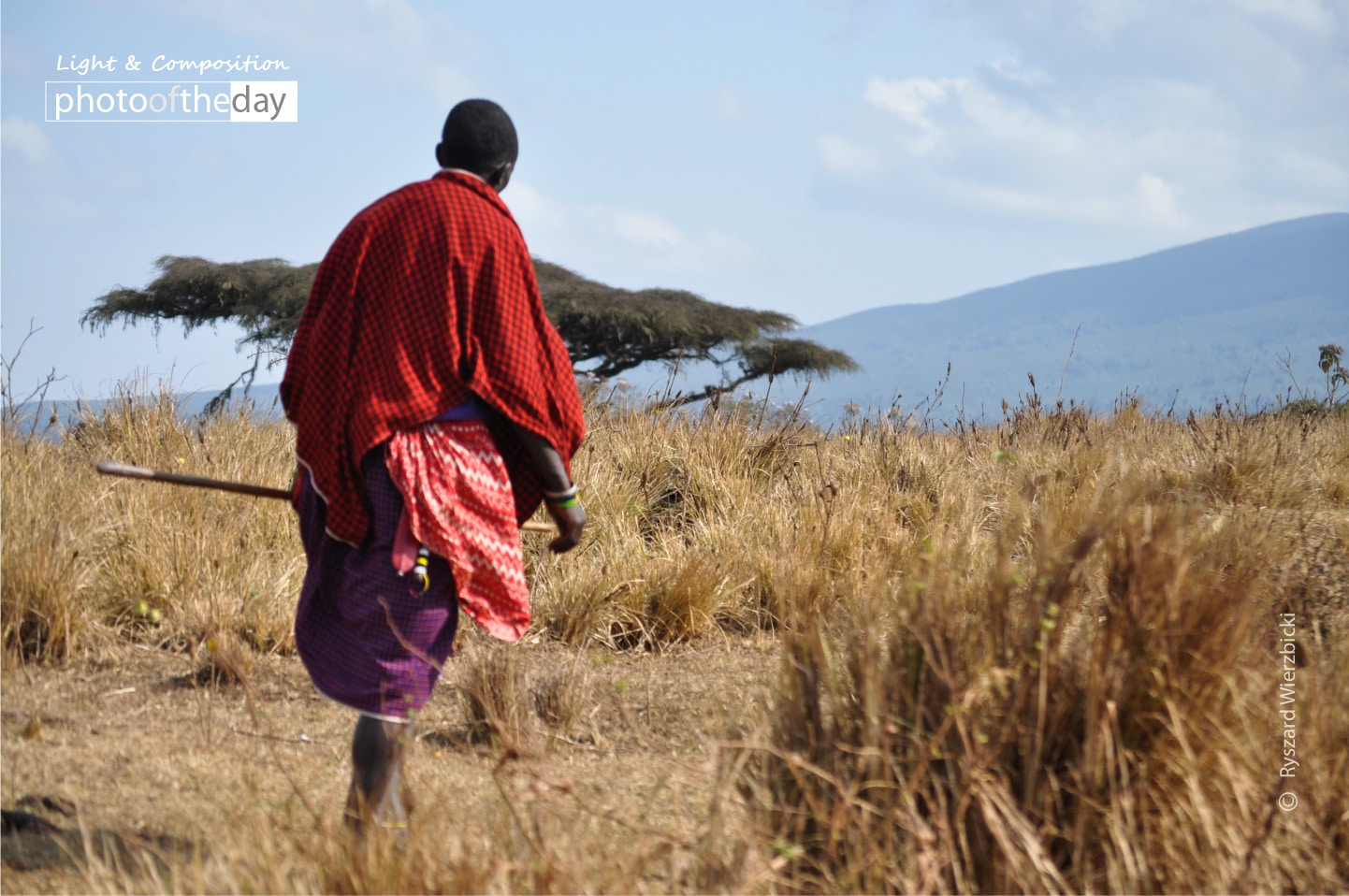
Savanna Walker by Ryszard Wierzbicki
Captured during a transformative expedition through the Serengeti and Ngorongoro districts in September 2011, this image represents a pivotal moment in the photographer's journey toward photojournalism. Drawn to the raw, unfiltered essence of the landscape, the photographer sought to document reality with absolute honesty. The composition captures the vast, untamed spirit of the savanna, showcasing a keen eye for natural narrative. This photograph is award-worthy for its authentic portrayal of one of the world's most iconic environments, reflecting a deep commitment to storytelling and the pursuit of capturing life exactly as it unfolds in the wild.
Ryszard Wierzbicki
Born in 1963, Ryszard Wierzbicki transitioned from a diverse career in social sciences and marketing to become a dedicated travel photographer and explorer. After emigrating to the United Kingdom in 2006, he traded his corporate life for a nomadic existence centered on photography, scuba diving, and humanitarian work with orphans in Southeast Asia. Based in Swindon, he has established multiple platforms for travelers and photographers, consistently using his lens to document the world with a focus on authentic, human-centric storytelling.
Resonance Score Breakdown
Transparency Note: The resonance score (12.0/20) is calculated based on social engagement metrics collected before the award announcement.
Expert Photography Reviews · 7
The Weight of the Horizon
The African elephant moves with a deliberate, rhythmic gait that seems to measure the very pulse of the earth, its heavy footfalls creating a low-frequency vibration that travels through the soil to communicate with others miles away.
Read the reflection →The Weight of the Horizon
I remember a guide in the bush named Elias who told me that the savanna doesn't keep secrets; it only keeps pace. We were sitting in the back of a dusty truck, the engine ticking as it cooled, listening to the silence that isn't really silent at all.
Read the reflection →Reviews & Comments
Share your thoughts about this award-winning photograph. Your reviews contribute to the community engagement score.
It’s jarring to see such crisp, golden light without the familiar blue haze of the deep. Down there, the water steals every warm wavelength, leaving us to battle backscatter and refraction just to find a hint of clarity. Here, the savanna’s clarity is effortless. I’m honestly envious of how the light hits that lion’s fur; it’s a luxury I rarely get. It’s a beautiful, dry world, but I can’t help but miss the salt.
Most savanna shots are just postcards, but this one hits differently. I’ve seen thousands of Serengeti frames, yet Wierzbicki’s choice to keep the horizon low forces you to confront the sheer scale of the grass. It’s the isolation of the subject that makes me ache for that silence. It doesn’t just document a trip; it captures the loneliness of the wild. Thirty years from now, people will still feel that vast, indifferent heat radiating off the plains.
“Raw, unfiltered essence” is a dangerous claim. When Wierzbicki frames the Serengeti, he strips away the human history of the land to sell us a pristine, empty wilderness. Why is the savanna presented as a void waiting for a tourist’s lens? It’s exhausting to see this colonial gaze recycled as “honesty.” I’ve seen this landscape a thousand times, yet it still feels like a theft. Whose home are we ignoring to make this shot look wild?
The horizon line bisects the frame at a near-perfect 1:3 ratio, anchoring the savanna’s vastness. Wierzbicki’s use of the 85mm focal length compresses the depth, forcing the walker into a singular vertical vector against the horizontal expanse. It’s a precise spatial equation. I’m genuinely struck by how the negative space in the upper quadrant creates a palpable sense of isolation. The geometry doesn’t just hold the subject; it dictates the walker’s lonely, rhythmic trajectory across the plane.
1/1500sec at f/5.6, ISO 400, 85mm. It’s a safe, clinical choice for a D5000. The shutter speed freezes the motion, but f/5.6 at 85mm leaves the background struggling for separation. It’s technically competent, yet it lacks the bite I’d expect from a Serengeti study. I’m honestly bored by the lack of risk here. You’ve captured the savanna, sure, but you haven’t challenged the sensor. It’s a clean file, but it’s just a file.
The ochre of the Serengeti’s parched grasses, reminiscent of a Turner sunset bleeding into dust, creates a chromatic tension that’s utterly intoxicating. It’s not merely light; it’s a visceral, sun-scorched vibration that hums against the horizon. I’ve found myself breathless before such arid, golden warmth, where the palette feels like a Morandi still life expanded to the scale of an empire. It’s a gorgeous, suffocating harmony that makes one’s heart ache for the wild, untamed heat.
The horizon line cuts the frame. It’s a clean, sharp divide. Below, the grass. Above, the pale, heavy sky. A single figure walks. It’s small. It’s lonely. I feel a sudden, sharp ache in my chest looking at that vastness. Nothing here is accidental. The empty corner isn’t empty. It’s a breath. It’s the weight of the savanna pressing down. Wierzbicki doesn’t crowd the silence. He lets the distance do the work. It’s enough.