Near China Town Point by Siew Bee Lim
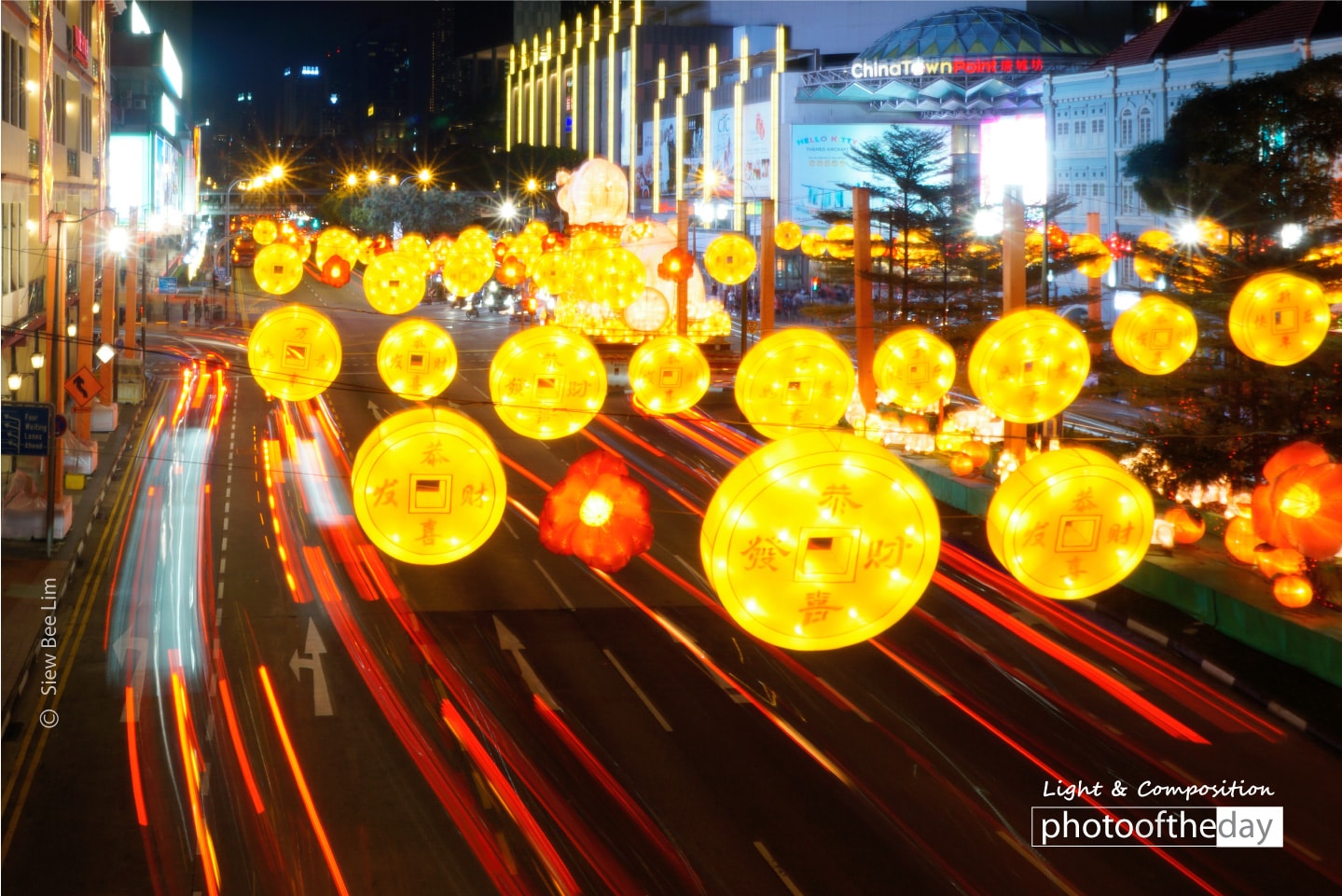
Captured in January 2019 near Chinatown Point, this long-exposure night photograph masterfully translates the kinetic energy of Singapore’s urban landscape into a visual rhythm. By utilizing a six-second shutter speed, the photographer captures the fluid motion of vehicles navigating the streets, their headlights painting vibrant, blurred trails against the backdrop of festive Chinese New Year illuminations. The choice of a narrow aperture emphasizes the depth of the scene, allowing the artistic street lighting to sparkle with clarity. This image is award-worthy for its successful marriage of technical precision and atmospheric storytelling, effectively turning a mundane traffic intersection into a dynamic, glowing tapestry of city life.
Siew Bee Lim
Born in Singapore in 1965, Siew Bee Lim is a dedicated photographer who rediscovered her passion for the craft through the Light & Composition platform. Though she initially explored photography during her early career as a programmer, she has since returned to the medium with a renewed commitment to formal learning and artistic growth. Drawing inspiration from her lifelong appreciation for literature and Chinese painting, she seeks to overcome her self-described lack of traditional artistic training by mastering the technical and creative nuances of modern digital photography.
Resonance Score Breakdown
Transparency Note: The resonance score (11.3/20) is calculated based on social engagement metrics collected before the award announcement.
Expert Photography Reviews · 8
The Hum of the Current
The smell of rain on hot asphalt always brings me back to the city at night, that metallic tang of ozone mixed with the faint, sweet exhaust of a bus idling nearby. It is a restless scent, one that vibrates against the skin like a low-frequency hum.
Read the reflection →The Ghost of the Commute
There was a blue bicycle leaning against the brick wall of the bakery on 4th Street. It had a rusted bell and a seat worn smooth by years of morning rides. Then, one Tuesday, it was simply gone.
Read the reflection →Reviews & Comments
Share your thoughts about this award-winning photograph. Your reviews contribute to the community engagement score.
The crimson streaks of traffic bleed into the asphalt like spilled wine, a visceral, electric warmth that makes my heart ache for the stillness of a Morandi study. It’s a collision of neon gold and the bruised, velvet violet of a Singaporean night, where the light doesn’t merely illuminate; it vibrates with a kinetic, feverish intensity that feels almost liquid, as if one could reach out and stain one’s own fingers with the city’s restless, glowing pulse.
At f/22, the diffraction limit is working overtime here, yet it’s precisely what gives these light trails their crystalline, starburst geometry. By forcing light through such a constricted aperture, the lens resolves the festive lanterns into sharp, geometric points of interference. It’s a risky optical gamble, but the resulting diffraction spikes are genuinely thrilling to behold. I’ve rarely seen such a clinical, rigid application of physics produce such a warm, kinetic pulse of urban life.
You’ve turned a busy intersection into a pulse. I’m looking at those light trails, and it’s like watching the city breathe. It’s not just technical skill; you waited for the rhythm of the traffic to settle into something that feels alive. I’ve stood on corners like this, feeling small against the rush, and you’ve captured that exact hum. There’s a quiet loneliness in the glow that hits me right in the chest. You really felt this place.
Most night photography is just light pollution disguised as art, but this works because of the restraint in those six seconds. I’ve seen thousands of light trails, yet these don’t just blur; they carve a rhythm through the frame. The f/22 aperture turns the street lamps into sharp, piercing stars that actually make me feel the humid, electric hum of a Singaporean night. It’s a rare, honest document of a city that’s constantly trying to outrun itself.
Six seconds of exposure turns the city into a frantic, bleeding vein. It’s a restless, neon-soaked purgatory where the shadows don’t offer refuge; they merely wait for the light to exhaust itself. I’ve stared at these blurred trails until my eyes ache, feeling the crushing weight of a city that refuses to sleep. It’s beautiful, yes, but it’s a cruel beauty. It doesn’t invite us in. It just reminds us how quickly we’re being erased.
Before the eye identifies the traffic, something in the chest tightens. It’s the rhythm of those light trails—a frantic, glowing pulse that mimics the city’s own restless heartbeat. I’ve stared at these streaks until my own breathing synced with their six-second blur. It’s disorienting, like a memory of a place I’ve never visited. When I return to it, the festive lanterns feel less like decoration and more like a warning of how quickly time slips away.
Six seconds at f/22 is a bold gamble against diffraction, yet it’s paid off here. One wonders how many damp evenings were spent dodging traffic to get those light trails just so. It’s a tidy bit of work, though I’d have preferred a bit more grit in the shadows. Still, I’ve stood on enough street corners to know the patience required for this rhythm. It’s a decent return on a cold night’s investment.
The shutter stays open, and the city bleeds light. It’s a six-second sequence where the traffic becomes a pulse, a rhythmic hum against the static festive glow. I’m struck by how the f/22 aperture turns those street lamps into sharp, crystalline stars. It’s a frame the editor keeps because the motion doesn’t blur the intent; it defines it. The cut would’ve been a mistake. I’d watch this loop for hours. It’s pure, kinetic cinema.