Leopard Flower by Siew Bee Lim
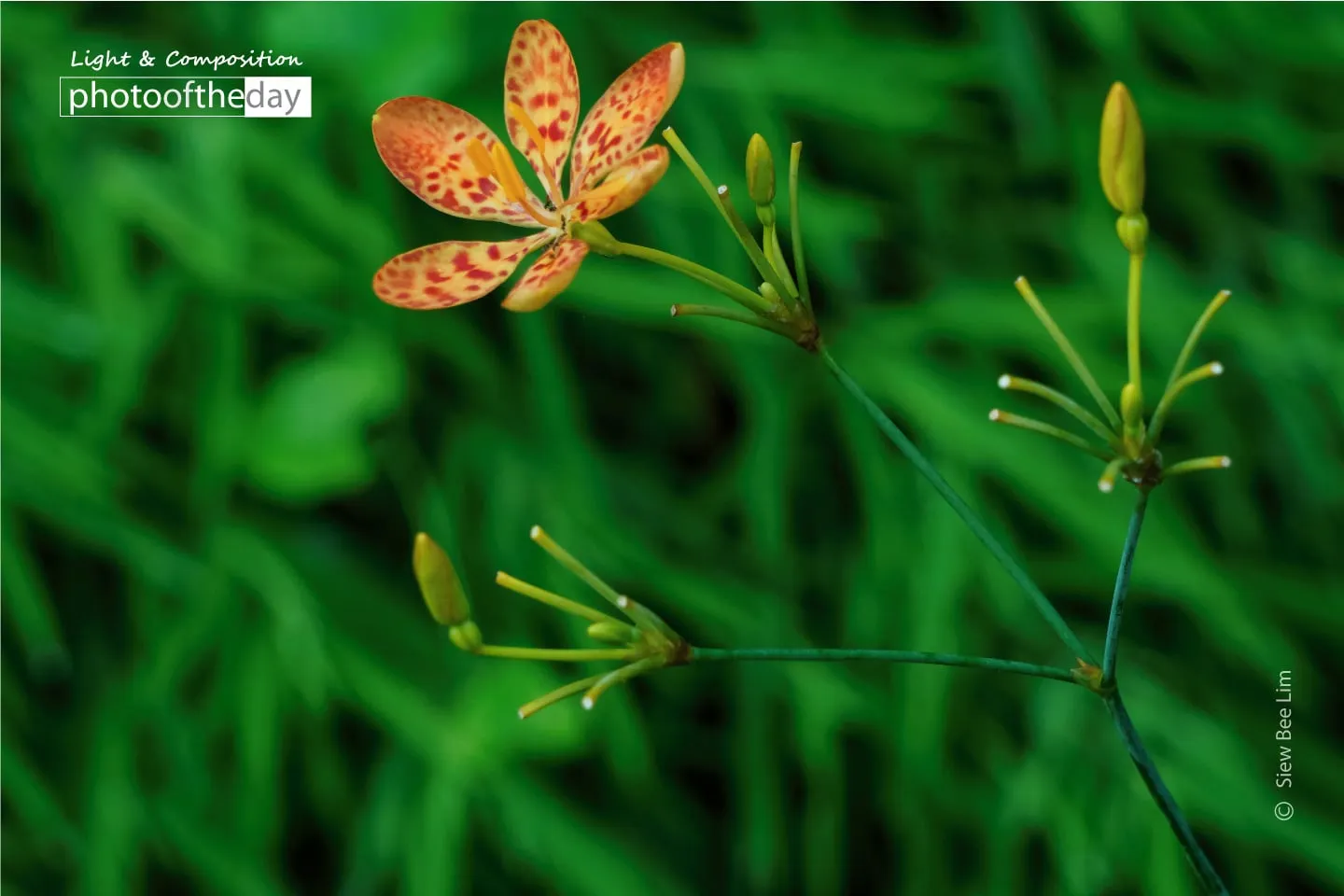
Captured on a fine December morning in the serene Chinese and Japanese Garden, this photograph highlights the delicate beauty of an Iris domestica, commonly known as a leopard flower. The photographer carefully isolated a single bloom against a soft, natural backdrop, emphasizing the vibrant textures and colors of the petal. By choosing a precise focal length, the photographer successfully drew attention to the intricate details of the flower, turning a simple garden observation into a refined botanical study. This image is award-worthy for its clean composition and the quiet, observant patience required to capture a solitary bloom in its natural environment.
Siew Bee Lim
Born in 1965 in Singapore, Siew Bee Lim is a dedicated photographer who rediscovered her passion for the craft after a career as a programmer. Though she initially explored photography through traditional darkroom techniques in her youth, she has since embraced modern digital learning to refine her artistic vision. Drawing inspiration from her lifelong appreciation for Chinese painting and literature, she now focuses on capturing the subtle beauty of the natural world, striving to develop her technical skills and creative expression through the Light & Composition platform.
Resonance Score Breakdown
Transparency Note: The resonance score (11.6/20) is calculated based on social engagement metrics collected before the award announcement.
Expert Photography Reviews · 8
The Weight of a Petal
There is a silence that belongs to the garden when the frost has not yet arrived, but the air has already begun to thin. We look at a bloom and see only the color, the shape, the outward display of life. We forget that the plant is a record of the season.
Read the reflection →The Quiet Language of Petals
There is a specific kind of wisdom found in the way a flower unfolds. It does not rush to show its face to the sun, nor does it worry about the wind that might scatter its seeds. It simply exists, a brief punctuation in the long sentence of the season.
Read the reflection →Reviews & Comments
Share your thoughts about this award-winning photograph. Your reviews contribute to the community engagement score.
The soft, verdant blur behind the Leopard Flower acts as a lush, humid stage, grounding the bloom in its Singaporean home. It’s not just a backdrop; it’s the quiet, breathing atmosphere that gives the petal its purpose. I’m genuinely moved by how the light catches those delicate, speckled textures, turning a simple garden into a portrait of resilience. It’s a botanical study, yes, but it feels like meeting a person who’s finally found their perfect light.
Nature doesn’t wait for the light to hit just right, and Siew Bee Lim caught this leopard flower at its peak. It’s a clean, sharp study, but I’m looking for the chaos of the street. Where’s the tension? A flower is static, yet here, the focus is surgical. It’s beautiful, sure, but I crave the pulse of the city. One tenth of a second later and the wind shifts. I’d trade this stillness for a heartbeat.
There’s a quiet dignity in how this leopard flower holds its own space. I’ve spent my life looking for that same stillness in people, that moment when a subject stops performing and just exists. It’s a botanical portrait, sure, but it feels like a conversation. I find myself leaning in, wanting to know what it’s seen. It’s rare to find such honest, unforced beauty. This bloom has a whole life in it. Truly lovely work.
Before the eye identifies the leopard flower, a sudden stillness settles in the chest. The speckled orange petals trigger a strange, rhythmic pulse, as if the bloom is breathing in sync with me. It’s an intimate, unsettling precision. When I return to this, I don’t see a botanical study; I feel the humidity of that December morning. It’s a quiet ache, really—the way those dark spots pull my focus until everything else just dissolves.
The leopard flower hangs in a void. It’s a study in restraint. I’ve spent minutes watching the curve of those spotted petals against the blur. It doesn’t demand attention. It simply exists. The background isn’t just soft; it’s a breath. I feel a sudden, sharp stillness in my chest. Nothing here is accidental. The empty corner is not empty. It’s the space where the flower finally finds room to be.
The morning air in the garden must have been still, holding its breath for this bloom. Siew Bee Lim didn’t just photograph a flower; she waited until the light softened enough to reveal the leopard spots, those intricate, quiet markings. I find myself leaning in, almost afraid to disturb the silence. It’s a rare, tender act of listening to the earth. She stood there in the cooling hour, letting the world fall away until only this beauty remained.
The leopard flower’s geometry dictates the frame. Its petals anchor the composition, creating a precise fulcrum against the blurred background. The spatial tension is held by the sharp, rhythmic spotting across the surface. It’s a rigorous study of form. I’ve grown weary of soft botanical shots, but this doesn’t collapse into sentimentality. The discipline of the f/8 aperture keeps the structure intact. It’s a rare moment where the negative space actually earns its keep.
1/200sec at f/8, 117mm, ISO 500. It’s a calculated compromise. Stopping down to f/8 was the right call to ensure the petal’s complex geometry remained sharp across the plane. ISO 500 on an ILCE-6000 sensor introduces noise I’d usually despise, yet here, it’s barely noticeable against the bokeh. I’m actually impressed by the discipline. You didn’t chase the light; you forced the optics to obey. It’s a clean, technical execution. Finally, some restraint.