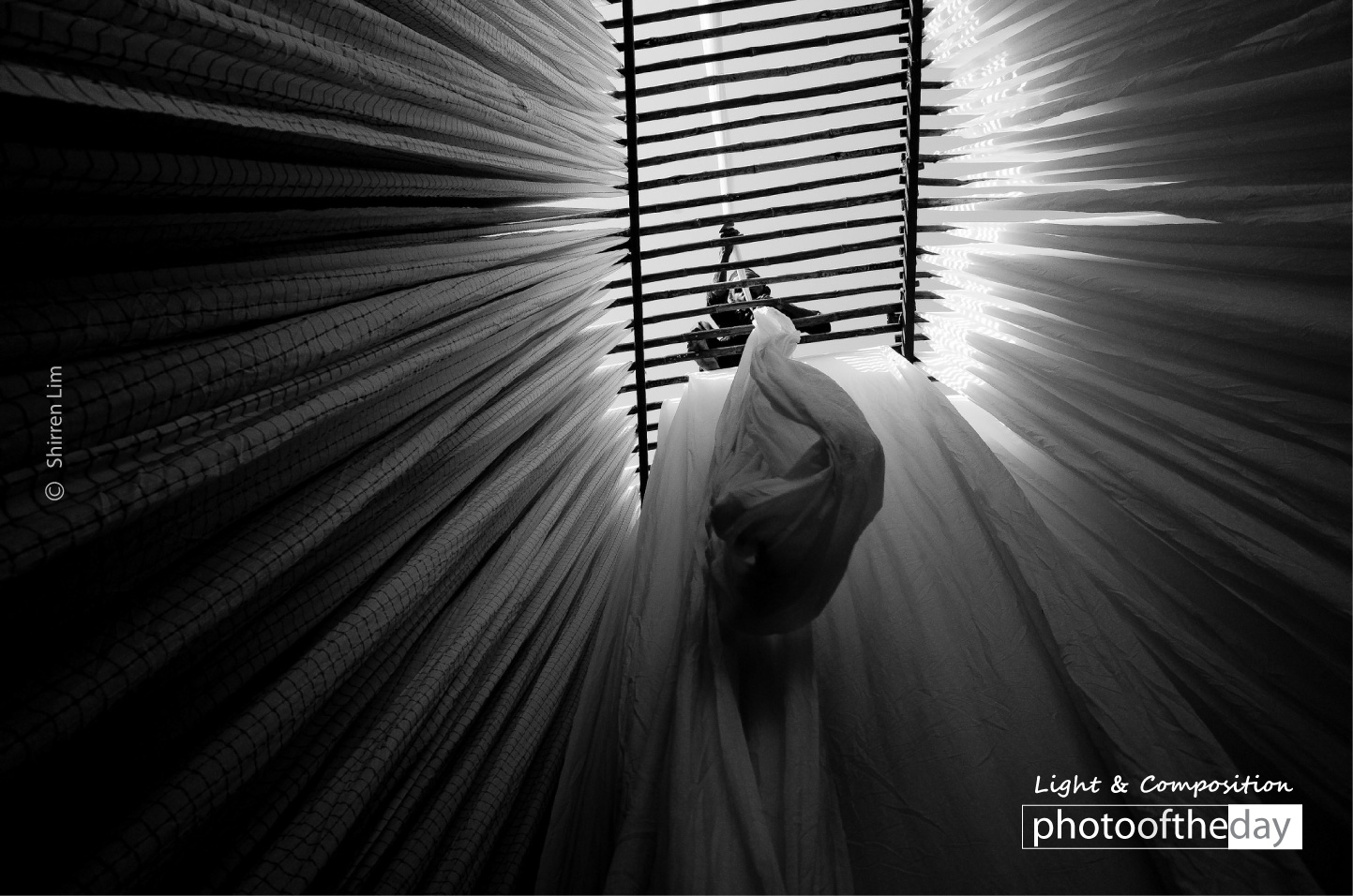
Cloth Maker by Shirren Lim
During a journey through the vibrant 'Blue City' of Jodhpur, India, the photographer sought to document the intricate artistry of local cloth makers. By utilizing a wide-angle lens and positioning the camera at a low angle, the photographer captured a compelling perspective from beneath the subject, emphasizing the artisan's presence within his workspace. This image is award-worthy for its raw, documentary approach, which successfully highlights the dignity of the craft and the human element behind the textile production, creating a powerful narrative that feels both intimate and culturally resonant.
Shirren Lim
Born in Penang Island, Malaysia, in 1970, Shirren Lim is a Jakarta-based photographer who discovered her true passion for the craft in 2009. Specializing in portraiture, she is deeply committed to capturing the sincerity and raw humanity of her subjects through an intense, earthy aesthetic. Inspired by the iconic work of Steve McCurry, Lim strives to create images that resonate globally, with her work having been featured in numerous web and printed publications.
Resonance Score Breakdown
Transparency Note: The resonance score (10.4/20) is calculated based on social engagement metrics collected before the award announcement.
Expert Photography Reviews · 8
The Weight of the Thread
It is 3:15 am, and the house is finally quiet enough to hear the rhythm of my own pulse. I am thinking about the things we build with our hands, the way we try to weave ourselves into the fabric of a world that is constantly unraveling.
Read the reflection →The Rhythm of the Loom
I often find myself wandering the narrow arteries of Jodhpur in my mind, where the air smells of turmeric and the dust of centuries.
Read the reflection →Reviews & Comments
Share your thoughts about this award-winning photograph. Your reviews contribute to the community engagement score.
Before the eye identifies the loom, something in the chest tightens. It’s the low angle, I think—that sudden, vertiginous shift that forces me to look up at the artisan like a child. My breath hitches, mimicking the rhythmic tension of the thread. When I return to this a year later, the blue shadows still feel cool against my skin. It’s a quiet, heavy intimacy that doesn’t just document a craft; it demands my total, breathless presence.
Dust motes dance in the shafts of light piercing this Jodhpur workshop, illuminating the rough textures of wooden looms and scattered fabric scraps. It’s a tactile symphony of labor. I’m struck by how the low angle forces us to look up at the artisan, making his tools feel like extensions of his own body. He isn’t just working; he’s anchored to this space. It’s a beautiful, gritty dialogue between the man and his craft.
The loom frame cuts the light. It’s a sharp geometry against the dust of Jodhpur. I’ve spent minutes watching the artisan’s hands. They don’t rush. The negative space above his head isn’t just air; it’s the weight of the work. It’s the silence between threads. I feel a sudden, quiet ache in my chest. Nothing here is accidental. The empty corner is not empty. It holds the breath of the maker. It’s enough.
The low angle hits you like a sudden dolly shot. You’re down there in the dust, watching the loom’s rhythm dictate the artisan’s life. It’s a wide, kinetic frame that refuses to blink. I’ve spent hours staring at this, and I still feel the heat of that Jodhpur sun. Lim didn’t just document a craft; she captured the exact moment the motion stopped. It’s the frame the editor keeps because the cut would’ve been a mistake.
There’s a quiet gravity in how he holds that fabric. You can tell he’s used to the rhythm of the loom, but he’s also clearly aware of the lens. It’s not a stolen moment; it’s a collaboration. I’m struck by the way his hands anchor the frame—they’ve got a whole life in them. Shirren didn’t just take this; she waited for him to let her in. It’s a rare, honest bit of grace.
The indigo here isn’t merely pigment; it’s the bruised, atmospheric blue of a Vermeer shadow, clinging to the artisan’s skin like a second, weary history. I’m breathless at how the ochre dust of Jodhpur quarrels with those deep, tidal-water textiles, creating a friction that’s almost tactile. It’s a chromatic ache, really, where the light doesn’t just illuminate the cloth maker—it stains him with the very essence of his own, beautiful, indigo-drenched labor.
At f/7.1, Lim’s choice to resolve every thread of the loom feels almost claustrophobic. I’m left craving the kinetic blur of the shuttle, something to break the clinical stillness of this Jodhpur workshop. Why settle for such rigid clarity when the movement of weaving is inherently fluid? It’s technically competent, sure, but I’d trade that sharpness for a single, honest smear of motion. It’s a missed opportunity to capture the rhythm, not just the object.
The low angle forces a brutal geometry upon the frame. The artisan’s limbs create a jagged fulcrum, anchoring the chaotic textile sprawl. It’s a rigid architecture that refuses to collapse under the weight of its own subject matter. The negative space above the loom provides the only necessary relief. I’m genuinely unsettled by how the wide-angle distortion sharpens the tension. It doesn’t just document; it constructs a spatial hierarchy that demands total visual submission.