Sightseeing by Payman Mollaie
Captured during a spring excursion through the Alborz Mountains in Iran’s Qazvin province, this landscape photograph masterfully balances the stark contrast between snow-dusted peaks and the emerging life of wetlands and vineyards. The photographer opted for a black-and-white treatment, recognizing that the scene’s inherent beauty relied on form and texture rather than color. By stripping away the distraction of hues, the image highlights the dramatic interplay of light and shadow across the rugged terrain. This work is award-worthy for its intentional minimalism and the photographer's keen ability to distill a complex mountain vista into a powerful, evocative composition.
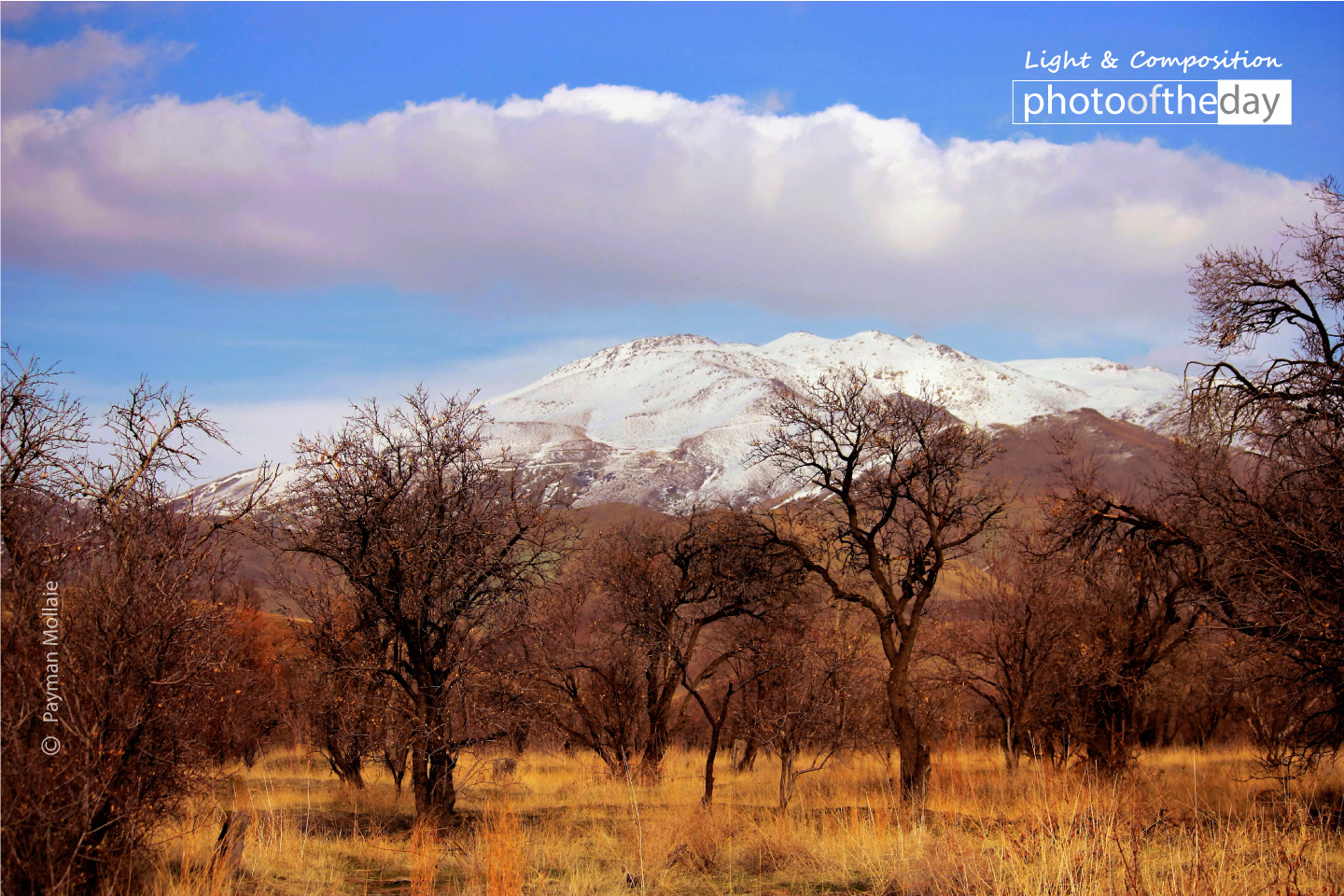
Exposure 1/1000sec @ f/4.5 | ISO 100 | Focal Length 55mm
Payman Mollaie
Born in 1981 in Qazvin, Iran, Payman Mollaie is a dedicated photographer with a profound passion for travel and the serene beauty of winter landscapes. He frequently utilizes analogue equipment, such as his Yashika camera, to pursue a minimalist aesthetic that emphasizes clean composition and artistic style. His work is deeply influenced by the quietude of snow-covered environments, which he believes offer the perfect canvas for creating striking, simplified imagery.
Resonance Score Breakdown
Transparency Note: The resonance score (11.0/20) is calculated based on social engagement metrics collected before the award announcement.
Expert Photography Reviews · 4
The Silence of High Altitudes
I often find myself wandering the mental map of a city, but there are moments when the mind demands a different kind of quiet—the kind found only where the pavement ends and the earth begins to rise.
Read the reflection →The Silence of Stone
Why do we feel the need to name the mountains, as if our labels could somehow anchor the shifting earth? We stand before the ancient, jagged edges of the world and imagine that we are observing something static, something that has been waiting specifically for our arrival.
Read the reflection →Reviews & Comments
Share your thoughts about this award-winning photograph. Your reviews contribute to the community engagement score.
It’s refreshing to see a landscape that doesn’t obsess over the hyper-sharpness of every pebble. Mollaie’s choice to flatten the Alborz Mountains into high-contrast silhouettes feels closer to Sugimoto’s long-exposure theatres than to standard travelogue work. I’m genuinely struck by the grain—it’s raw, almost tactile. Why resolve the distant peaks when the atmosphere is this heavy? He’s traded technical perfection for a mood that feels far more honest than a clinical, high-resolution file ever could.
You’ve stripped away the color, and it’s the right call. Looking at these jagged peaks against the quiet wetlands, I feel a strange, cold stillness in my chest. It’s lonely, but not empty. You didn’t just snap a mountain; you waited until the light carved the earth into something raw. And that’s where the truth lives. You weren’t just sightseeing. You were listening to the silence of the Alborz. I respect that patience. It’s honest work.
At f/4.5, the 55mm focal plane barely resolves the micro-contrast of those distant Alborz ridges. It’s a delicate dance with the diffraction limit, yet the sensor captures a crispness that my own eyes would surely miss. I’m genuinely moved by how the monochromatic conversion emphasizes the light’s scattering across the snow. It doesn’t just show a mountain; it maps the physics of the terrain. It’s a rare, cold clarity that feels almost tactile against the screen.
The snow-dusted peaks of Taleghan don’t merely sit against the sky; they carve into the void. Mollaie’s decision to strip away color reveals a brutal, tectonic silence. It’s in the deep, ink-stained crevices of these mountains that I feel a sudden, sharp ache for the forgotten. He hasn’t just captured a landscape; he’s forced the light to surrender its secrets to the dark. It’s a cold, honest reckoning with the earth’s heavy, unyielding bones.