Thai Mackerel Fishes by Ryszard Wierzbicki
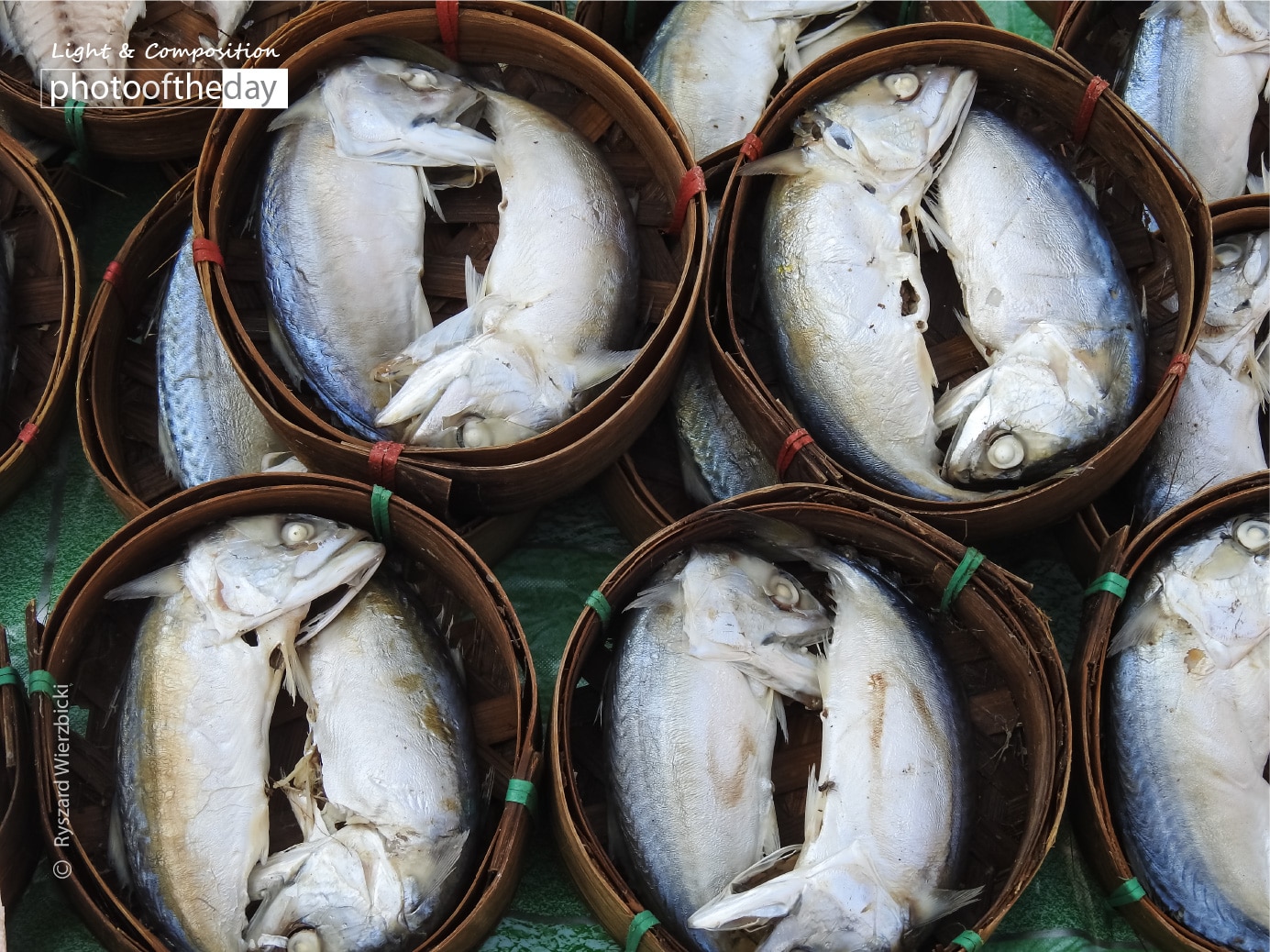
Captured at a bustling market in Khanom in February 2019, this photograph highlights the iconic Thai Mackerel, a staple of local culture and cuisine. The photographer focuses on the characteristic bent heads of the fish, which are traditionally sold in pairs and serve as a symbolic element of daily life across Thailand. By documenting this common market sight, the image elevates a humble culinary subject into a compelling cultural study. The award-winning quality of the work lies in its ability to transform a routine street scene into a vibrant, authentic narrative that resonates with the essence of South-East Asian life.
Ryszard Wierzbicki
Born in 1963, Ryszard Wierzbicki is a Polish-born photographer and educator currently based in Swindon, United Kingdom. After a diverse career in social sciences and marketing, he transitioned into a life of exploration, focusing his lens on the vibrant cultures and landscapes of South-East Asia. His work is deeply influenced by his extensive travels and his commitment to charitable causes, including his volunteer work with Thai and Burmese orphans. As the founder of the photography and travel platforms Instant Travelling and World Around, he continues to document the world with a focus on authentic human experiences.
Resonance Score Breakdown
Transparency Note: The resonance score (12.2/20) is calculated based on social engagement metrics collected before the award announcement.
Expert Photography Reviews · 8
The Geometry of Sustenance
There is a quiet geometry to the way we feed ourselves. We often think of nourishment as a solitary act of consumption, a fuel for the engine of the day, yet it is deeply rooted in the architecture of the collective.
Read the reflection →The Weight of the Ordinary
Why do we assume that significance must be loud, or that beauty requires a grand stage? We spend our lives chasing the extraordinary, convinced that meaning is found only in the rare or the monumental.
Read the reflection →Reviews & Comments
Share your thoughts about this award-winning photograph. Your reviews contribute to the community engagement score.
You’ve captured the rhythm of a morning in Khanom. Those bent necks aren’t just food; they’re a quiet, repetitive geometry of survival. I’ve walked markets like this, and the smell of salt and heat hits me just looking at your frame. You didn’t try to make it pretty, and that’s why it works. You just let the fish tell their story. There’s something honest happening here. You waited, and I can feel it.
The bent necks of these mackerel feel almost performative, a staged tragedy of the market stall. Why do we insist on framing local sustenance as an exotic curiosity for the outsider’s lens? It’s a clean composition, sure, but it leaves me feeling uneasy. Does this aestheticizing of a daily staple actually honor the culture, or does it just package it for consumption? I’ve seen this gaze before, and it rarely asks who gets to eat.
We look at these mackerel, their necks bent in a shared, silent bow, and we see more than a market stall. They’ve been arranged with such intention that they seem to be whispering to one another. I’ve spent my life listening to stories, and I find myself leaning in, waiting for these fish to speak. It’s a humble, rhythmic portrait of a culture’s daily bread. Honestly, it makes me feel quite hungry for home.
Market stalls are the thresholds of urban life, yet here, the architecture of the display dominates. The rhythmic repetition of the mackerel’s bent necks creates a datum line that organizes the chaotic void of the market. It’s a structural grid of organic matter. I’m struck by how the light rakes across the scales, defining mass through texture rather than volume. It’s a fleeting, visceral geometry that makes me crave the salt-air humidity of Khanom.
Seeing these mackerel arranged in their iconic, rigid curves, I’m struck by a sudden, sharp pang of melancholy. It’s a clean, clinical composition, but it lacks the chaotic, salt-sprayed pulse of the ocean I’ve spent my life documenting. While the market context is clear, it’s a sterile record of a life already extinguished. I prefer my subjects breathing, wild, and entirely indifferent to my presence. This is just commerce, not a connection to nature.
The woven baskets cradle these mackerel like precious relics, their curved forms echoing the rhythmic geometry of the market stall. I’m struck by the way the light catches the silvered, dried scales, turning a humble commodity into a sculptural still life. It’s not just food; it’s the architecture of a culture. Wierzbicki captures the quiet dignity of the vendor’s trade, where the environment—the texture of the baskets and the dappled light—tells the story before we even look away.
Before the eye identifies the mackerel, a sudden stillness settles in the chest. It’s the geometry of those bent necks that triggers a visceral, rhythmic pulse. I’ve spent hours staring at these silver curves, and they don’t just represent a market; they mimic the way we carry our own burdens. Returning to this frame a year later, I still feel that sharp, salty ache of displacement. It’s a quiet, haunting weight I can’t quite shake.
It’s a decent enough study of the mackerel, though one wonders if the photographer simply wandered past, clicked, and moved on for a cold drink. The composition is tidy, but it lacks the grit of a long vigil in the humidity. I’ve spent enough hours waiting for a scene to settle to know when a frame feels rushed. It’s competent, certainly, but I’m left wanting the scent of the market and the ache of the wait.