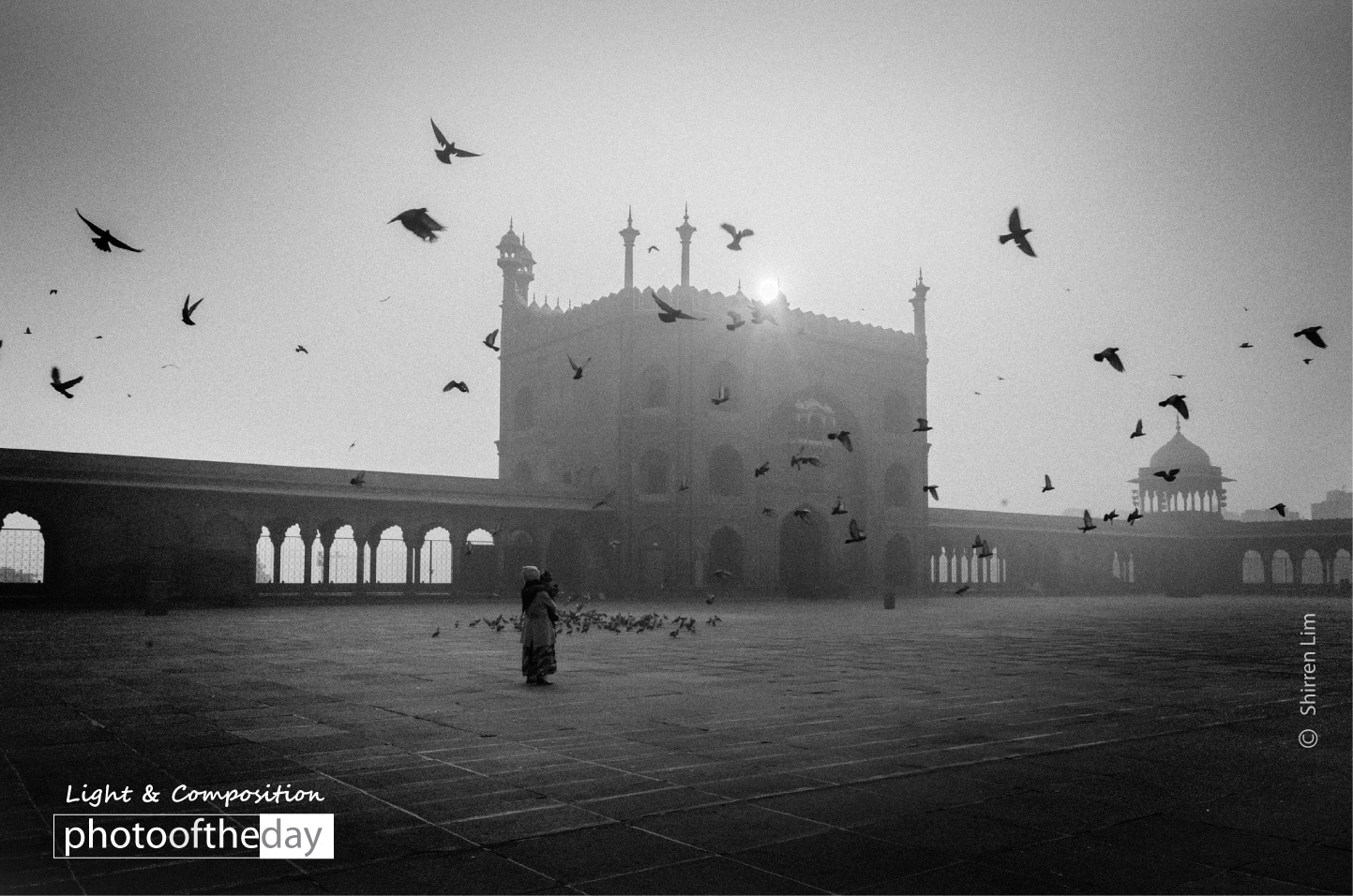
Jama Masjid by Shirren Lim
Captured during a journey through Northern India in early 2019, this image of the Jama Masjid reflects the quiet anticipation of a morning in Delhi. As the early fog lingered over the city, the photographer waited patiently within the historic mosque for the perfect moment of movement. By timing the shutter release with the flight of birds against the architectural backdrop, the photographer transformed a serene scene into a compelling visual narrative. The photograph is award-worthy for its masterful use of atmosphere and composition, capturing the timeless, ethereal quality of one of India’s most iconic landmarks as it awakens.
Shirren Lim
Shirren Lim is a Malaysian photographer currently based in Jakarta, Indonesia. Since discovering her passion for the craft in 2009, she has dedicated herself to portraiture, striving to capture the raw essence of humanity through an intense and earthy aesthetic. Heavily influenced by the evocative storytelling of National Geographic and Steve McCurry, Lim seeks to document moments that resonate with global significance. Her work, celebrated for its simple yet powerful compositions, has been featured in various international web and print publications.
Resonance Score Breakdown
Transparency Note: The resonance score (12.1/20) is calculated based on social engagement metrics collected before the award announcement.
Expert Photography Reviews · 8
The Architecture of Breath
Silence is not merely the absence of sound; it is a weight, a physical presence that settles into the corners of old stone like dust. When the world is still, the air thickens with the ghosts of prayers and the slow, rhythmic pulse of history.
Read the reflection →The Weight of Grey
There is a specific, heavy stillness to a morning when the fog refuses to lift, pressing against the glass like a damp wool blanket. It is a muted, monochromatic silence that strips the world of its distractions, leaving only the essential outlines of things.
Read the reflection →Reviews & Comments
Share your thoughts about this award-winning photograph. Your reviews contribute to the community engagement score.
The birds are a nice touch, but they don’t tell me who lives here. I’m looking for the soul of Delhi in these stones, yet I find only a stage set. Where are the people? A mosque isn’t just architecture; it’s a heartbeat. I’ve spent years waiting for a look that says, “I’m here.” This feels like a missed conversation. It’s technically clean, sure, but it’s lonely in a way that leaves me cold.
Stripped of hue, one finds the monochromatic expanse of the Jama Masjid isn’t merely absent of colour, but a study in the charcoal-grey of a Morandi still life, where the fog’s silvered opacity softens the stone’s edges. It’s a haunting, breathless silence I’ve felt in the deepest winter, where the birds’ silhouettes, like ink drops in water, create a tension that makes my own heart ache with the sheer, quiet weight of the morning.
f/8 at 1/250s, ISO 400. A sensible choice for the Jama Masjid’s scale. The depth of field holds the sandstone texture, but the shutter speed barely freezes the birds. It’s a gamble that almost pays off. I’ve spent hours chasing that exact blur, and it’s frustratingly imprecise here. The motion isn’t a narrative; it’s a smear. Technically, it’s a near miss. You’ve captured the light, but the mechanical execution lacks the necessary bite.
Morning fog clings to the stone, and we feel the silence of Delhi before the world wakes. Shirren didn’t just photograph a mosque; she listened to the rhythm of the air. When those birds take flight, it’s as if the building itself is exhaling. I find my own breath catching in my chest, watching that movement. It’s a quiet, holy conversation between architecture and life. This is a photograph that asks to be returned to, again and again.
Delhi’s fog is a trap, but Lim didn’t blink. Those birds aren’t just decoration; they’re the pulse of the Jama Masjid. If she’d fired a fraction of a second later, the geometry would’ve dissolved into chaos. I’ve spent years chasing that exact blur against stone, and it hits me right in the chest. It’s raw, quiet, and perfectly timed. She caught the breath before the city woke up. That’s the decisive moment, plain and simple.
The geometry of the Jama Masjid’s arches echoes the rigorous structuralism of early architectural studies, yet Lim’s choice to introduce the birds disrupts that stillness with a kinetic grace reminiscent of Kertész. It’s a delicate balance between permanence and the fleeting. I’ve spent decades studying how light defines stone, but the way she’s captured this particular, hazy Delhi morning actually made me catch my breath. It’s a rare, quiet dialogue between ancient masonry and sudden, frantic life.
Atmospheric scattering in this Delhi fog effectively softens the high-frequency details, yet the lens resolves the Jama Masjid’s sandstone textures with surprising acuity. The birds, caught in a shallow focal plane, exhibit minimal motion blur, suggesting a shutter speed perfectly calibrated to the light’s low intensity. I’m genuinely moved by how the diffraction of light across those ancient arches creates such ethereal depth. It’s a rare moment where the physics of optics perfectly mirrors the quietude of the scene.
You waited for the birds to break that heavy Delhi silence, and it paid off. I’ve spent enough mornings in places like the Jama Masjid to know that stillness isn’t empty; it’s expectant. You caught that breath before the day begins. It makes me feel the damp chill of the stone against my own palms. There’s something honest happening here. You didn’t just frame architecture; you captured the quiet pulse of a city waking up.