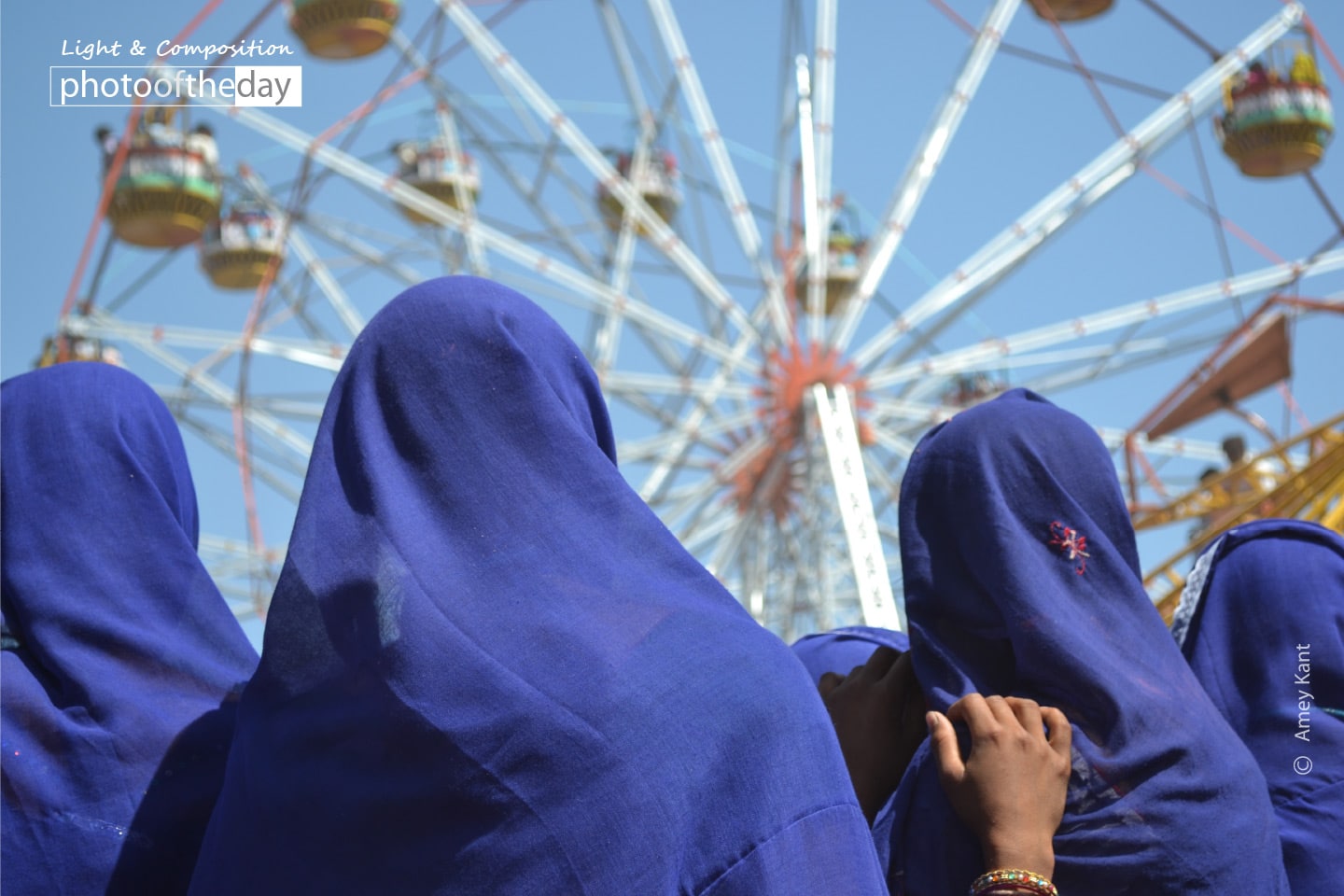
Tribal Women in a Carnival by Amey Kant
Captured during the photographer's inaugural visit to the Bhagoria Haat carnival in March 2011, this image documents a vibrant cultural tradition in Madhya Pradesh, India. The photographer was drawn to the striking visual harmony of a group of tribal women adorned in matching traditional attire, standing out amidst the bustling energy of the festival. By focusing on the collective presence of these women, the image captures a fleeting, authentic moment of communal identity. Its award-worthy quality lies in the photographer's ability to isolate a compelling human narrative within the chaotic, colorful environment of a rural tribal carnival.
Amey Kant
Based in Dewas, India, Amey Kant is a dedicated photographer who balances his professional career with a profound commitment to street and travel photography. Since beginning his photographic journey in 2011, he has channeled his passion into documenting the diverse cultures and landscapes he encounters during his travels. Driven by a long-term ambition to capture the essence of the world through his lens, Kant views photography as a vital pursuit that transcends the boundaries of a simple hobby.
Resonance Score Breakdown
Transparency Note: The resonance score (11.6/20) is calculated based on social engagement metrics collected before the award announcement.
Expert Photography Reviews · 4
Threads of Belonging
I was walking through the local farmers' market this morning, feeling a bit invisible in my oversized coat. Everyone seemed to be moving in their own private orbits, clutching bags of produce and checking their phones.
Read the reflection →The Rhythm of the Crowd
I remember sitting on a low stone wall in a market in Oaxaca, watching a group of women move through the crush of the crowd. They didn't weave or dodge; they moved like a single organism, a tide of fabric and shared purpose that parted the chaos around them.
Read the reflection →Reviews & Comments
Share your thoughts about this award-winning photograph. Your reviews contribute to the community engagement score.
The frame’s geometry relies on the rhythmic repetition of the women’s vibrant saris. It’s a calculated arrangement of mass against the chaotic backdrop of the Bhagoria Haat. The vertical alignment of the figures creates a necessary fulcrum, anchoring the visual noise. I’m genuinely struck by how the negative space doesn’t collapse under the weight of the color. The composition holds its own. It’s a disciplined study in spatial tension that refuses to dissolve into mere sentiment.
The vibrant saris of these women don’t merely decorate the frame; they struggle against the encroaching dust of the Bhagoria Haat. It’s a violent, beautiful friction. I’ve stared at the way the shadows cling to their faces, refusing to yield to the carnival’s frantic color. It’s haunting. Kant understands that identity isn’t found in the light, but in the dark, stubborn silence these women maintain while the world around them dissolves into chaotic, meaningless noise.
You found a quiet pocket in the middle of that Bhagoria madness. It’s hard to keep your head when everything is swirling, but you did. I look at those women and I don’t just see the matching saris; I feel the weight of their collective gaze. You waited for them to settle into that frame. And it’s honest. I’ve been in those crowds, and you caught the exact moment they stopped being a spectacle.
These women are standing together, but they aren’t really with the photographer. They’re looking past the lens, caught in the gravity of their own community. It’s a vibrant, colorful scene, yet I feel a distance here. They haven’t invited us in; they’re just enduring the shutter. I find myself wanting to know what they were whispering before the camera arrived. This face has a whole life in it, but it’s a life kept safely behind glass.