Talons by Shirren Lim
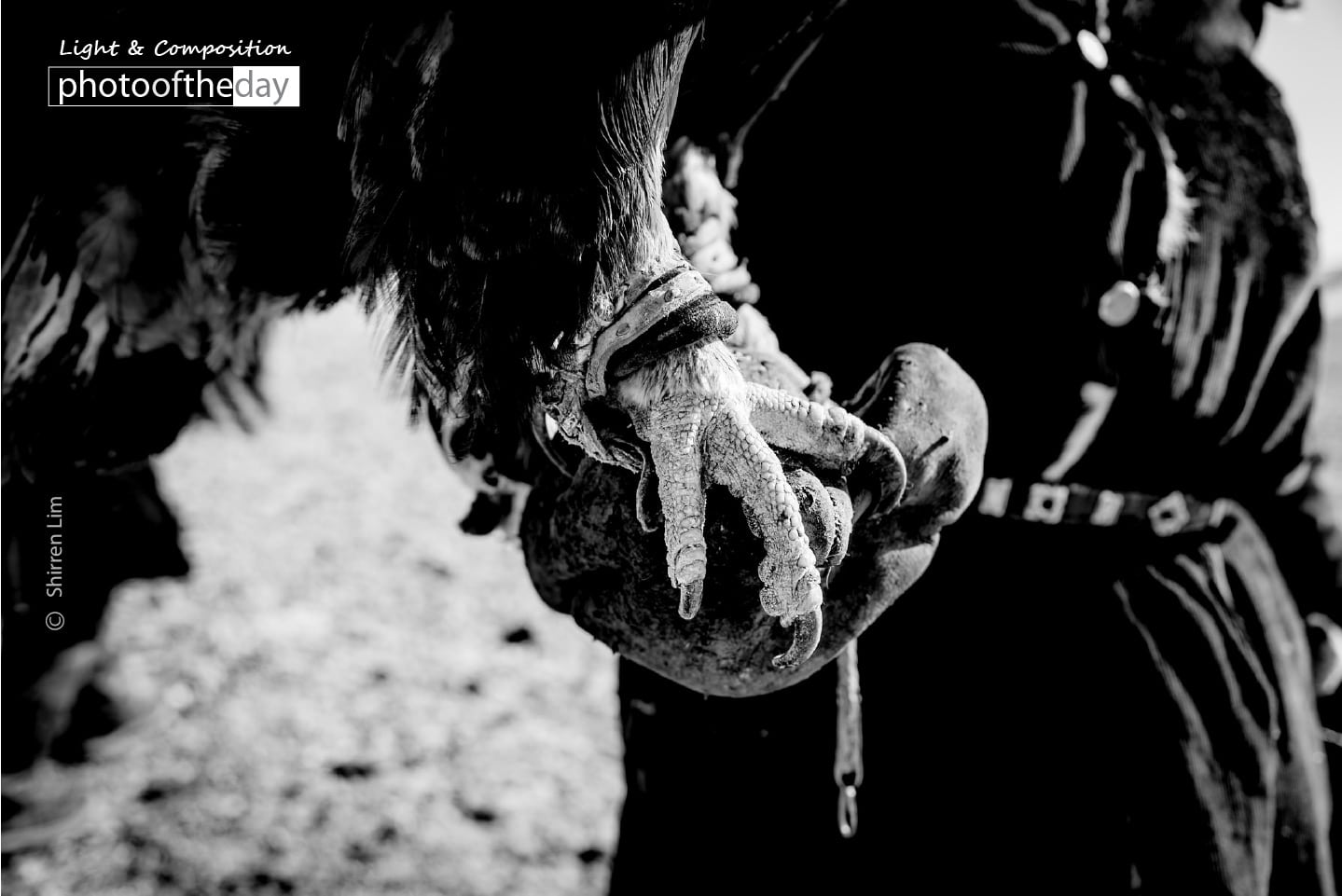
During an immersive two-day expedition to Modon Hoshoo in Saksai Village, the photographer sought to document the ancient culture of Kazakh eagle hunters. While observing the birds in action on a mountain morning, the photographer was struck by the formidable presence of the female hunting eagles. This image focuses specifically on the raptor's talons, capturing the raw power and physical strength inherent in these majestic creatures. The photograph is award-worthy for its sharp, intimate perspective on a traditional hunting practice, stripping away the surroundings to highlight the lethal, natural precision of the eagle.
Shirren Lim
Born in Penang Island, Malaysia, in 1970, Shirren Lim is a Jakarta-based photographer who discovered her true passion for the craft in 2009. She specializes in portraiture, aiming to capture the sincere and uncovered expressions of humanity with an intense, earthy style that emphasizes simple, heart-centered compositions. Inspired by the iconic work of Steve McCurry, Lim aspires to create images that resonate globally, and her evocative work has been featured in numerous web and printed publications.
Resonance Score Breakdown
Transparency Note: The resonance score (10.7/20) is calculated based on social engagement metrics collected before the award announcement.
Expert Photography Reviews · 6
The Weight of Stillness
There is a profound gravity in the things that hold us. We often overlook the strength required to simply remain, to grip the branch or the earth with such unwavering intent. It is a quiet, singular focus—a commitment to the present moment that requires no movement to be felt.
Read the reflection →The Weight of the Wild
I remember sitting in a small tea house in the Altai mountains, watching an old man sharpen a knife. He didn't look up, but he spoke about the mountains as if they were temperamental neighbors—something to be respected, never mastered.
Read the reflection →Reviews & Comments
Share your thoughts about this award-winning photograph. Your reviews contribute to the community engagement score.
f/2.8 at 200mm, 1/1000s, ISO 400. That shallow depth of field isolates the talons with clinical precision. It’s a calculated risk that pays off; the focus plane is razor-thin, pinning the texture of the scales against the soft, blurred mountain backdrop. I’ve seen enough eagle shots to know they’re usually messy, but this is disciplined. The shutter speed effectively freezes the tension in those claws. It’s technically sound. Honestly, it makes me hold my breath.
You’ve stripped away the noise of the hunt to focus on the anatomy of survival. I’ve spent enough time in the field to know that stillness is the hardest thing to capture. When I look at these talons, I don’t just see a bird; I feel the tension of a creature that knows exactly what it’s for. You waited for that precise, lethal geometry. It’s honest, and it’s cold. I respect that.
There’s a cold, sharp intelligence in those talons. I’ve spent years watching how hands—human or otherwise—reveal a life’s work, and these claws don’t lie. They’re built for survival, not for show. It’s a brutal, honest look at a partnership that’s older than the village itself. Looking at the way they grip, I feel a sudden, sharp shiver of respect. It’s not just a bird; it’s a living, breathing piece of history.
Stripping away the landscape to isolate these talons feels like a violent act of decontextualization. Why must we reduce a living, cultural partner to a mere instrument of lethality? It’s technically sharp, sure, but it leaves me cold. By erasing the Kazakh hunter’s hand, Lim turns a complex tradition into a fetishized object. Does the raptor exist only for our aesthetic consumption? I find this clinical focus on the claws deeply unsettling. Where is the humanity?
The detail in these talons is striking, but I’m left wondering about the cost of such intimacy. When you’re this close to a hunting eagle, you’re usually encroaching on its space. Was this bird tethered or stressed for the sake of a clean frame? I’ve spent weeks in the cold waiting for a raptor to land naturally; this feels too convenient. It’s a sharp shot, but I can’t help but feel a bit uneasy.
The focal plane here is razor-thin, isolating the keratin texture of the talons against a soft, atmospheric blur. At this magnification, the diffraction limit hasn’t compromised the micro-contrast; it’s perfect. I’m genuinely unsettled by how the lens resolves the microscopic jaggedness of those claws. It’s a brutal, clinical dissection of predatory anatomy. You don’t just see the power; you feel the physics of the grip. It’s an extraordinary, chilling piece of optical engineering.