Sharing Innocence by Liton Chowdhury
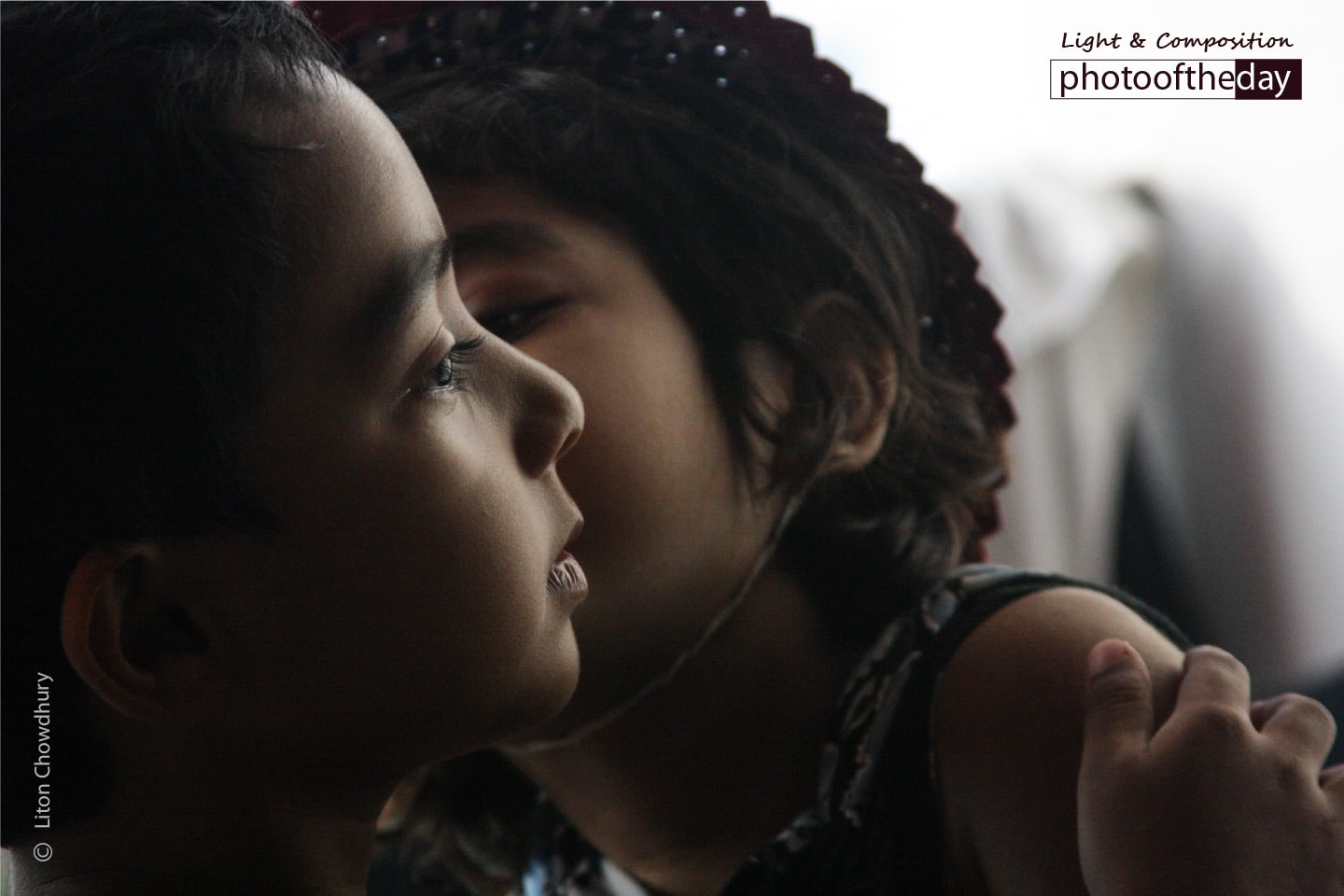
During a weekend trip to Bakkhali, the photographer captured a fleeting, candid moment of children playing on a hotel balcony. The scene, defined by the genuine, unscripted interactions of youth, evoked a profound sense of shared innocence and secret joy. By focusing on the authentic expressions and the natural light filtering onto the balcony, the photographer successfully translated a simple domestic scene into a poignant portrait of childhood. This image stands out for its ability to transform a casual observation into a narrative-driven composition that resonates with the universal purity of early life.
Liton Chowdhury
Based in Kolkata, India, Liton Chowdhury is a software professional who balances his career with a deep-seated passion for photography. His artistic journey began with the desire to document the formative years of his daughter, who remains his primary muse and most frequent subject. Through his lens, Chowdhury explores the nuances of portraiture, consistently seeking to capture the authentic, fleeting moments that define childhood and family life.
Resonance Score Breakdown
Transparency Note: The resonance score (12.3/20) is calculated based on social engagement metrics collected before the award announcement.
Expert Photography Reviews · 8
The Language of Play
I remember a rainy Tuesday in a small village outside of Kyoto, watching two boys chase each other through a narrow alleyway. They didn’t have a ball or a kite, just a discarded plastic crate and a shared, frantic energy that defied the gloom of the weather.
Read the reflection →The Weight of a Whisper
I was cleaning out my desk this morning and found a handful of smooth pebbles I’d collected from a beach trip years ago. I remember holding them in my palm, feeling their coolness, and thinking how heavy they felt for such small things.
Read the reflection →Reviews & Comments
Share your thoughts about this award-winning photograph. Your reviews contribute to the community engagement score.
The shutter caught the exact frame the editor keeps. It’s a tight sequence, the motion suspended in the soft, directional light of that balcony. You can feel the rhythm of their play, the kinetic energy of youth frozen just before the cut. I’ve spent years looking for this kind of stillness. It’s honest, unscripted, and frankly, it makes me miss being that young. The composition holds perfectly; any movement would have ruined the secret.
Bakkhali’s balcony light hits those kids just right. It’s that fleeting, unscripted chaos Cartier-Bresson lived for. You caught the exact micro-second where their joy isn’t posed—it’s raw. If you’d waited a heartbeat longer, the geometry of their laughter would’ve dissolved into just another snapshot. I’m actually smiling looking at this; it’s rare to see such pure, unburdened energy frozen so cleanly. You were paying attention. That’s the difference between a picture and a moment.
The blur here isn’t a failure; it’s a liberation. By refusing to pin these children down with clinical sharpness, Chowdhury captures the kinetic blur of youth itself. It’s closer to the impressionistic ghosts of Muybridge than a standard portrait. I’m genuinely moved by how the light bleeds into their movement. Why resolve the edges when the feeling is so fluid? It’s a rare, messy honesty that makes me wish more photographers would stop chasing resolution.
Most entries in this category rely on staged sentimentality, but this captures the frantic, unposed geometry of childhood. I’ve seen thousands of portraits, yet the way these children lean into the balcony railing creates a tension that feels genuinely fragile. It’s the raw, messy honesty of their laughter that caught me off guard. In thirty years, we won’t care about the location; we’ll just remember the feeling of being that small, that wild, and that free.
Echoing the candid spontaneity of Helen Levitt’s street work, Chowdhury captures a fleeting intimacy that feels refreshingly unposed. The interplay of light across the balcony railing recalls the tonal delicacy of early Leica snapshots, yet it avoids the trap of mere nostalgia. I’m genuinely moved by the children’s unguarded expressions; it’s a rare, quiet honesty that cuts through the noise of contemporary portraiture. It’s not just a scene of play; it’s a dialogue with the history of childhood.
The balcony frame feels like a stage, but who built it? These children are playing, yet I’m struck by a sudden, sharp discomfort. Are they performing for the lens, or is their joy truly unscripted? When we label this “universal purity,” do we erase the specific reality of their lives in West Bengal? It’s a pretty composition, but it doesn’t challenge the observer. Why are we so eager to consume their innocence as a commodity?
The balcony holds its breath. Sunlight spills across the concrete, carving out a quiet stage for these children. They don’t notice the frame. They don’t notice me. I’ve spent years looking for this stillness in the chaos of West Bengal. It’s rare. The empty space between them isn’t just distance. It’s a pause. A shared secret. I feel a sudden, sharp ache for my own lost afternoons. Nothing here is accidental. The empty corner isn’t empty.
We watch these children on the balcony, their laughter caught in the soft, coastal light of Bokkhali. It’s a quiet, unscripted secret they’re sharing, and we’re lucky to be invited into their circle. I’ve spent my life listening for these moments, and here, the silence between them tells the whole story. It’s a beautiful, fleeting glimpse of pure connection. Honestly, it makes me ache for the simplicity of my own childhood. This is a photograph worth returning to.