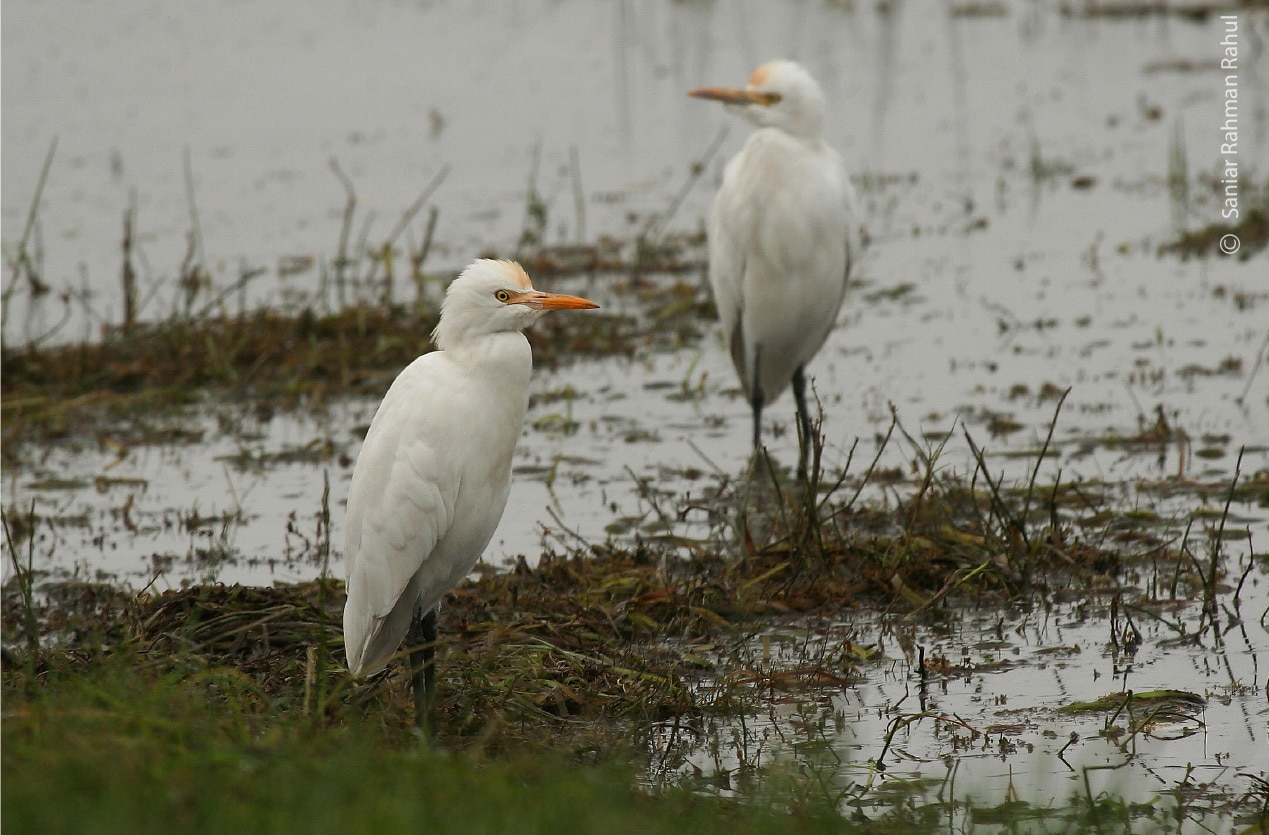
Cattle Egrets by Saniar Rahman Rahul
Captured within the serene, seasonally inundated wetlands of Tanguar Haor, this image showcases a colony of cattle egrets in their natural habitat. The photographer expertly documents the behavior of these cosmopolitan herons, highlighting their symbiotic relationship with the environment and their preference for nesting near water. The composition is elevated by the birds' graceful presence against the lush, textured backdrop of the Bangladeshi landscape. This award-winning photograph stands out for its clarity and the photographer's keen ability to capture a fleeting moment of wildlife activity, turning a routine feeding scene into a compelling study of avian life.
Saniar Rahman Rahul
Based in Dhaka, Bangladesh, Saniar Rahman Rahul is an accomplished Art Director at Grey Worldwide with a deep-rooted passion for visual storytelling. His journey into photography began in childhood, inspired by his father, and was later refined through a distinguished career in graphic design and advertising. Rahul’s work is characterized by a sophisticated eye for composition and a commitment to capturing the natural beauty of his homeland, earning him recognition as a talented observer of the world around him.
Resonance Score Breakdown
Transparency Note: The resonance score (11.2/20) is calculated based on social engagement metrics collected before the award announcement.
Expert Photography Reviews · 4
The Architecture of Arrival
There is a quiet, rhythmic intelligence to the way birds navigate the world.
Read the reflection →The Geometry of Gathering
Cattle egrets often follow the movement of large grazing mammals, not out of a sense of companionship, but because the disturbance of the grass reveals a hidden bounty of insects.
Read the reflection →Reviews & Comments
Share your thoughts about this award-winning photograph. Your reviews contribute to the community engagement score.
The air in Tanguar Haor holds a heavy, humid stillness that I’ve felt in my own bones. He stood here in the cooling hour, waiting for the egrets to settle into the reeds. It’s not just a study of birds; it’s a quiet communion with the wetlands. When I look at the soft, diffused light clinging to their white feathers, I feel a sudden, sharp ache for that silence. It’s a beautiful, patient surrender.
The Tanguar Haor wetlands aren’t merely a backdrop; they’re a suffocating, verdant void. These egrets, suspended in the humidity, don’t just exist—they haunt the frame. I’m unsettled by how the light refuses to define them, leaving their forms to bleed into the murky, unyielding shadows. It’s a quiet violence. When I look at these birds, I don’t see nature. I see the heavy, silent weight of time pressing against the living, and it’s terrifying.
The frame resolves into a series of rhythmic, white vectors against a dark, textured horizontal plane. Rahul’s placement of the egrets creates a near-perfect Fibonacci spiral that draws the eye across the negative space of the water. It’s a brilliant spatial equation where the birds’ verticality offsets the marsh’s density. I’m genuinely struck by how the geometry stabilizes the chaos of the flock. It’s not just wildlife; it’s a masterclass in balancing mass and void.
The wings are mid-flap, frozen in that frantic, beautiful chaos. It’s not just wildlife; it’s a dance. If Rahul had clicked a fraction later, the geometry of those white feathers against the dark, textured water would’ve dissolved into a blur. I’ve spent years chasing that exact tension. It’s the decisive moment, pure and simple. My heart actually skipped a beat seeing the symmetry here. He was paying attention. That’s the only thing that matters.