The Value of Money by Liton Chowdhury
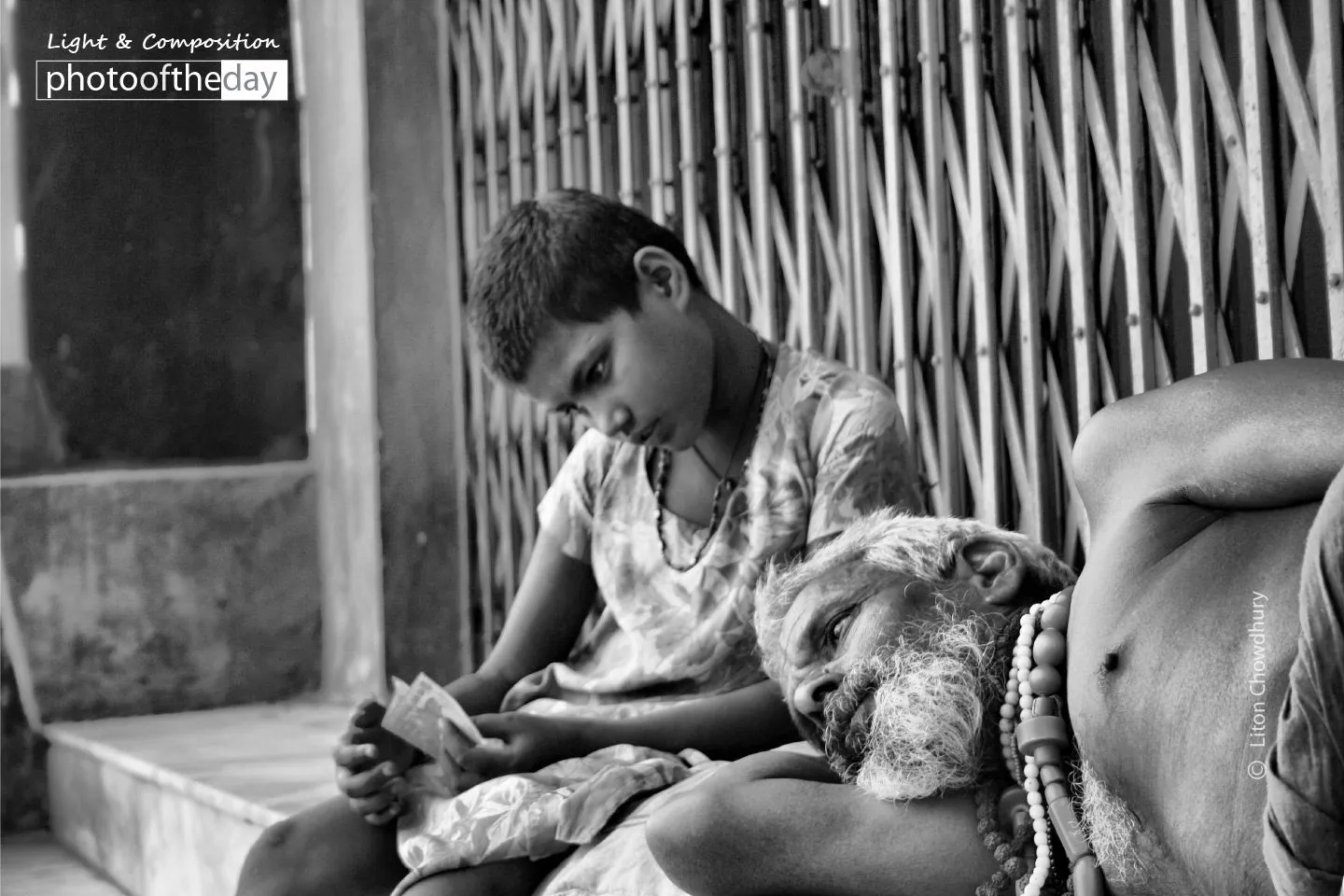
Captured in the spiritual heart of Varanasi, this poignant documentary photograph tells the story of a young girl abandoned at a holy ghat due to her developmental challenges. The image captures a moment of profound human connection, where a local sadhu, having renounced worldly life, provides care for the child. The photographer was struck by the irony of the situation: when offered a small sum of money, the sadhu immediately passed it to the girl, demonstrating that for those living on the fringes of society, material wealth holds no significance compared to the sanctity of human compassion. This powerful narrative, combined with its emotive composition, highlights the resilience found within the city's sacred spaces.
Liton Chowdhury
Based in Kolkata, India, Liton Chowdhury balances a professional career in software engineering with a deep-seated passion for photography. His journey began as a pursuit to document the fleeting childhood moments of his daughter, who remains his most frequent and cherished subject. Through his lens, Chowdhury explores the human condition, often focusing on documentary themes that reveal the quiet, poignant stories hidden within everyday life. His work reflects a commitment to capturing authentic emotion and the complex social tapestries of his surroundings.
Resonance Score Breakdown
Transparency Note: The resonance score (12.9/20) is calculated based on social engagement metrics collected before the award announcement.
Expert Photography Reviews · 7
The Currency of Breath
There is a specific weight to the coins we carry, a cold, metallic assurance that we are tethered to the world of things.
Read the reflection →The Weight of a Copper Coin
I keep a small, tarnished thimble in my sewing box, worn smooth by a thumb that stopped moving years ago. It is a hollow thing, yet it feels heavy with the quiet labor of a life spent mending what was torn.
Read the reflection →Reviews & Comments
Share your thoughts about this award-winning photograph. Your reviews contribute to the community engagement score.
This photography tells a very touchy story which shows a very different approach to life we know and experience in our materialistic world. It is especially close for me because I had been in Varanasi and found this city one of the most influential for my personal photographic perception of the world around.
Most documentary work from Varanasi relies on the same tired tropes of color and chaos. Chowdhury avoids that trap. By focusing on the sadhu’s weathered hands passing the coin to the child, he captures a moral inversion that hits me right in the chest. It’s the intimacy of that exchange, not the location, that ensures this will matter in thirty years. It’s a rare, quiet victory over the noise of street photography.
The frame resolves into a precise isosceles triangle formed by the sadhu’s posture and the girl’s seated form. A dominant vertical axis runs through the sadhu’s spine, anchoring the composition against the chaotic, textured background. The negative space in the upper quadrant creates a necessary tension, forcing our eyes back to the intersection of their hands. It’s a perfect geometric equilibrium. I’m genuinely moved by how the math here elevates such raw, human vulnerability.
In Varanasi, we find a girl abandoned, yet held by a sadhu who has renounced everything. When we look at them, we see the true currency of the ghats. It isn’t the coins, but the gentle hand passing them on. I’ve stared at this for hours, and it breaks my heart in the most beautiful way. It’s a reminder that when we listen to the silence between souls, we finally understand what matters.
Varanasi’s ghats aren’t a backdrop for our moral lessons. Why does the girl’s vulnerability serve as a prop for the sadhu’s saintliness? I feel a sharp, uncomfortable prick of resentment watching her reduced to a symbol of abandonment. Does the camera’s gaze truly honor her, or does it just consume her trauma to validate our own empathy? It’s a polished frame, sure, but whose dignity did we trade to get this shot?
There’s a profound stillness here that only comes when a photographer stops being a stranger. You can see it in the sadhu’s hands—they aren’t just holding the girl; they’re anchoring her. It’s a quiet, sacred exchange. I’m genuinely moved by the way she leans into him, fully trusting his presence. This face has a whole life in it, and because Chowdhury waited for that connection, he didn’t just take a picture; he received a gift.
Varanasi’s ghats are defined by their heavy, rhythmic stone thresholds, yet here, the architecture recedes into a blurred, dark void. It’s the light—that sharp, directional spill across the sadhu’s weathered skin—that anchors the space. I’m struck by how the stone steps, usually a datum for movement, become a static stage for this quiet, human exchange. It’s a raw, spatial honesty; the building doesn’t matter, only the profound, fragile shelter these two create within it.
Varanasi’s ghats have been documented since the early colonial surveys, yet Chowdhury’s framing avoids the usual ethnographic trap. The sadhu’s gesture echoes the tactile intimacy of Dorothea Lange’s Migrant Mother, but here, the exchange of currency subverts the traditional power dynamic. It’s a rare, quiet subversion of the gaze. Honestly, the way he hands that coin to the child caught me off guard; it’s a startling, genuine rupture in the long, often exploitative history of street portraiture.