Surprised by Lavi Dhurve
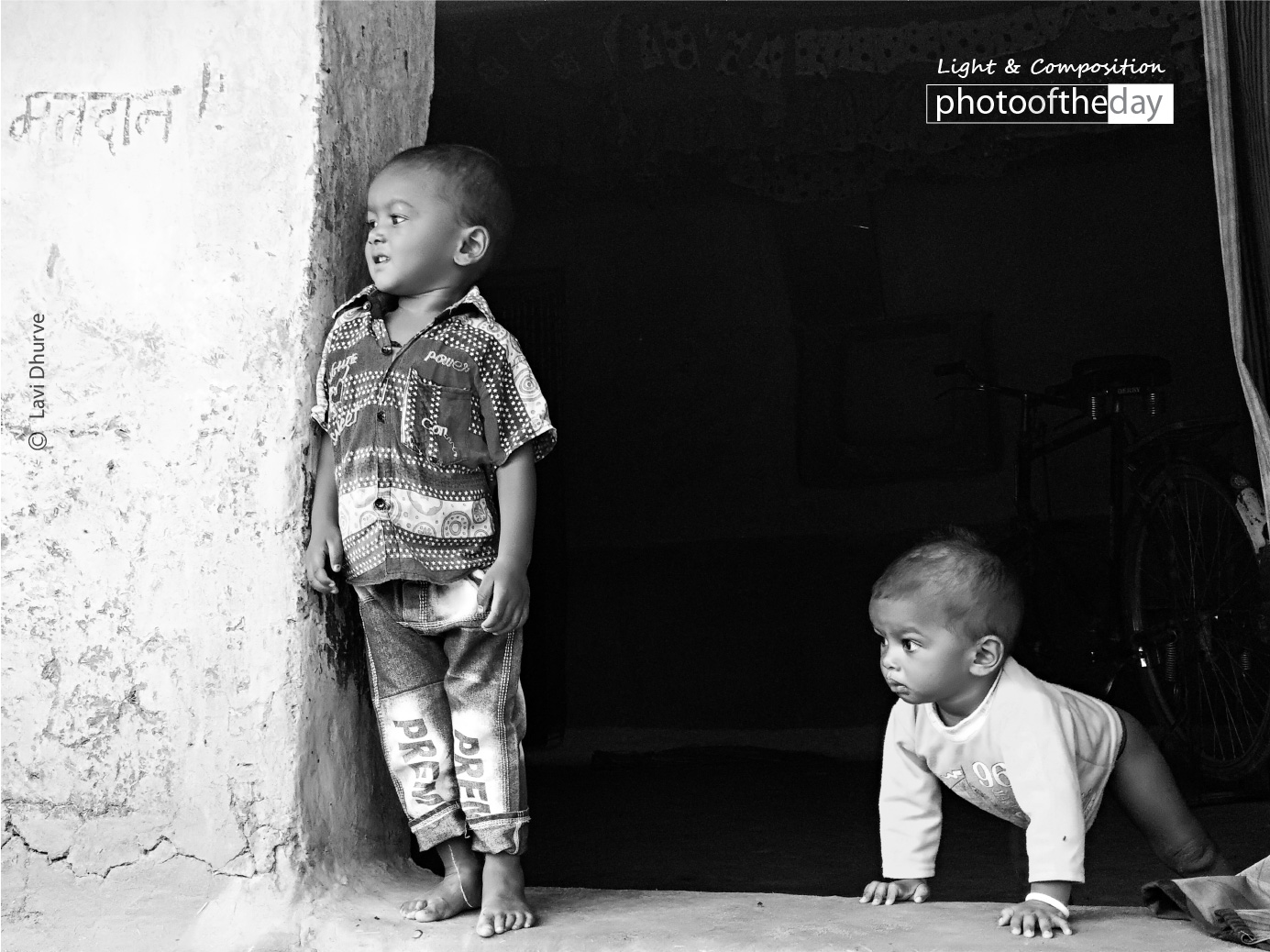
Captured on a summer day in July, this poignant portrait features two brothers, Shivam and Saurabh, peering from their home in a quiet village. The photographer masterfully documents their genuine reaction to the sounds of play echoing through the alleyway, freezing a moment of innocent curiosity. By focusing on the brothers' expressive faces, the image transcends a simple neighborhood snapshot to become a study in childhood wonder. The composition is award-worthy for its ability to transform an everyday, fleeting interaction into a timeless narrative of rural life, highlighting the photographer's keen eye for human connection and the beauty found in simple, authentic moments.
Lavi Dhurve
Hailing from a small village in Madhya Pradesh, the 'Heart of India,' Lavi Dhurve finds profound inspiration in the simplicity of rural life. Her work is deeply rooted in a passion for art, culture, and the human spirit, with a particular focus on capturing the candid beauty of children and the natural world. Through her lens, Dhurve seeks to document the quiet elegance of everyday existence, from the golden light of sunrise to the vibrant lives of the people within her community.
Resonance Score Breakdown
Transparency Note: The resonance score (11.4/20) is calculated based on social engagement metrics collected before the award announcement.
Expert Photography Reviews · 7
The Architecture of Wonder
Why do we assume that the most profound truths are found in the grandest gestures? We spend our lives waiting for the monumental, for the shift in the earth that signals a change in our own internal weather.
Read the reflection →The Threshold of Wonder
There is a specific architecture to childhood, built not of brick or mortar, but of thresholds. We spend our earliest years living in the doorway, that liminal space between the safety of the interior and the vast, unscripted noise of the world outside.
Read the reflection →Reviews & Comments
Share your thoughts about this award-winning photograph. Your reviews contribute to the community engagement score.
The frame’s geometry relies on the verticality of the doorframe, which anchors the brothers’ faces against the encroaching shadows. It’s a tight, disciplined architecture. The negative space to the left creates a necessary fulcrum, balancing the subjects’ gaze. I’m genuinely unsettled by how the darkness swallows their shoulders, forcing the eye back to the center. It doesn’t rely on sentiment; it relies on the rigid, unforgiving placement of light. The composition holds. It’s precise.
The light here doesn’t just fall; it waits. In the quiet dust of Sarni, Lavi caught the brothers as they leaned into the unknown. It’s that fleeting, breathless second before a child’s curiosity turns to recognition. I’ve spent hours in similar stillness, and I can almost feel the heat radiating from those walls. It’s a rare, sacred pause. Looking at them, I feel a sudden, sharp ache for the simplicity of my own childhood.
We look at Shivam and Saurabh and we hear the alleyway’s hum before we see their faces. They’ve paused, caught in that fragile space between stillness and the call of play. It’s a quiet, honest tension. I find myself leaning in, wanting to know what they’ve heard. Lavi didn’t just point a lens; he waited until the boys were truly present. It’s a photograph that asks to be returned to, again and again.
Before the eye identifies the brothers, a sudden stillness pulls at the chest. It’s the visceral activation of curiosity, that held-breath moment when the world outside the frame suddenly matters more than the room. I feel a sharp, phantom ache for my own lost childhood wonder. When I return to this, the shadows around their eyes feel heavier, like a secret they’ve decided not to tell. It’s a quiet, haunting anchor for the restless mind.
The frame splits into a rigid grid defined by the vertical door frame and horizontal lintel. The brothers’ faces occupy the upper-right quadrant, creating a heavy visual anchor that balances the negative space of the shadowed wall. It’s a precise 1:2 ratio of light to dark that forces the eye toward their expressions. I’m genuinely moved by how the geometry traps their curiosity; it’s a perfectly solved spatial equation where every vector points toward childhood wonder.
The focal plane sits perfectly on the brothers’ pupils, capturing the micro-contrast of their irises against the soft, atmospheric diffusion of the alleyway. It’s a masterclass in managing the diffraction limit; the resolution here reveals textures the naked eye would surely miss. I’m genuinely moved by how the lens renders the subtle interplay of light across their skin. It’s not just a portrait; it’s a precise, optical preservation of pure, fleeting childhood wonder.
Most portraits of children feel staged, but these brothers aren’t performing for the lens. They’re anchored by the frame’s edge, their eyes locked on something just beyond our reach. It’s that raw, unscripted tension that makes me stop. I’ve seen thousands of village snapshots, yet this one lingers because it captures the exact second curiosity overrides caution. Thirty years from now, we won’t remember the alley, but we’ll still feel the weight of their gaze.