Mesmerizing Pattern by Masrur Ashraf
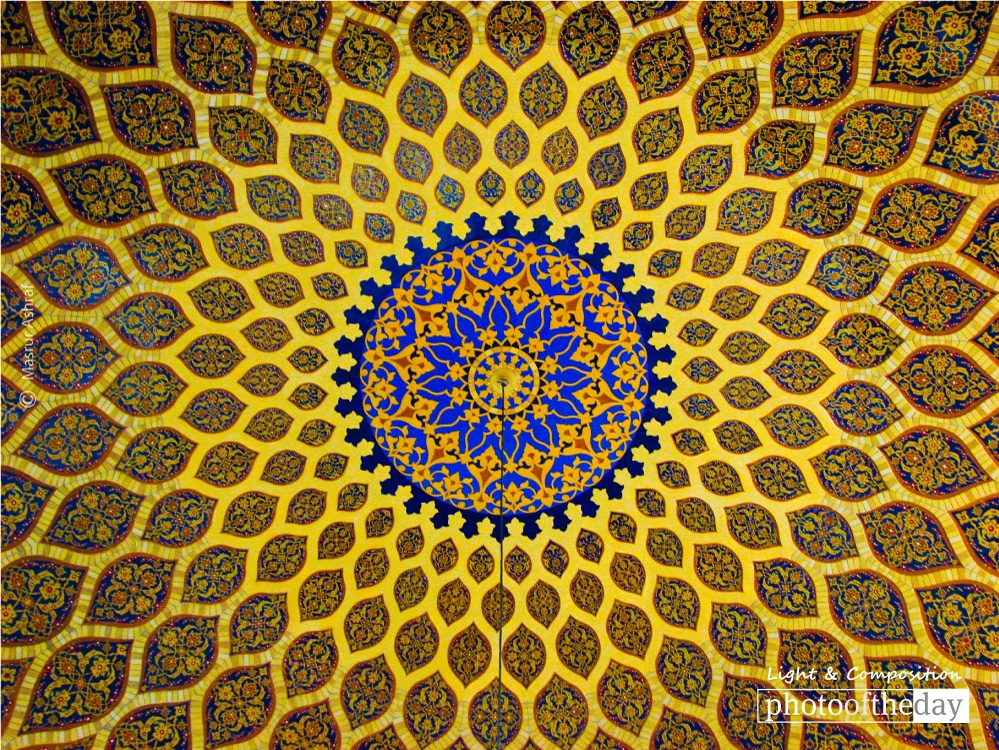
Captured within the architectural splendor of the Ibn Battuta Mall in Dubai, this photograph highlights the intricate geometric patterns adorning the interior of a dome. The photographer focused on the central symmetry of the Islamic design, meticulously framing the complex motifs to draw the viewer's eye toward the heart of the structure. By emphasizing the interplay of light and shadow across the ornate surfaces, the image transforms a static architectural detail into a mesmerizing visual experience. This work is award-worthy for its technical precision in capturing delicate patterns and its ability to elevate a travel observation into a compelling study of cultural artistry.
Masrur Ashraf
Born in Dhahran, Saudi Arabia, in 1982, Masrur Ashraf is an Indian national with an academic background in Telecommunications and Marketing. His photographic journey began with his father's vintage Canon AE-1, eventually evolving into a deep passion for landscape and rural life photography. Currently based in Saudi Arabia, he strives to document the humbling beauty of village life in West Bengal, India, aiming to share the richness and dynamism of these communities with a global audience through his evocative imagery.
Resonance Score Breakdown
Transparency Note: The resonance score (12.5/20) is calculated based on social engagement metrics collected before the award announcement.
Expert Photography Reviews · 6
The Geometry of Silence
We often look for meaning in the grand gestures of life, forgetting that the universe frequently speaks in the language of repetition. When we trace the lines of a leaf or the veins in a stone, we are witnessing a rhythm that predates our own hurried existence.
Read the reflection →The Infinite Echo
Why do we seek order in the chaos of existence? Perhaps it is because we are terrified of the void, and so we build walls, weave tapestries, and trace lines that return to their own beginning.
Read the reflection →Reviews & Comments
Share your thoughts about this award-winning photograph. Your reviews contribute to the community engagement score.
I like the pattern and how it increases harmonic in size almost like a sun flower. And how the blue complements the golden yellow.
Thank you Ola
The central axis here is absolute, anchoring the radial symmetry of the dome’s tessellation. It’s a perfect exercise in geometric recursion. The 1:1 ratio of the inner ring to the outer perimeter creates a hypnotic visual gravity that pulls the eye inward. I’m genuinely breathless at how the light gradients define each tile’s depth. It’s a solved equation of Islamic proportion, where every vector converges precisely at the center. It’s simply elegant math in motion.
We look up into the Ibn Battuta dome and find a conversation between geometry and the divine. It’s a portrait of a culture, not a person. The patterns aren’t just stone; they’re a silent dialogue of ancestors whispering through light. I feel a strange, quiet hum when I trace these lines. It’s as if the architect listened to the stars before placing a single tile. This is a photograph that asks to be returned to.
The jury’s obsession with the clarity of these Islamic motifs misses the point entirely. At 1/10sec, Ashraf was on the verge of something kinetic, yet he chose to freeze the geometry into a static, predictable grid. It’s technically competent, sure, but I’d have loved to see him surrender to the blur. Why resolve every tile? I find myself wishing he’d let the architecture bleed into a rhythmic, painterly abstraction instead of this safe, sharp archival record.
I’m staring at this dome, and honestly, it feels like a hollow souvenir. Ashraf captures the geometry of Ibn Battuta Mall, but why strip away the commercial noise? By isolating these patterns, he turns a living cultural space into a sterile, decorative object. Whose heritage is being curated here, and for whose consumption? It’s technically sharp, sure, but it’s also deeply detached. Does this symmetry actually honor Islamic design, or does it just make it look like wallpaper?
Before the eye identifies the geometry, the chest tightens. It’s a dizzying, recursive pull toward the center of that dome. I feel a sudden, sharp vertigo, as if the ceiling might swallow me whole. When I return to this a year later, the intricate tiles don’t just sit there; they hum. It’s a quiet, rhythmic activation of the nervous system. I’ve never been to Dubai, yet this pattern follows me into my restless, waking sleep.
The lens locks onto the dome’s geometry, holding a rhythm that feels like a slow, hypnotic pan. It’s a static shot, yet the symmetry pulls you into the center with the force of a tracking shot. I’ve stared at these patterns for minutes; they don’t just sit there, they hum. It’s the kind of frame an editor keeps because the cut would have been a mistake. Ashraf caught the exact pulse of the architecture.