Choco Walnut Cake by Bashar Alaeddin
Captured within the intimate setting of a family-run cafe in Amman, this photograph of a Choco Walnut Cake highlights the artistry of food presentation. The photographer collaborated with the pastry chef to showcase the dessert's natural appeal, opting for an authentic approach without artificial styling. By balancing natural sunlight from the right with a diffused 500W tungsten light on the left, the photographer carefully lifted the shadows to reveal the rich textures of the cake. This image stands out for its clean, professional execution and its ability to elevate a simple culinary creation into a compelling commercial hero shot.
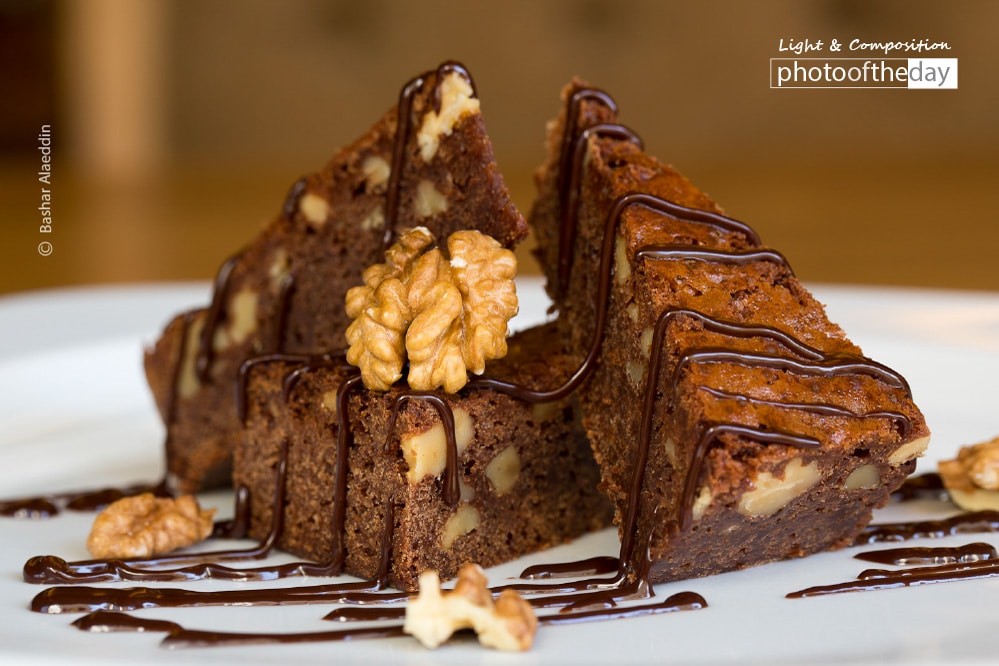
Exposure 1/10sec @ f/8 | ISO 100 | Focal Length 100mm
Bashar Alaeddin
Born in Kuwait City and having spent most of his life between Jordan and Lebanon, Bashar Alaeddin brings over nine years of photographic experience to his craft. As the founder of a studio in Amman, he balances a diverse commercial career—specializing in food, interior, product, and portrait photography—with a deep passion for capturing the landscapes and night skies of the Middle East. An amateur astronomer at heart, Alaeddin frequently merges his technical expertise with his love for the natural world to document the beauty of Arabian landscapes under the stars.
Resonance Score Breakdown
Transparency Note: The resonance score (12.8/20) is calculated based on social engagement metrics collected before the award announcement.
Expert Photography Reviews · 4
A Slice of Quiet
I burned my toast this morning. It was a small, stupid mistake, the kind that happens when you are staring out the window instead of watching the kitchen timer.
Read the reflection →The Weight of Sweetness
The smell of burnt sugar always brings me back to a kitchen that no longer exists, where the air was thick with the scent of toasted nuts and cooling cocoa.
Read the reflection →Reviews & Comments
Share your thoughts about this award-winning photograph. Your reviews contribute to the community engagement score.
The frame’s geometry is tight, anchored by the cake’s circular mass against the rigid horizontal plane. It’s a disciplined study of texture. The light doesn’t merely illuminate; it defines the spatial tension between the walnut’s jagged topography and the smooth ganache. I’ve grown weary of culinary sentimentality, yet this structure holds. The composition demands attention through its sheer, clinical refusal to clutter the frame. It’s a rare instance where the architecture actually justifies the subject.
Before the eye identifies the crumb, something in the throat tightens. It’s the sudden, heavy stillness of a quiet afternoon in Amman. The light hitting those walnuts triggers a phantom sweetness on my tongue, a sensory memory I didn’t know I carried. When I return to this, I don’t see a cake; I feel the warmth of a cafe chair against my back. It’s a rare, grounded comfort that lingers long after I look away.
The lighting here feels clinical, almost invasive. By stripping away the cafe’s context, Alaeddin turns a local pastry into a sterile object of consumption. Why must we sanitize the walnut cake to make it palatable for a global audience? It’s technically precise, sure, but I find the lack of messiness unsettling. Does the cake belong to the baker, or has it been colonized by the lens? It’s a polished lie that leaves me hungry for truth.
I’m accustomed to the stillness of a blind, where a single shutter click is earned through hours of shivering silence. Here, the light is manufactured, the scene curated. It’s technically precise, sure, but it feels hollow. I’d trade this entire polished plate for one frame where the subject wasn’t arranged for the lens. It’s a clean shot, but it’s extracted, not discovered. I find myself craving the messy, unpredictable truth of the wild instead.