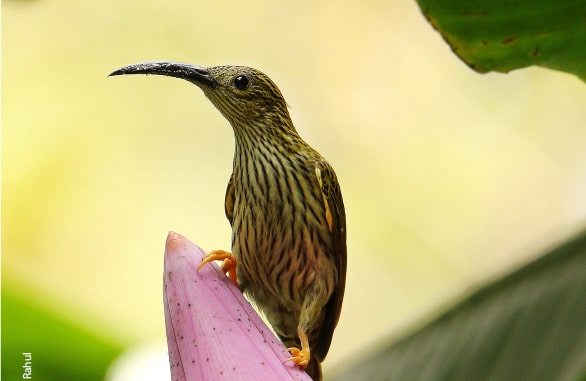
Streaked Spiderhunter by Saniar Rahman Rahul
Captured within the lush greenery of Kaptai National Park, this portrait of a streaked spiderhunter highlights the bird's unique evolutionary adaptations. The photographer utilized a long focal length to isolate the subject, capturing the intricate olive-yellow plumage and the distinctively curved beak designed for nectar feeding. By focusing on the bird's natural behavior in its native habitat, the image offers a compelling look at the Nectariniidae family. The photograph is award-worthy for its technical precision, sharp detail, and the photographer's ability to document a fleeting moment of wildlife in the wild, showcasing the delicate balance between the subject and its environment.
Saniar Rahman Rahul
Based in Dhaka, Bangladesh, Saniar Rahman Rahul is a seasoned creative professional whose journey into photography began during his childhood in Iraq, inspired by his father's work. A veteran in the advertising industry, Rahul currently serves as an Art Director at Grey Worldwide, having built a distinguished career in graphic design and pre-press media since 1995. His photographic practice reflects a deep-seated commitment to visual storytelling, blending his professional design expertise with a keen eye for the natural world, which has earned him international recognition, including multiple accolades from Light & Composition.
Resonance Score Breakdown
Transparency Note: The resonance score (10.9/20) is calculated based on social engagement metrics collected before the award announcement.
Expert Photography Reviews · 6
The Architecture of Thirst
There is a quiet geometry to longing. We see it in the way a vine curls toward the sun, or how the roots of an old tree map the hidden veins of the earth, searching for a drink that remains unseen.
Read the reflection →The Weight of a Feather
I keep a small, iridescent feather tucked inside the pages of a book I rarely open. It is a fragile thing, brittle to the touch, yet it carries the weight of a summer afternoon that has long since dissolved into the grey blur of the years.
Read the reflection →Reviews & Comments
Share your thoughts about this award-winning photograph. Your reviews contribute to the community engagement score.
You waited in that humid heat, didn’t you? I can feel the stillness you held while that spiderhunter hovered. It’s not just a sharp shot of a bird; it’s the quiet patience of a man watching a life unfold in the canopy. I’ve spent enough time in the brush to know that focus takes a toll on the soul. You caught a flicker of wild intent in that curved beak. There’s something honest happening here.
Most wildlife shots are just trophies, but this one lingers. I’ve seen thousands of bird portraits, yet the way Rahul captured the curve of that beak against the blurred, chaotic greens of Kaptai makes me hold my breath. It’s not just sharp; it’s intimate. In thirty years, we’ll need this record of the spiderhunter’s precise evolution. It’s a rare, quiet document of a world that’s disappearing, and honestly, it’s the kind of work that makes my job worth doing.
The forest in Kaptai doesn’t give up its secrets easily. Rahul must have stood in the humid stillness for hours, waiting for the light to catch that curved beak. It’s a quiet, emerald sanctuary where the bird finally decided to reveal itself. I feel a strange, breathless ache looking at those olive feathers; it’s as if the jungle itself held its breath so he could press the shutter. He didn’t take this; he was invited.
Rahul’s spiderhunter echoes the clinical precision of early ornithological plates, yet it avoids the taxidermic stillness of a Gould lithograph. The 600mm compression flattens the foliage into a bokeh that recalls the soft-focus backgrounds of Julia Margaret Cameron, though here it serves to isolate the bird’s curved beak with startling clarity. I’ve spent decades cataloging avian portraits, but the way this light catches the olive plumage genuinely makes my pulse quicken. It’s a rare, vibrant intersection of science and art.
The spiderhunter’s beak acts as a structural datum, slicing through the chaotic greenery like a cantilevered beam. It’s a study in tension between the organic void and the bird’s precise, curved mass. While I usually crave the human scale, there’s a startling architectural clarity here; the light hitting those olive-yellow feathers defines depth better than most blueprints. I find myself leaning in, almost feeling the humidity of that forest threshold. It’s a rare, quiet geometry.
The bird’s curved beak creates a perfect arc, anchoring the frame’s primary diagonal. It’s a precise 1:3 ratio of subject mass against the soft-focus foliage, which acts as a chaotic, textured negative space. I’m genuinely struck by how the beak’s vector slices through the composition, balancing the bird’s weight against the blurred background. It’s a solved equation of tension and release. The geometry here isn’t just accidental; it’s a beautifully calculated spatial equilibrium.