Stick Insect by Saniar Rahman Rahul
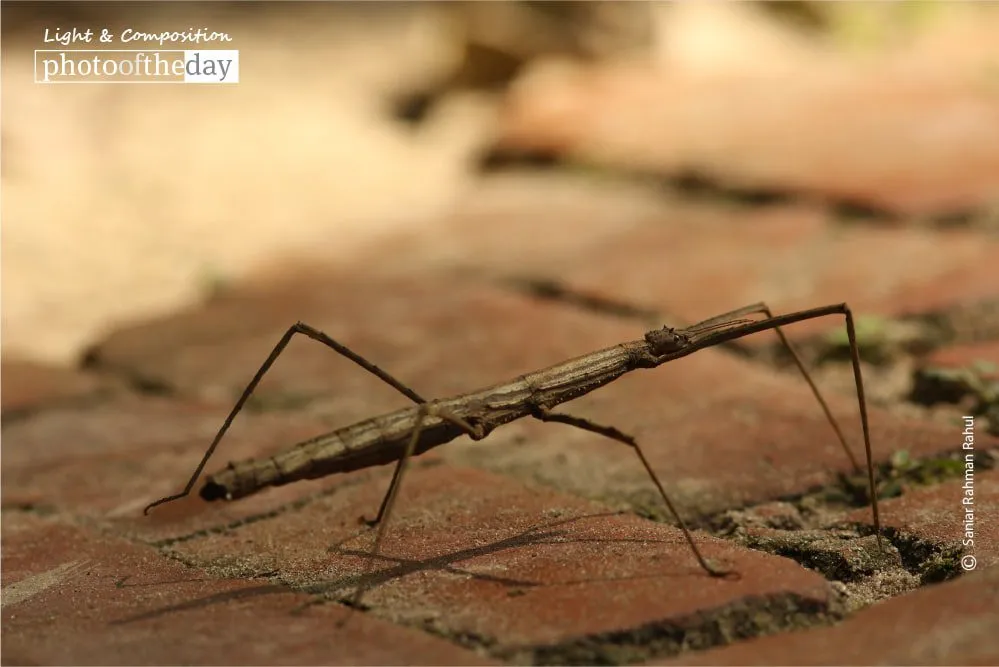
Captured within the lush biodiversity of Kaptai National Park, this photograph highlights the remarkable camouflage of a Phasmatodea stick insect. The photographer utilized a 300mm focal length to isolate the subject against the dense foliage, emphasizing the insect's intricate textures and evolutionary mimicry. By focusing on the subtle interplay between the creature and its environment, the image reveals the hidden wonders of the tropics. This shot is award-worthy for its technical precision and the photographer's ability to transform a master of concealment into a compelling, high-definition subject, showcasing the delicate balance of life in the Bangladeshi wilderness.
Saniar Rahman Rahul
Based in Dhaka, Bangladesh, Saniar Rahman Rahul is an accomplished Art Director at Grey Worldwide with a deep-rooted passion for visual storytelling. His photographic journey began in childhood, inspired by his father, and was later refined through his extensive professional background in graphic design and advertising. Since rediscovering his creative focus in 1997, Rahul has become a celebrated figure in the photography community, recognized for his technical mastery and his ability to capture the nuanced beauty of the natural world.
Resonance Score Breakdown
Transparency Note: The resonance score (11.2/20) is calculated based on social engagement metrics collected before the award announcement.
Expert Photography Reviews · 5
The Art of Disappearing
We often mistake visibility for existence. In our modern urban sprawl, we prioritize the loud, the monumental, and the brightly lit, assuming that if something cannot be immediately identified, it must not be there.
Read the reflection →The Art of Becoming Invisible
The stick insect does not merely hide; it practices a profound form of self-erasure, aligning its own body with the rigid geometry of a twig until the boundary between the living organism and the woody substrate dissolves entirely.
Read the reflection →Reviews & Comments
Share your thoughts about this award-winning photograph. Your reviews contribute to the community engagement score.
The insect mimics the twig. It’s a quiet deception. I’ve spent minutes tracing the line where the creature ends and the bark begins. It doesn’t scream for attention. It simply exists. The surrounding blur offers a necessary breath. Nothing here is accidental. The empty corner is not empty. It holds the weight of the forest. I feel a sudden, sharp stillness in my own chest. It’s a rare, honest grace.
The palette here isn’t merely green; it’s the bruised, mossy olive of a Morandi still life, bleeding into the pale, desiccated ochre of a dying leaf. It’s a chromatic whisper, really, where the insect’s chitinous body dissolves into the foliage like a secret kept too long. I’m breathless at how the light catches that singular, brittle limb—it’s a fragile, verdant haunting that makes one feel the humid, heavy silence of the Chittagong canopy pressing against the lens.
Camouflage isn’t merely survival; it’s an ontological vanishing act. Rahul’s insect doesn’t just hide; it dissolves into the architecture of the leaf, forcing us to confront the terrifying silence of nature. I’ve stared at these textures until my eyes ached, searching for the boundary where the creature ends and the void begins. It’s unsettling. When light refuses to define the subject, it leaves us alone with the shadow’s indifference. We aren’t looking at life; we’re looking at absence.
The insect’s body acts as a structural datum, mimicking the rigid fenestration of a branch. It’s a study in solid and void, where the creature’s limbs define a threshold between camouflage and exposure. I’m struck by how the light rakes across those chitinous textures, revealing a depth that feels almost tectonic. It’s a fragile architecture, really. I find myself leaning in, wondering if the surrounding foliage is merely a facade for this tiny, living inhabitant.
It’s technically sharp, sure, but that’s precisely why it leaves me cold. By isolating the insect with such clinical precision, Rahul has stripped away the very camouflage that makes the creature fascinating. I’d have preferred a deeper, chaotic blur—something closer to Sugimoto’s long-exposure abstractions than this rigid, high-definition cataloging. Why resolve the insect so aggressively when its entire evolutionary purpose is to vanish? It’s a missed opportunity to explore the beauty of total visual dissolution.