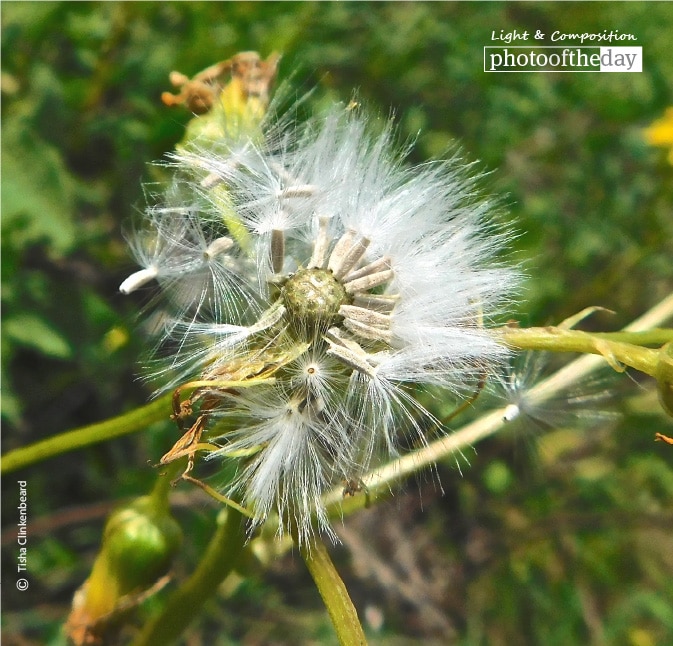
Dandelion in the Wind by Tisha Clinkenbeard
Captured during a vibrant spring day in Texas, this photograph highlights the delicate, ephemeral beauty of a dandelion caught in a gust of wind. The photographer observed the wildflowers blooming across the landscape, focusing on the fragile transition as the plant’s seeds were dispersed by the breeze. By timing the shot perfectly to freeze the movement of the fluff against the natural backdrop, the image transforms a fleeting moment of nature into a poignant study of fragility. This work is award-worthy for its keen observation of natural cycles and the graceful, ethereal composition that brings a common meadow scene to life.
Tisha Clinkenbeard
Based in Powderly, Texas, Tisha Clinkenbeard has cultivated a deep connection to photography that predates the digital era. Her work has been showcased in prestigious venues such as The Fine Arts Center of Hot Springs and Portland’s Black Box Gallery, alongside various fine art exhibitions throughout Texas. Driven by a desire to document the world as she wanders, she shares her unique perspective through her photo blog, Found Round & About, and has seen her nature photography featured in publications like Birds & Blooms.
Resonance Score Breakdown
Transparency Note: The resonance score (12.6/20) is calculated based on social engagement metrics collected before the award announcement.
Expert Photography Reviews · 5
The Geometry of Letting Go
When a dandelion reaches its final stage of maturity, it forms a perfect sphere of seeds, each attached to a tiny, silken parachute designed to catch the slightest breath of air.
Read the reflection →The Geometry of Letting Go
I remember sitting on a porch in rural Nebraska with an old farmer named Elias. He was watching a patch of weeds go to seed in the late afternoon heat. He told me that most people see a nuisance, but he saw a promise.
Read the reflection →Reviews & Comments
Share your thoughts about this award-winning photograph. Your reviews contribute to the community engagement score.
f/2.8 at 1/2000s, ISO 200, 100mm. A razor-thin plane of focus. It’s a calculated risk that pays off. The shutter speed effectively arrests the seed dispersal, preventing motion blur from muddying the geometry. I’ve seen enough soft macro work to last a lifetime, but this doesn’t suffer from that malaise. It’s sharp where it needs to be. Honestly, the clinical precision of the focal plane here is the only thing that kept me interested.
It’s a quiet miracle, isn’t it? Tisha didn’t chase this moment; she waited for the wind to speak. I’ve spent enough hours in the tall grass to know that feeling—the stillness before the seeds take flight. She stood there, breath held, listening to the breeze move through the Texas meadow. It’s a fragile, fleeting grace. Looking at those drifting white wisps, I feel a sudden, sharp ache for the things we can’t hold onto.
One suspects the shutter clicked after a long, tedious afternoon of watching weeds. It’s a decent enough capture, though I’ve spent enough hours in the tall grass to know the wind rarely plays ball. Did she return for a second day, or did she simply get lucky with a breeze? I’m genuinely envious of the stillness she found in that Texas field. It’s a quiet, earned moment that doesn’t scream for attention. That’s rare.
The wind doesn’t just move the seeds. It carves the air. I’ve spent minutes watching the white fluff drift into the blur of the Texas meadow. It’s quiet. The background isn’t a distraction; it’s a breath. I feel a sudden, sharp ache for the things we lose to the breeze. Nothing here is accidental. The empty corner isn’t empty. It’s the space where the dandelion finally finds its rest. It’s enough.
Before the eye identifies the dandelion, a sudden stillness settles in the chest. It’s the physiological echo of a held breath, waiting for the seeds to scatter. I’ve felt this exact, quiet ache before—the realization that beauty is just a precursor to loss. When I return to this in a year, I won’t see Texas; I’ll feel that frantic, fragile dispersal. It doesn’t just capture wind; it captures the precise moment our own defenses finally let go.