Aim High by Montasir Khandker
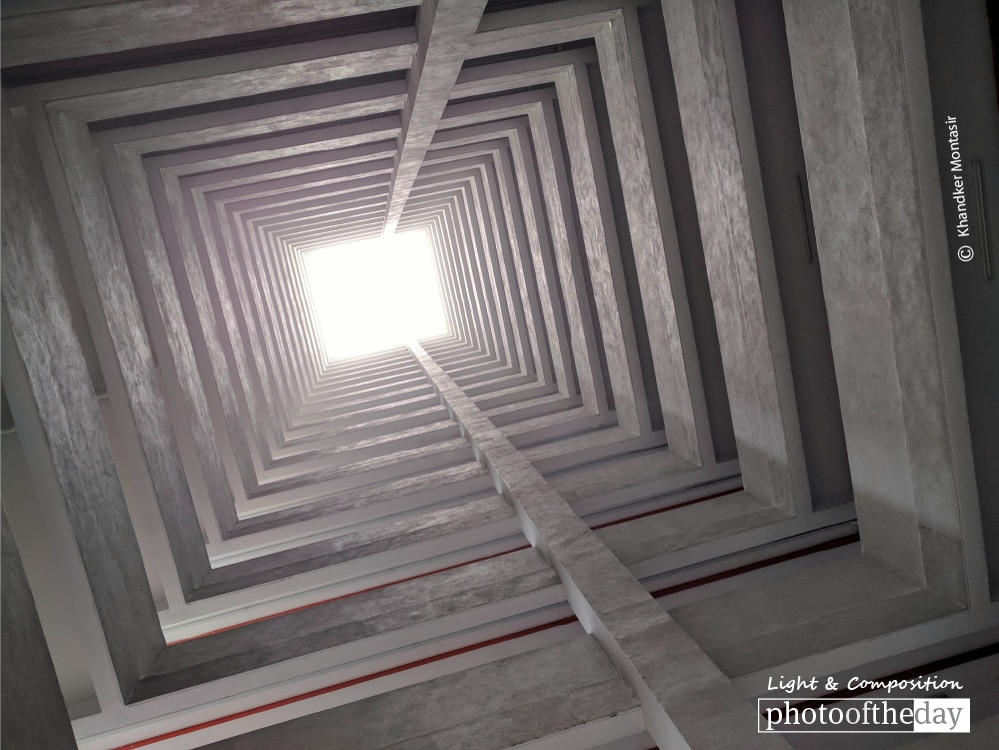
Captured from the vantage point of his own apartment, the photographer explores a unique perspective that mimics the diminutive scale of an ant looking up at its surroundings. By utilizing the lens of his Nexus 6P, he transforms an everyday architectural view into a contemplative study of height and human perspective. The image serves as a visual metaphor for the philosophy of aiming high, suggesting that even when targets are missed, the act of reaching remains inherently rewarding. This work is award-worthy for its ability to find profound, artistic meaning within the mundane structures of daily life.
Montasir Khandker
Born in the district town of Bogra, Bangladesh, Khandker Md. Montasir now resides in the bustling capital of Dhaka. He discovered photography during his university years, eventually transforming a simple hobby into a profound artistic passion. Montasir is celebrated for his unique compositional eye, which frequently captures subtle details that often escape the casual observer. His work functions as a narrative canvas, blending technical expertise with a distinct creative vision that continues to captivate an international audience.
Resonance Score Breakdown
Transparency Note: The resonance score (12.5/20) is calculated based on social engagement metrics collected before the award announcement.
Expert Photography Reviews · 8
The Spine of the Sky
The smell of rain on hot concrete always brings me back to the feeling of being very small. It is a sharp, metallic scent that clings to the back of the throat, tasting faintly of dust and ozone.
Read the reflection →The Weight of Upward
We build to hide from the horizon. Stone and steel rise, a vertical ambition that ignores the earth beneath our feet. There is a strange comfort in looking up; it pulls the neck taut, forces the eyes away from the dust and the small, broken things we leave behind.
Read the reflection →Reviews & Comments
Share your thoughts about this award-winning photograph. Your reviews contribute to the community engagement score.
Before the eye identifies the concrete geometry of Kajang, something in the chest tightens. It’s that vertiginous pull, the sudden, sharp activation of the inner ear. I’ve spent minutes staring at these rising lines, and they still make me feel small, almost breathless. Returning to it a year later, the scale hasn’t softened; it’s a reminder of how we inhabit space. It’s not just architecture, it’s the physical ache of looking up.
The vertical axis here is aggressive, forcing a convergence that pulls the eye toward a vanishing point at the zenith. It’s a study in forced perspective where the 4:1 ratio of concrete mass to sky creates a claustrophobic, yet exhilarating, geometric tension. I’m genuinely dizzy looking at how those sharp, linear edges slice the frame. It’s a perfect spatial equation; the architecture doesn’t just exist, it dictates the viewer’s trajectory through the negative space.
Concrete rises. It cuts the sky into sharp, geometric slivers. I’ve spent minutes tracing the lines where the building meets the void. It’s quiet here. The architecture doesn’t demand attention; it invites a breath. I feel small, yet steady. Nothing here is accidental. The empty corner is not empty. It’s a pause. A rare, still moment in Kajang. I’d stay longer, just to watch the light shift against the gray. It’s enough.
The camera tilts, straining against the verticality of the Kajang skyline. It’s a dizzying, upward gaze that forces the viewer to crane their neck. I’ve spent years watching frames that beg for motion, but this one holds its breath perfectly. The composition captures that specific, breathless moment before a fall. It’s a brave, claustrophobic perspective. Honestly, it makes me feel small in the best way possible. The cut would have been a mistake; it’s perfect.
Khandker’s frame doesn’t just reach; it bruises the sky. By forcing the lens upward from a Kajang apartment, he turns concrete into a jagged, suffocating geometry. I’ve always felt a strange, cold vertigo looking at these vertical voids. It’s not about the height, but the silence trapped between the buildings. The shadows here aren’t merely gaps; they’re the heavy, unyielding weight of our own insignificance. It’s a brutal, honest confrontation with the abyss above us.
The Nexus 6P’s small sensor struggles with the diffraction limit here, yet it’s precisely that constraint that renders the architecture’s verticality so stark. The focal plane compresses the Kajang skyline into a rigid, geometric ascent. I’m genuinely moved by how the lens’s inherent softness softens the harsh concrete edges, turning a mundane apartment block into a shimmering, abstract monolith. It’s a rare moment where optical limitation actually enhances the emotional weight of the reach.
You’ve turned a mundane view from your apartment into something that actually makes me feel small, in the best way. It’s that ant’s-eye perspective that gets me. I’ve spent years looking for the extraordinary in the everyday, and you found it right outside your window. Because you didn’t just snap a building; you captured the ambition of reaching upward. There’s something honest happening here. You waited for the right light, and I can feel it.
Looking up from a Kajang apartment, the frame turns concrete into a vertical ambition. It’s a clever angle, but does it ignore the human cost of these cramped, towering structures? I feel a sharp, claustrophobic ache looking at these balconies. Who actually lives in these shadows, and who gets to romanticize them as a metaphor for success? When we flatten a neighborhood into a geometric study, what are we choosing not to see?