The Girl by the Road by Ryszard Wierzbicki
Captured during a journey toward Luang Prabang, this poignant image highlights the stark reality of rural life in Laos. The photographer observed children laboring in the hay fields alongside their parents, while younger siblings wandered unprotected near the roadside. By utilizing a long focal length, the photographer isolated the subject against the blurred landscape, emphasizing the vulnerability of childhood amidst demanding manual labor. This candid portrait is award-worthy for its empathetic storytelling and its ability to transform a fleeting roadside encounter into a powerful social commentary on the daily struggles of families in the region.
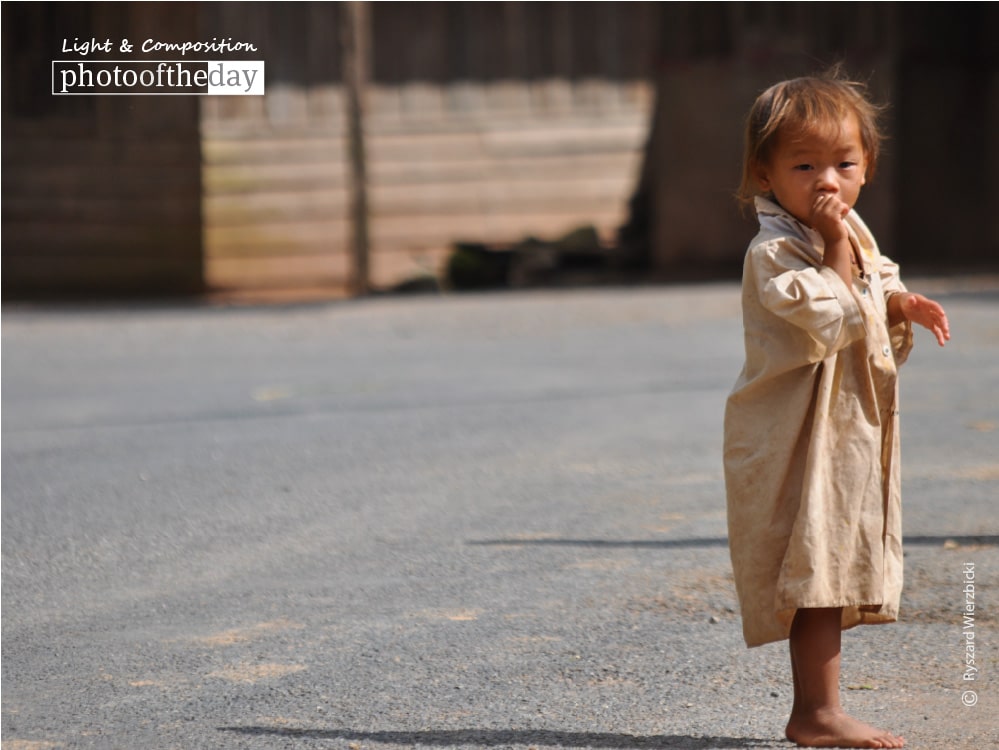
Exposure 1/1000sec @ f/8.0 | ISO 200 | Focal Length 201.6mm
the Road, by Ryszard Wierzbicki
Born in Poland in 1963, Ryszard Wierzbicki transitioned from a career in social sciences and education to become a dedicated traveler and photographer. After relocating to the United Kingdom in 2006, he shifted his focus toward exploring South-East Asia and documenting the lives of those he encountered. His work is deeply informed by his background in child care and his commitment to humanitarian causes, often blending his passion for photography with active volunteerism for orphanages in the region.
Resonance Score Breakdown
Transparency Note: The resonance score (12.3/20) is calculated based on social engagement metrics collected before the award announcement.
Expert Photography Reviews · 8
The Rootedness of Waiting
In the high alpine meadows, certain perennial plants remain dormant beneath the snow for months, their energy pulled deep into the taproot, waiting for the precise thermal trigger to signal the thaw.
Read the reflection →The Weight of Waiting
In the quiet corners of a map, time seems to behave differently. We often think of childhood as a frantic, upward trajectory—a series of milestones to be cleared, a race toward the horizon of adulthood.
Read the reflection →Reviews & Comments
Share your thoughts about this award-winning photograph. Your reviews contribute to the community engagement score.
The shutter snaps, and the world stops dead. That compression from the 200mm lens flattens the heat of the Laotian road, pinning the girl against a blur of dust and labor. It’s a tight, breathless frame. I’ve spent years watching editors hunt for this exact beat, where the narrative hangs in the stillness. It’s haunting. I felt a sharp ache in my chest seeing her isolation; it’s the cut that never came.
The compression of that 200mm lens flattens the landscape, turning the horizon into a mere datum line behind the child. It’s a spatial lie, yet it captures the crushing scale of the rural void. I’m struck by how the road acts as a harsh threshold, separating her from the field’s labor. It’s lonely, isn’t it? By omitting the context of the parents, the frame forces us to confront the architecture of her isolation alone.
Wierzbicki’s compression of the Laotian landscape echoes the flattened perspective of early telephoto experiments, yet it avoids the clinical detachment of those predecessors. By isolating the child with that 200mm reach, he forces an intimacy that feels almost intrusive. It’s a delicate balance; the bokeh recalls the soft focus of Pictorialism, but the subject’s gaze is startlingly modern. I’ve spent decades cataloging such roadside encounters, but this one actually made me catch my breath. It’s hauntingly precise.
The light here isn’t just illumination; it’s a heavy, humid weight pressing against the girl’s solitude. He stood back, letting the long lens compress the distance until the road became a blur of indifference. I feel a quiet ache in my chest looking at her. She’s waiting for something that hasn’t arrived. It’s a lonely, honest stillness. He didn’t rush her; he just listened to the silence of the fields until she finally appeared.
The road stretches. It’s a thin, dusty ribbon. She stands alone, small against the vast, blurred gold of the fields. I’ve spent minutes staring at the space behind her. It’s heavy. It’s quiet. The blur isn’t just a lens choice; it’s a separation. She’s tethered to nothing. Nothing here is accidental. The empty corner is not empty. It’s the weight of her solitude. I feel a sudden, sharp ache in my chest.
The compression of the 200mm lens flattens the depth, forcing the subject against a blurred, indistinct horizon. It’s a rigid, clinical isolation. The girl’s placement at the frame’s edge creates a precarious spatial tension that demands resolution. The background’s lack of detail serves the architecture, not the narrative. I’ve grown weary of sentimental roadside portraits, yet the geometric discipline here holds. The composition doesn’t just frame a child; it anchors her within a brutal, calculated void.
At 201.6mm, the compression of the background is exquisite. By stopping down to f/8, Wierzbicki avoided the diffraction limit while maintaining a razor-thin focal plane that isolates the subject’s gaze. The bokeh, a function of that long focal length, renders the Laotian heat into a soft, painterly haze. It’s technically precise, yet I’m genuinely moved by the way the lens resolves the dust on her skin. It’s a haunting, optical triumph of human vulnerability.
Most candid portraits of children in rural settings lean too heavily on sentimentality, but Wierzbicki avoids that trap. By compressing the distance with a 200mm lens, he forces the girl’s isolation against the blurred, indifferent landscape. It’s a brutal, honest framing of childhood labor. I’ll admit, the weight of her gaze made me look away for a second. In thirty years, this won’t just be a travel photo; it’ll be a haunting record of a vanishing reality.