Shopkeeper’s Monkey by Ryszard Wierzbicki
Captured during a 2016 expedition across Palawan Island, this portrait documents an unexpected encounter at a roadside shop in Alimanguan Village. While traveling to the Victoria Beach House, the photographer paused to observe a monkey kept by a local shopkeeper. The image highlights the raw, candid interaction between the animal and its environment, rendered with a long focal length that isolates the subject against the backdrop. This photograph is award-worthy for its ability to transform a spontaneous travel moment into a poignant wildlife study, showcasing the photographer's keen eye for detail and his commitment to documenting the authentic, often overlooked facets of his global travels.
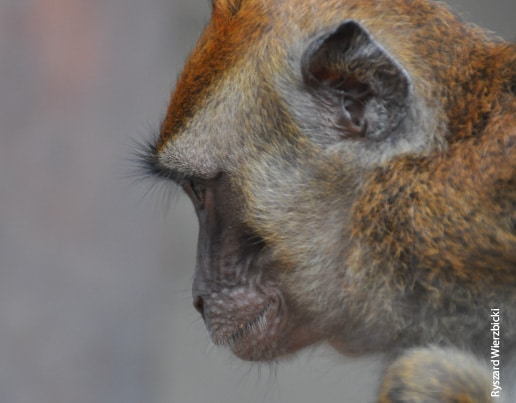
Exposure 1/200sec @ f/6.3 | ISO 800 | Focal Length 269.1mm
Ryszard Wierzbicki
Born in Poland in 1963, Ryszard Wierzbicki transitioned from a diverse career in social sciences and marketing to a life dedicated to global exploration and photography. After emigrating to the United Kingdom in 2006, he shifted his focus toward documenting his extensive travels through South-East Asia and his passion for scuba diving. A dedicated volunteer for charities supporting orphans in Thailand and Burma, Wierzbicki also fosters community through his travel and photography forums, consistently capturing the spirit of the world with a narrative-driven approach.
Resonance Score Breakdown
Transparency Note: The resonance score (12.3/20) is calculated based on social engagement metrics collected before the award announcement.
Expert Photography Reviews · 6
The Mirror of the Wild
If we were to look into the eyes of another species, would we find a reflection of our own soul, or merely the cold indifference of a world that does not know our names? We often categorize the living as if we are the only ones keeping a ledger of existence.
Read the reflection →The Weight of a Gaze
We often mistake stillness for absence, as if a creature caught in a moment of pause is merely waiting for the world to resume its frantic pace. But look closer at the eyes that have seen the dust of a thousand roads and the slow turning of the seasons.
Read the reflection →Reviews & Comments
Share your thoughts about this award-winning photograph. Your reviews contribute to the community engagement score.
It’s a portrait of captivity, not wildlife. Seeing a primate tethered to a roadside shop makes my stomach turn, yet the jury rewards the aesthetic of the encounter rather than questioning the animal’s misery. A long lens doesn’t excuse the exploitation here; it just isolates the subject from the chains that likely held it. I’ve spent weeks in the brush for a single frame, and I know this wasn’t earned. It was merely taken.
The shutter clicks, and the world stops. It’s a tight, telephoto compression that flattens the Palawan heat into a single, breathless moment. The monkey’s gaze is heavy, holding a narrative that doesn’t need a second act. I’ve spent hours in editing suites looking for this kind of stillness. It’s a frame the editor keeps because the cut would have been a mistake. Honestly, that look in its eyes makes me want to put the camera down.
The light here isn’t the dramatic gold of a sunset, but the flat, honest clarity of a humid Palawan afternoon. Ryszard didn’t rush. He stood by that roadside, waiting for the monkey to reveal its own quiet interiority. I feel a strange, heavy ache in my chest looking at those eyes; it’s the look of a creature caught between two worlds. He listened to the stillness of the village, and the shutter finally answered.
You caught that monkey’s gaze, and it’s heavy. There’s a weary intelligence in those eyes that makes me feel like I’m intruding on a private grief. You didn’t just snap a roadside animal; you found a soul tethered to a shopkeeper’s world. Because you held your ground with that long lens, the isolation feels earned. It’s a quiet, uncomfortable truth. I’ve seen enough travel photos, but this one actually stopped me. You waited. I can feel it.
Wierzbicki’s frame echoes the ethnographic detachment of early colonial travelogues, yet there’s a startling intimacy in the monkey’s gaze that disrupts that tired lineage. Using the D90’s compression at 269mm, he flattens the space, recalling the clinical isolation of Avedon’s portraits. It’s a curious, unsettling tension. I’ve spent decades cataloging such roadside encounters, but the creature’s weary, human-like resignation actually stopped me cold. It’s not just a travel snap; it’s a quiet, haunting interrogation of captivity.
A tethered primate isn’t a wildlife subject; it’s a captive. Why does Wierzbicki frame this as a spontaneous encounter rather than a transaction of exploitation? The long lens isolates the monkey, stripping away the shopkeeper’s presence to sanitize the reality of its confinement. It makes me wince. Does the aesthetic quality of the bokeh justify ignoring the chain around its neck? Whose travel narrative are we really consuming here, and at what cost to the subject?