Boys on the Swings by Ryszard Wierzbicki
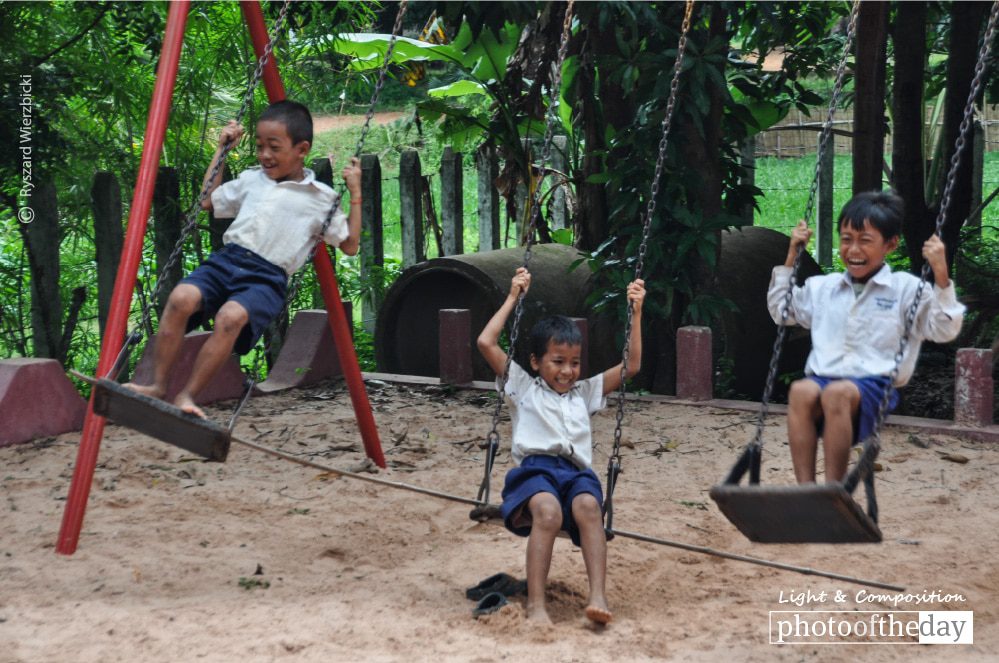
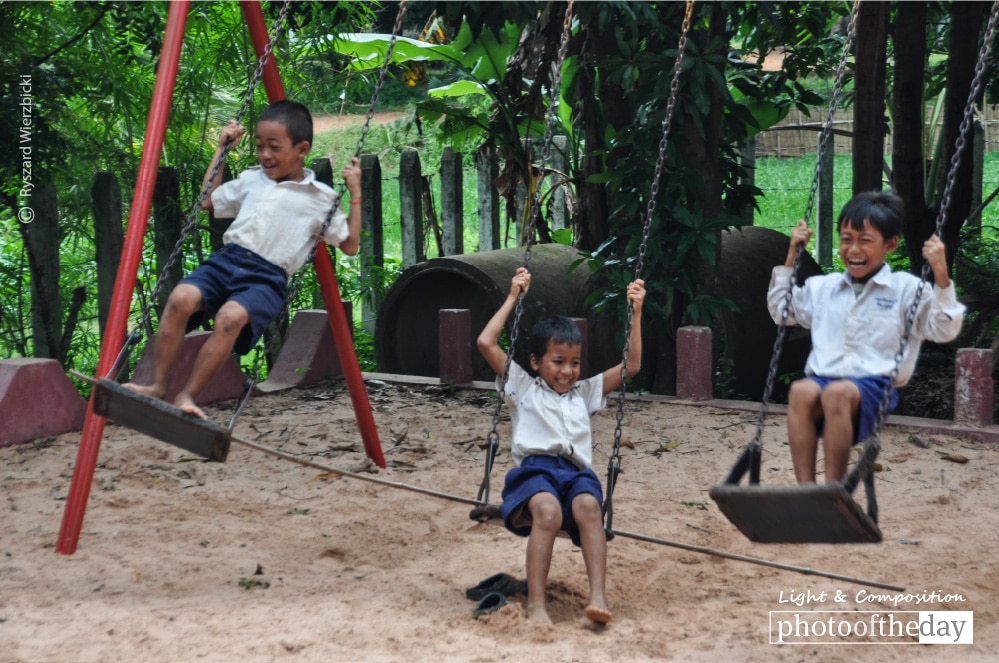
Captured at a local primary school in the Siem Reap area of Cambodia, this evocative photograph freezes a fleeting moment of childhood joy. The photographer utilized a long focal length to isolate the children playing on the swings, creating a compressed perspective that emphasizes their spirited movement against the schoolyard backdrop. By focusing on the candid interaction of the students, the image captures a universal sense of play that transcends cultural boundaries. Its award-worthy quality lies in the photographer's ability to document an authentic, unposed scene with technical precision, turning a simple schoolyard activity into a poignant narrative of life in South-East Asia.
Exposure 1/250sec @ f/6.3 | ISO 560 | Focal Length 269.1mm
Ryszard Wierzbicki
Born in Poland in 1963, Ryszard Wierzbicki transitioned from a career in social sciences and marketing to a life dedicated to exploration and photography. After emigrating to the United Kingdom in 2006, he began documenting his extensive travels across South-East Asia, often volunteering with charitable organizations for orphans. A passionate scuba instructor and founder of multiple travel forums, Wierzbicki now focuses his creative energy on capturing the human experience through his lens, blending his background in child education with a deep-seated commitment to visual storytelling.
Resonance Score Breakdown
Transparency Note: The resonance score (12.2/20) is calculated based on social engagement metrics collected before the award announcement.
Expert Photography Reviews · 8
The Arc of Momentum
When a seed pod of the touch-me-not plant reaches maturity, it develops a tension in its walls that waits for the slightest disturbance to trigger an explosive release, scattering its contents into the unknown.
Read the reflection →The Pendulum of Breath
Gravity is a heavy promise, yet we spend our earliest years trying to defy it. We climb, we leap, we hang suspended in the air, convinced that if we kick hard enough, we might just unhook ourselves from the earth.
Read the reflection →Reviews & Comments
Share your thoughts about this award-winning photograph. Your reviews contribute to the community engagement score.
It’s refreshing to see a frame where the subjects aren’t performing for a lens. Using a 270mm focal length from a distance shows restraint; it’s how you capture genuine joy without intruding on a child’s sanctuary. I’ve spent weeks in blinds waiting for a bird to forget I exist, and I recognize that same quiet invisibility here. It’s a rare, honest moment. I actually found myself smiling at their play. It wasn’t extracted; it was earned.
The swing arcs. Gravity pulls. The frame compresses the schoolyard into a flat, dusty stage. I’ve spent minutes watching these boys. They don’t know I’m here. The blur of motion against the stillness of the wall creates a tension I find difficult to leave. It’s quiet. Nothing here is accidental. The empty corner is not empty. It holds the weight of their laughter. I feel a sudden, sharp ache for the simplicity of that arc.
You waited for that arc, didn’t you? There’s a raw, kinetic energy in how you’ve compressed those boys against the schoolyard. It’s not just a travel shot; it’s the feeling of being ten years old and weightless. I’ve spent enough time in schoolyards to know that specific, frantic joy. You didn’t just document a swing; you caught the exact second they forgot the world existed. And that’s the only reason this matters. You felt it.
Before the eye identifies the swings, a sudden, sharp lightness catches in my chest. It’s the kinetic memory of gravity losing its grip. The compressed depth flattens the schoolyard into a blur, forcing my focus onto the boys’ suspended limbs. I feel that familiar, aching tug of childhood’s fleeting momentum. When I return to this, I don’t see Cambodia; I see the precise, terrifying speed of being young, before the world demands we land.
At 269mm, the compression is aggressive, forcing the focal plane into a razor-thin slice of reality. Shooting at f/6.3 on a D90, Wierzbicki’s pushed the sensor’s limits, yet the bokeh remains surprisingly creamy. I’m genuinely moved by how the diffraction across those swinging limbs softens the harsh Cambodian light. It’s a delicate optical balancing act. While the ISO 560 introduces a touch of luminance noise, it doesn’t detract from the sheer, kinetic joy captured here.
The compression here, born of that 269mm focal length, flattens the space in a way that recalls the graphic, layered street work of Henri Cartier-Bresson, yet it lacks his decisive geometry. It’s a pleasant enough study of motion, but I’ve seen this schoolyard trope a thousand times since the mid-century. Honestly, I’m still waiting for a contemporary eye to find a new rhythm in this subject. It’s technically competent, but it doesn’t push the conversation forward.
The light here isn’t the dramatic gold of a sunset, but the flat, honest clarity of a Cambodian afternoon. It’s a quiet, dusty stillness. Ryszard didn’t rush; he waited until the movement of the swings aligned with the schoolyard’s rhythm. I feel a sudden, sharp ache in my chest seeing their unburdened joy. He stood back, letting the long lens compress the space, listening to the children until the air itself seemed to hold its breath.
The ochre dust of Siem Reap rises like a fever, staining the air with the bruised, sun-baked terracotta of a Morandi still life. It’s a chromatic ache, that particular shade of parched earth, which makes my heart stutter against the vibrant, primary-hued shirts of the children. They’ve suspended themselves in a golden, dusty light that feels almost liquid, turning a simple schoolyard into a Vermeer-like study of suspended time, where the colour itself breathes.