Contact Beach by Hugo Baptista
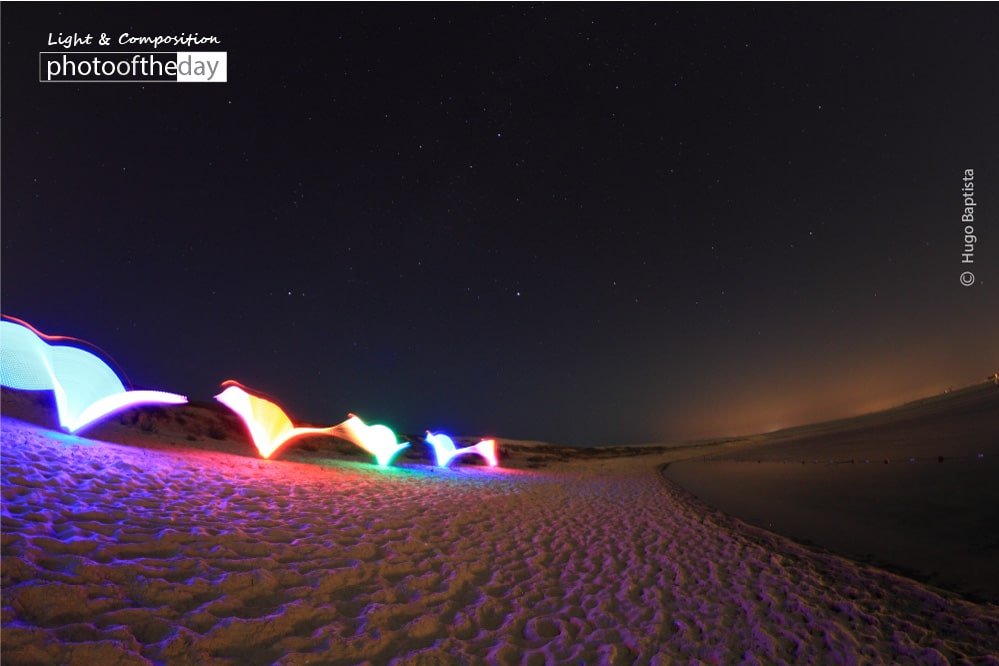
Captured at Lagoa de Santo André, Portugal, this evocative night photograph was born from a long-exposure time-lapse session. The photographer spent the early morning hours on the beach, allowing the camera to record the ethereal interplay of light and landscape from 1 AM until 6 AM. Inspired by the cinematic atmosphere of the film Contact, the image captures a surreal, otherworldly stillness. The photograph is award-worthy for its masterful use of long-exposure techniques to transform a quiet coastal scene into a haunting, dreamlike composition that bridges the gap between reality and science fiction.
Hugo Baptista
Born in South Africa to Angolan parents and holding Portuguese nationality, Hugo Baptista is a versatile visual artist currently based in Voorburg, the Netherlands. As a freelance 3D animator, VFX artist, and photographer, he approaches his work as a pragmatic autodidact who constantly experiments across various visual disciplines. His background in computer graphics informs his photography, allowing him to treat scenes like 3D canvases where he meticulously balances color, light, and symmetry to create complex yet simple compositions.
Resonance Score Breakdown
Transparency Note: The resonance score (12.0/20) is calculated based on social engagement metrics collected before the award announcement.
Expert Photography Reviews · 6
The Architecture of Silence
We often mistake the night for an absence, a hollow space where the world simply ceases to be. But the dark is not empty; it is a heavy, velvet curtain draped over the shoulders of the earth, holding the secrets that the sun is too loud to hear.
Read the reflection →The Long Watch of Night
There is a particular rhythm to the hours when the world is asleep. While the sun dictates the pace of our daily lives, the night operates on a different clock, one that moves with the slow, deliberate pulse of the tide.
Read the reflection →Reviews & Comments
Share your thoughts about this award-winning photograph. Your reviews contribute to the community engagement score.
The horizon line dissolves. It’s just the sand, the dark water, and the vast, unblinking sky. I’ve stood on beaches like this, waiting for the world to stop spinning. It’s terrifying. The exposure stretches time until the tide becomes a ghost. Nothing here is accidental. The empty corner is not empty. It’s a weight. I feel a sudden, sharp ache in my chest. Silence, captured in twenty-five seconds. It’s enough.
The indigo of the Lagoa de Santo André at night isn’t merely dark; it’s the bruised, velvet blue of a Vermeer shadow, swallowing the horizon until the sky bleeds into the sand. It’s a haunting, spectral luminescence that makes my pulse quicken with a strange, cold vertigo. One finds the palette doesn’t just describe the coast; it’s a shivering, chromatic alchemy that feels like watching the world dissolve into the infinite, silent reach of the stars.
The horizon line bisects the frame with surgical precision, creating a perfect 1:1 ratio between the dark, terrestrial mass and the celestial expanse. Baptista’s use of the 8mm lens introduces a subtle curvilinear distortion that anchors the composition, pulling the viewer toward the central vertical axis. It’s a beautifully solved spatial equation. I’m genuinely breathless at how the star trails resolve into geometric vectors, turning a static beach into a calculated, rhythmic expansion of light.
Most long-exposure night shots are just technical exercises in patience, but this one actually breathes. By compressing five hours into a single frame, Baptista forces the stars to surrender their static nature. It’s haunting. I’ve stared at this for weeks, and I still feel a genuine shiver looking at that horizon. What separates this from the usual coastal clutter is the restraint; he didn’t over-process the sky, letting the silence of the beach do the heavy lifting.
Using an 8mm fisheye at f/3.5, Baptista forces the sensor to resolve starlight across a massive field of view. The diffraction limit here is pushed to its edge, yet the resulting chromatic aberration near the frame’s periphery creates a haunting, ethereal glow. It’s a rare instance where optical distortion feels like a deliberate, cosmic choice. I’m genuinely moved by how the long exposure renders the tide as a static, velvet void. It’s hauntingly beautiful physics.
Lagoa de Santo André is a fragile sanctuary, not a film set. While the long exposure creates a haunting, cinematic stillness, I can’t help but worry about the wildlife disturbed during those five hours of darkness. Did the photographer remain stationary, or did they wander the dunes? It’s a beautiful composition, but I’m left uneasy. I’ve spent too many nights in the field to ignore the cost of such access. Was the silence truly respected?