Greeting Visitor by Ryszard Wierzbicki
Captured during a motorbike journey through the rural villages of Siem Reap, Cambodia, this image documents a poignant encounter with local children. The photographer navigated the complex dynamics of travel photography, balancing the need for patience, humor, and rapport to gain the trust of his subjects. By engaging with the children near their school, he transformed a fleeting moment into a genuine connection. The photograph is award-worthy for its ability to capture the raw, inquisitive spirit of childhood in a remote setting, showcasing the photographer’s dedication to authentic storytelling and his commitment to building bridges through the lens.
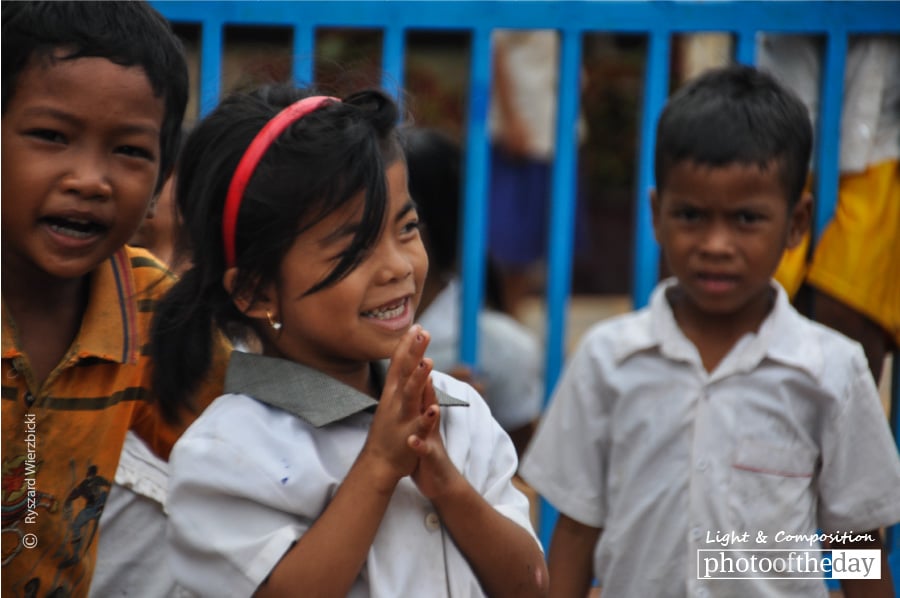
Exposure 1/500sec @ f/6.3 | ISO 400 | Focal Length 220mm
Ryszard Wierzbicki
Born in Poland in 1963, Ryszard Wierzbicki transitioned from a career in social sciences and marketing to become a dedicated traveler and photographer. After relocating to the United Kingdom in 2006, he shifted his focus toward exploring South-East Asia and documenting the human experience. His work is deeply influenced by his background in child care and his passion for volunteering with orphanages. As the founder of the travel forums Instant Travelling and World Around, he actively fosters a community for explorers who share his commitment to adventure, scuba diving, and visual storytelling.
Resonance Score Breakdown
Transparency Note: The resonance score (11.7/20) is calculated based on social engagement metrics collected before the award announcement.
Expert Photography Reviews · 6
The Language of the Unspoken
How do we measure the distance between two strangers when language fails to bridge the gap? We often assume that understanding requires a shared vocabulary, a common history, or a set of agreed-upon truths.
Read the reflection →The Mycelium of Connection
Mycelium networks operate in a silent, subterranean language, connecting the roots of disparate trees to share nutrients and warnings across the forest floor.
Read the reflection →Reviews & Comments
Share your thoughts about this award-winning photograph. Your reviews contribute to the community engagement score.
You didn’t just snap a picture of these kids; you earned their curiosity. I’ve spent enough time on the road to know that look—it’s not a pose, it’s a genuine question directed at you. Because you waited, the distance between the lens and their world vanished. I felt a real ache in my chest seeing that small hand reaching out. You weren’t a tourist here. You were a guest. There’s something honest happening here.
Dust settles on the road. The children wait. It’s a quiet tension, a pause before the movement begins. I’ve spent years looking for this stillness in the chaos of travel. The frame breathes. It doesn’t crowd the subjects. It lets the space around them hold the weight of their curiosity. Nothing here is accidental. The empty corner is not empty. It’s a breath. I feel a sudden, sharp ache for that simplicity. It’s enough.
Why does the lens prioritize the children’s curiosity over their agency? Wierzbicki captures a fleeting smile, yet I’m left unsettled by the power imbalance inherent in this motorbike encounter. Are these children truly participants, or are they merely props in a traveler’s narrative of discovery? It’s a polished frame, but it feels extractive. I find myself wincing at the romanticization of rural poverty. Does the photographer’s rapport actually bridge a gap, or does it just widen the distance?
Of the thousands of travel shots I’ve reviewed, most are merely snapshots of poverty. Wierzbicki avoids that trap because he captures the children’s genuine, unposed curiosity rather than their circumstance. The 220mm compression flattens the background, forcing us to confront their eyes directly. It’s rare to see such unfiltered joy; honestly, it makes me miss the simplicity of my own childhood. This will endure because it’s a portrait of human connection, not just a place.
It’s a familiar trope—the Western traveler finding innocence in the rural periphery. Wierzbicki’s framing echoes the candid humanism of Henri Cartier-Bresson, yet the 220mm compression flattens the space, stripping away the environmental context that made earlier ethnographic work so vital. I’ve seen this gaze a thousand times since the colonial era. Still, the genuine, unscripted curiosity in those eyes caught me off guard; it’s a fleeting, honest spark that almost redeems the tired travelogue aesthetic.
Light here doesn’t merely illuminate; it interrogates the faces of these children, carving them from the Cambodian dust. I’m unsettled by how the shadows cling to their expressions, refusing to let the innocence breathe. It’s a heavy, silent confrontation. When I look at the way the darkness swallows the background, I feel a sudden, sharp ache for the things we leave behind. Wierzbicki hasn’t just captured a greeting; he’s forced us to confront the void.