Blizzard by Nilla Palmer
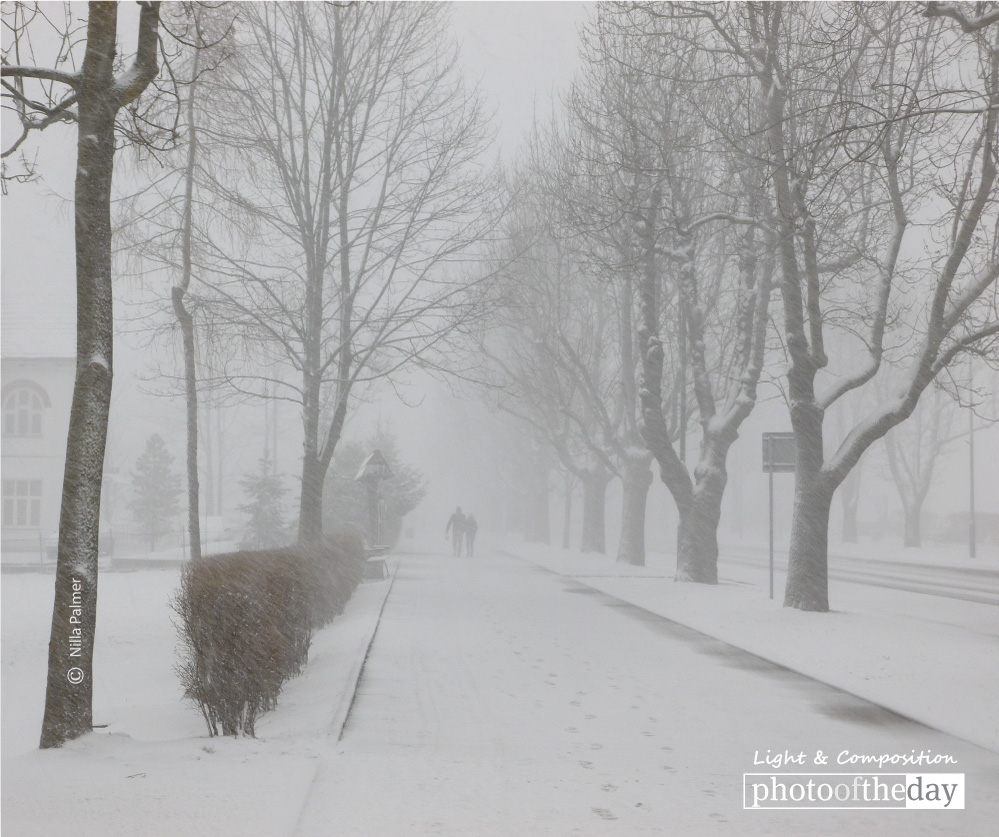
Captured during a sudden, fierce blizzard in the Polish mountain town of Zakopane, this image transforms a mundane errand into a striking visual narrative. While navigating the winter elements with groceries in hand, the photographer was struck by the stark, ethereal beauty of the snow-covered path unfolding before her. Utilizing her Panasonic camera, she managed to frame the raw, biting atmosphere of the storm. The photograph is award-worthy for its ability to find profound stillness and artistic composition within a challenging, chaotic environment, turning a simple walk home into a hauntingly beautiful testament to the power of nature.
Nilla Palmer
Based in Brisbane, Australia, Nilla Palmer balances a professional career as a Technical Writer with a vibrant life as a freelance travel photographer. Her deep-seated passion for the medium began in childhood with a 110mm film camera and was further refined through professional portraiture work using vintage Hasselblad equipment. A dedicated globetrotter, Palmer draws inspiration from her extensive travels, aiming to capture candid, evocative moments that resonate with viewers and encourage them to explore the world beyond their own doorsteps.
Resonance Score Breakdown
Transparency Note: The resonance score (13.2/20) is calculated based on social engagement metrics collected before the award announcement.
Expert Photography Reviews · 5
The Quiet After the Rush
I walked to the mailbox this morning in a thin sweater, completely forgetting that the wind had turned sharp overnight. My fingers went numb before I even reached the end of the driveway.
Read the reflection →The Silence of White
If the world were to be erased by a single, soft stroke, would we find peace or terror in the blankness? We spend our lives building monuments of noise, marking our territory with words, habits, and heavy footprints.
Read the reflection →Reviews & Comments
Share your thoughts about this award-winning photograph. Your reviews contribute to the community engagement score.
Groceries in hand, one assumes the blizzard wasn’t a planned expedition. It’s a snapshot born of necessity rather than the long, shivering vigil I usually demand. Still, there’s a biting honesty in that Zakopane whiteout that makes me miss the sting of frozen fingers. It’s rare to find such stillness in a hurried errand. She didn’t wait for the light, but she certainly endured the weather. I’ve been that cold; it’s a respectable way to work.
Zakopane’s vernacular timber structures usually define the threshold between shelter and the void, yet here, the blizzard erases the datum entirely. It’s a disorienting collapse of space where fenestration and mass dissolve into white noise. I’ve spent years critiquing how we flatten architecture, but this frame captures the visceral, biting weight of the atmosphere itself. It’s haunting; I can almost feel the cold seeping through the walls. It’s not a building, but the feeling of being lost.
Before the eye identifies the Zakopane snow, something in the chest tightens. It’s the physiological memory of biting cold, that sharp intake of air that freezes the throat. I feel a sudden, phantom shiver looking at the blurred path. It’s not just a storm; it’s the quiet isolation of being caught in the white. When I return to this, I don’t see groceries. I see the heavy, beautiful weight of being utterly, perfectly alone.
At f/3.8, the Lumix lens struggles with the diffraction limit, yet that softness actually serves the blizzard’s chaotic geometry. The focal plane is shallow, barely catching the crystalline structure of the foreground flakes before they dissolve into the atmospheric haze. It’s a fragile, fleeting capture of light scattering through ice. I’m genuinely moved by how the sensor’s limitations here mimic the human eye’s inability to focus during a storm. It’s hauntingly, physically honest.
Zakopane’s biting whiteout echoes the stark, high-contrast isolation found in early Pictorialist snow studies, yet it’s stripped of their romantic artifice. Palmer’s framing captures a frantic, granular texture that recalls the raw immediacy of a handheld Leica snapshot from the thirties. It’s rare to see such chaotic weather rendered with this level of quiet, geometric restraint. Honestly, I’m genuinely moved by how she’s turned a mundane grocery run into a haunting, monochromatic meditation on human insignificance.