Light in Darkness by Blair Horgan
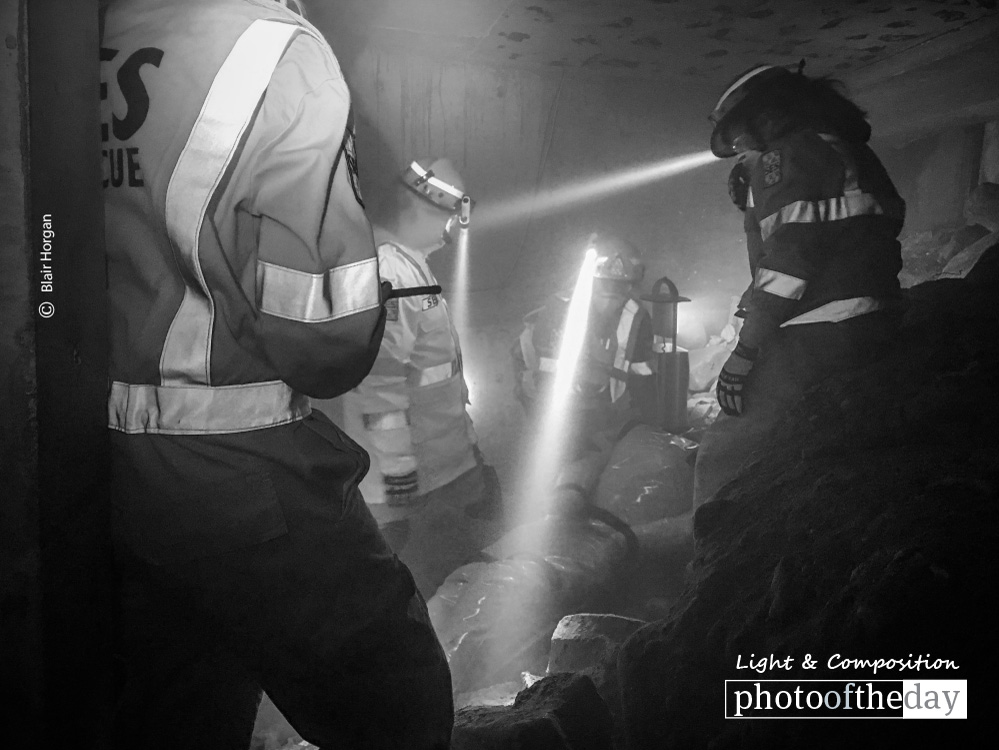
Captured during a high-stakes SES emergency services training exercise, this photograph documents a simulated building collapse. The photographer focused on the volunteers as they meticulously assessed the site and cleared debris in search of victims. By choosing a black-and-white palette, the image emphasizes the raw intensity and dramatic shadows of the scene, stripping away distractions to highlight the human effort involved. This work is award-worthy for its authentic, documentary-style approach, effectively conveying the urgency and dedication of the emergency responders in a compelling, high-contrast narrative.
Blair Horgan
Beginning his journey in Melbourne, Australia, Blair Horgan developed his foundational skills under the mentorship of Rennie Ellis in 1991. Though photography remained a background pursuit for many years, he has since transitioned to full-time practice, balancing his craft with family life. Horgan is defined by his preference for candid, unposed storytelling, often drawing inspiration from his daughters and the spontaneous moments of everyday life.
Resonance Score Breakdown
Transparency Note: The resonance score (13.5/20) is calculated based on social engagement metrics collected before the award announcement.
Expert Photography Reviews · 5
The Architecture of Rescue
We often speak of light as a thing that reveals, as if the world were a room waiting for a lamp to be struck. But there is a different kind of light, one that does not merely show us what is there, but asks us who we are when the familiar structures of our lives begin to buckle.
Read the reflection →The Weight of Dust
The taste of grit is the first thing to arrive—a dry, metallic coating on the back of the throat that speaks of pulverized stone and ancient, broken mortar. It is a flavor that settles deep in the lungs, a reminder that everything solid eventually returns to powder.
Read the reflection →Reviews & Comments
Share your thoughts about this award-winning photograph. Your reviews contribute to the community engagement score.
The frame holds a frantic, jagged rhythm. It’s a sequence frozen mid-breath, where the debris feels like it’s still settling. I’ve watched enough disaster footage to know the tension here is real; the high-contrast shadows carve out the volunteers’ focus with surgical precision. The cut would’ve been a mistake. It’s the frame the editor keeps because it captures the exact second the chaos stops and the work begins. Honestly, it makes my own pulse race.
The frame resolves into a series of aggressive, intersecting triangles. The debris creates a jagged diagonal vector that forces the eye toward the lower-left quadrant, where the rescuers’ forms anchor the composition. It’s a tight, high-contrast equation of light against shadow. I’m genuinely struck by how the verticality of the rubble balances the horizontal tension of the search. It’s a perfectly solved spatial problem, turning chaotic collapse into a rigid, satisfying geometric order.
f/2.8 at 1/125s, ISO 1600, 35mm. A tight aperture choice for a chaotic scene. It’s a gamble that pays off by isolating the responders from the debris. I’ve seen enough training exercises to know the light here is unforgiving, yet the contrast holds. It’s technically sound, though the noise at ISO 1600 is a distraction I can’t ignore. It’s a cold, calculated capture. Honestly, the grit actually makes me respect the effort.
Before the eye identifies the rubble, something in the chest tightens. It’s the weight of the shadow, that heavy, charcoal silence Horgan pulls from the Tasmanian dark. I feel my own breath hitch, mimicking the responders’ focus. It’s not just a training exercise; it’s the visceral ache of searching for what’s lost. When I return to this a year later, the urgency remains, a phantom pulse that follows me into the quiet of my own home.
The focal plane here is razor-thin, slicing through the dust-choked air of Burnie with surgical precision. I’m genuinely moved by how the lens resolves the grit against the high-contrast shadows; it’s a masterclass in managing diffraction limits amidst chaos. The bokeh as a function of the wide aperture renders the background debris into a soft, monochromatic blur, forcing the eye to fixate on the responders. It’s rare to see such technical clarity in the midst of simulated disaster.