Peace … by Tanmoy Saha
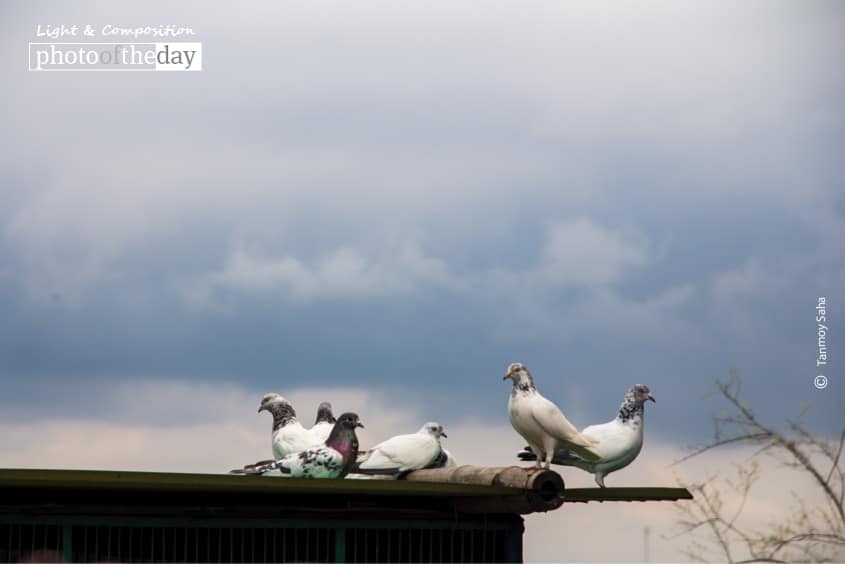
Captured from a rooftop in Narayangonj, this evocative image explores the dual symbolism of pigeons as icons of both peace and freedom. The photographer observed a local enthusiast’s flock, struck by the profound irony that these birds, though possessing the liberty to fly anywhere, choose to remain in their home. By focusing on the birds in their natural, domestic environment, the image captures a quiet, contemplative moment that highlights the photographer's ability to find beauty in everyday life. The composition is award-worthy for its thematic depth, transforming a simple scene of urban wildlife into a poignant meditation on the nature of contentment and belonging.
Tanmoy Saha
Based in Dhaka, Bangladesh, Tanmoy Saha Turja has been refining his photographic craft since 2007. His diverse portfolio spans portraits, landscapes, and wildlife, reflecting a keen eye for the subtle narratives within his environment. Having honed his technical foundation through studies at the Dhaka University Photography Society and Pathshala, he consistently seeks to capture the intersection of nature and human experience. His work is characterized by a thoughtful approach to storytelling, aiming to reveal the quiet, meaningful moments that define his surroundings.
Resonance Score Breakdown
Transparency Note: The resonance score (12.1/20) is calculated based on social engagement metrics collected before the award announcement.
Expert Photography Reviews · 6
The Weight of Returning
I once spent an afternoon in a small village in Puglia watching an old man release his pigeons. They circled the terracotta rooftops in a frantic, grey cloud, disappearing into the glare of the Mediterranean sun. I asked him if he worried they wouldn't come back.
Read the reflection →The Weight of Staying
There is a specific silence that follows the closing of a cage door, even when the door is never locked.
Read the reflection →Reviews & Comments
Share your thoughts about this award-winning photograph. Your reviews contribute to the community engagement score.
Most entries in this category rely on the frantic motion of wings to grab attention. Saha does the opposite. By framing these pigeons in their domestic stillness, he captures a rare, heavy silence that feels almost tactile. I’ve stared at this for hours, and it’s the birds’ refusal to leave that haunts me. It’s a quiet study of loyalty over liberty. In thirty years, we’ll still be asking why they stayed. That’s why it wins.
At f/5.6, the 85mm focal plane resolves the pigeons’ iridescent neck feathers with startling clarity. It’s a delicate balance; the diffraction limit hasn’t yet softened the texture of those wings. I’m genuinely moved by how the lens captures the subtle chromatic aberration along the birds’ silhouettes against the urban haze. It’s not just a flock; it’s a precise optical study of light scattering across plumage. I’ve rarely seen such domestic stillness rendered with this much technical rigor.
The frame divides into a rigorous grid, anchored by the vertical tension of the rooftop edge against the soft, chaotic clusters of pigeons. It’s a study in mass distribution; the birds create a dense, organic weight that perfectly offsets the negative space of the sky. I’m genuinely moved by how the 85mm compression flattens the depth, turning the flock into a geometric pattern. It’s a beautifully solved spatial equation, where domesticity is defined by precise, calculated equilibrium.
You waited on that rooftop until the chaos of Narayangonj faded into the background. There’s something honest happening here. It’s not just about birds; it’s about the quiet gravity of home. I’ve spent enough time in crowded places to know that feeling of wanting to fly but choosing to stay. You caught that tension perfectly. And honestly, looking at these pigeons, I felt a sudden, sharp ache for my own quiet corner. You really saw them.
There’s a heavy, humid stillness in these Narayangonj rooftops. Tanmoy waited for the light to soften, catching the pigeons in that suspended moment between flight and rest. I’ve spent enough hours on similar ledges to know he felt the same quiet ache I do—the irony of wings that choose to stay. It’s a humble, honest meditation on belonging. He didn’t chase the birds; he simply listened to the air until they finally settled.
The frame’s geometry relies on the rhythmic distribution of avian mass against the muted urban backdrop. It’s a disciplined arrangement, though the negative space occasionally threatens to collapse under the weight of the birds’ clustering. The vertical lines of the rooftop provide a necessary fulcrum, anchoring the chaos. I’ve rarely seen such structural restraint in wildlife work. It doesn’t rely on sentiment; it holds because the architecture of the flock is perfectly, coldly resolved.