Mumbai Beggar Girl by Kristian Bertel
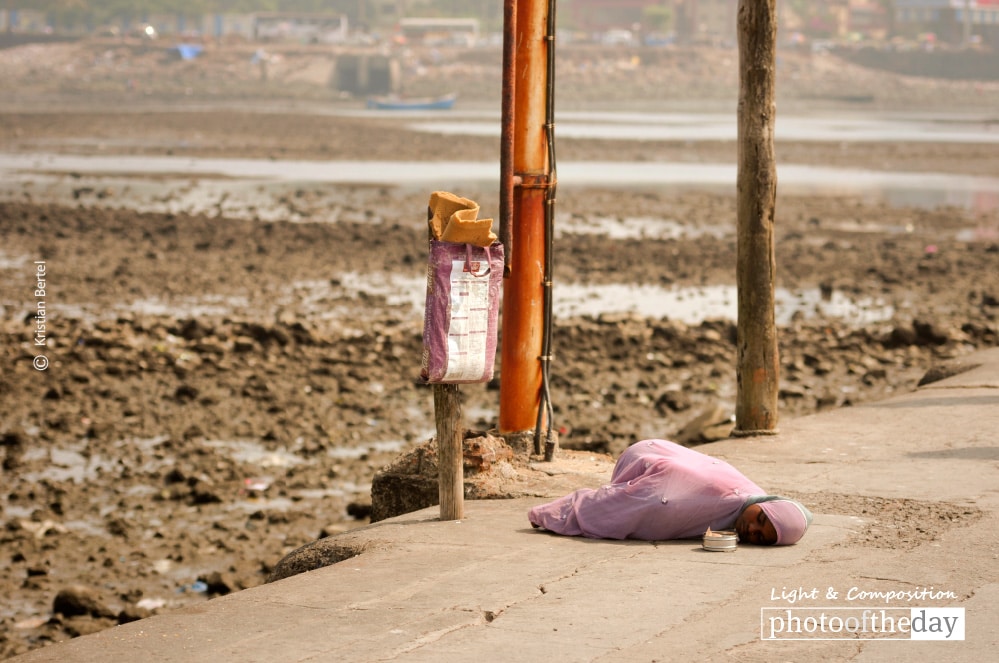
Captured amidst the bustling streets of Mumbai, this poignant portrait highlights the persistent social reality of beggary in India. The photographer approaches the subject with a documentary lens, framing the girl within the complex historical and cultural context of alms-giving that remains deeply embedded in the nation's social fabric. By focusing on the human element of this widespread issue, the image transcends a simple street snapshot, offering a compelling narrative on poverty and the lives of street children. Its award-worthy quality lies in the photographer's ability to evoke empathy while documenting a challenging, age-old social condition with grace and clarity.
Kristian Bertel
Based in Aarhus, Denmark, Kristian Bertel has been refining his photographic craft since 2006. He is internationally recognized for his extensive, long-term documentary projects focused on India, where he captures the nuanced human conditions of urban and rural life. His work is defined by a deep commitment to travel photography, specifically highlighting the stories of street children and the socio-economic realities of the Indian subcontinent.
Resonance Score Breakdown
Transparency Note: The resonance score (11.3/20) is calculated based on social engagement metrics collected before the award announcement.
Expert Photography Reviews · 5
The Weight of a Glance
We walk past the edges of things. We look, but we do not see. There is a distance we maintain, a thin membrane of indifference that keeps the world at bay.
Read the reflection →The Weight of a Glance
I was waiting for the bus this morning when a young girl at the corner caught my eye. She wasn't asking for anything, just standing there, watching the crowd move past her like a river. For a second, our eyes locked.
Read the reflection →Reviews & Comments
Share your thoughts about this award-winning photograph. Your reviews contribute to the community engagement score.
Mumbai’s urban fabric is defined by its thresholds, yet here, the architecture recedes into a blurred, chaotic datum. The girl occupies the void between crumbling masonry and the street’s relentless movement. I’m struck by how the harsh, directional light catches the texture of her skin, contrasting against the deep, recessed shadows of the alley. It’s a brutal reminder that for some, the city isn’t a structure to inhabit, but a wall to lean against.
The light here isn’t the golden hour I usually seek; it’s the harsh, unforgiving glare of a Mumbai afternoon. It flattens the world, yet it forces us to look at her eyes. I’ve stood in such heat, waiting for the shadows to soften, but here, the light demands we don’t look away. It’s a heavy, honest presence. My heart aches seeing her stillness amidst that chaotic, sun-drenched street. She’s waiting for something, too.
The jury’s obsession with clarity here feels stifling. By pinning this girl to the frame with such clinical sharpness, the photographer denies her the kinetic, chaotic blur of Mumbai’s streets. I’d have preferred a long exposure, letting the city’s frantic energy bleed into her stillness. It’s a missed opportunity for abstraction. Why resolve every detail when the reality is so fractured? It’s technically competent, sure, but it feels trapped in a conventional, rather boring documentary cage.
The subject’s placement creates a precarious spatial tension. The frame’s rightward lean forces the eye toward the girl’s gaze, yet the background clutter threatens to dissolve the figure entirely. It’s a fragile balance. I’ve grown tired of the sentimentality surrounding this subject, but the geometry here holds. The vertical alignment of the wall provides a necessary fulcrum. It doesn’t collapse under the weight of its own narrative. It’s a rare, disciplined moment of visual clarity.
Most street portraits of poverty lean on sentimentality, but this one avoids that trap. The girl’s direct, unblinking gaze into the lens forces a confrontation that’s impossible to ignore. It’s the way her hand rests against the weathered wall—a small, human anchor in a chaotic urban frame—that makes me ache for her future. In thirty years, this won’t just be a record of Mumbai; it’ll be a haunting reminder of the humanity we so often walk past.