Water Run by Ryszard Wierzbicki
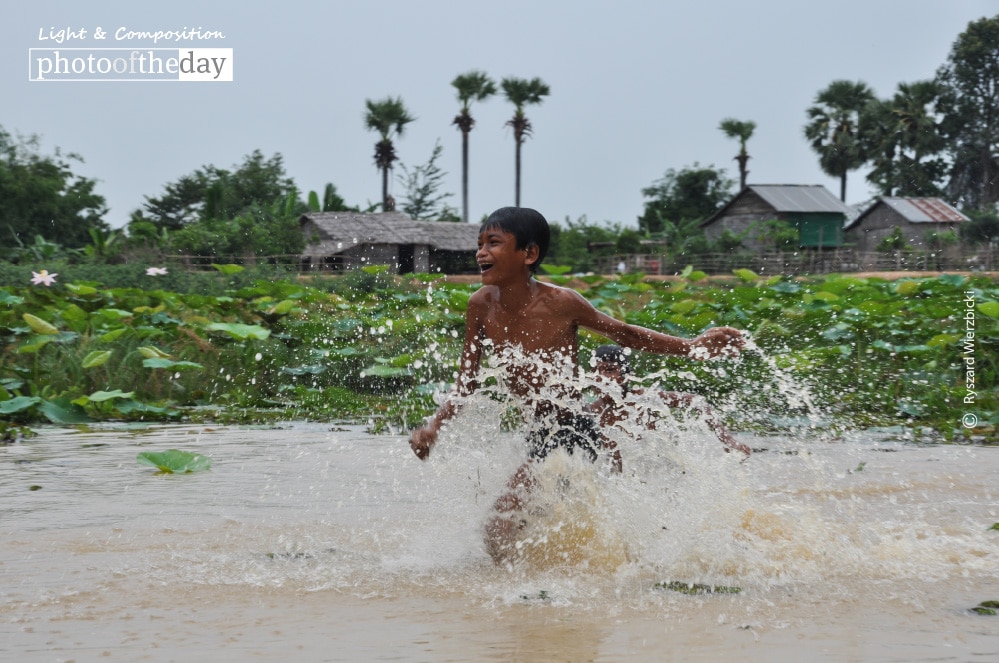
In the arid landscapes of Cambodia, where water reservoirs are scarce, the simple presence of water becomes a source of boundless joy. Ryszard Wierzbicki captured this fleeting moment of pure childhood exuberance as a young boy leaps and dives, fully immersed in his play. The image serves as a poignant reminder of the universal nature of happiness, found even in the most modest surroundings. By freezing the dynamic motion of the boy against the backdrop of his environment, the photographer highlights the raw, uninhibited energy of youth, earning recognition for its evocative storytelling and masterful composition.
Ryszard Wierzbicki
Born in 1963, Ryszard Wierzbicki is a Polish-born photographer and educator who relocated to the United Kingdom in 2006. With a diverse professional background spanning social sciences, marketing, and scuba instruction, he brings a unique, empathetic perspective to his travel photography. His work is deeply influenced by his volunteer efforts with orphanages in South-East Asia and his passion for exploration, which he shares through his dedicated travel and photography platforms, Instant Travelling and World Around.
Resonance Score Breakdown
Transparency Note: The resonance score (11.7/20) is calculated based on social engagement metrics collected before the award announcement.
Expert Photography Reviews · 4
The Weight of Gravity
Can we ever truly leave the earth, or are we merely negotiating our surrender to it? We spend our lives tethered by invisible strings, walking with a measured caution that suggests we are afraid of what might happen if we let go.
Read the reflection →The Weight of Gravity
In the physics of childhood, gravity is not a law to be obeyed, but a suggestion to be ignored. We spend our early years testing the limits of our own buoyancy, convinced that if we run fast enough or jump high enough, we might just leave the earth behind.
Read the reflection →Reviews & Comments
Share your thoughts about this award-winning photograph. Your reviews contribute to the community engagement score.
The shutter speed has effectively neutralized the boy’s kinetic energy, yet it’s the refraction through the suspended droplets that captivates me. By pushing the focal plane to capture those micro-spheres of water, Wierzbicki reveals a refractive index the naked eye simply misses. It’s breathtaking. The chromatic aberration at the edges of the spray is minimal, suggesting a high-quality glass element. I’m genuinely moved by how the lens resolves that fleeting, liquid chaos into such crystalline, scientific precision.
The light here isn’t just illumination; it’s a witness to the boy’s fleeting suspension in the air. I’ve spent enough hours waiting for the sun to soften to recognize that stillness. He didn’t capture a jump; he listened to the water’s rhythm until the boy became part of the landscape itself. It’s a quiet, aching joy. Looking at it, I feel a sudden, sharp longing for the simplicity of that Cambodian heat. It’s truly beautiful.
The frame’s geometry hinges on the boy’s arc, a violent disruption of the horizontal water line. It’s a precarious balance. The negative space above the splash provides the necessary relief, preventing the composition from collapsing into chaos. I’ve grown weary of sentimental snapshots, yet the structural discipline here holds. The tension between the vertical descent and the static background creates a rigid, satisfying fulcrum. It doesn’t just capture motion; it anchors it within a precise, unforgiving architecture.
Freezing a boy mid-air in Siem Reap feels safe, almost academic. I’m bored by the obsession with clarity here; it’s a conservative choice that ignores the visceral, chaotic texture of water. Why resolve the boy so sharply when the motion itself is the story? I’d rather see the blur of his limbs, a smear of kinetic energy closer to Muybridge’s studies than this static, polite capture. It’s technically sound, but it lacks soul.