Trekkin by Stephen Chu
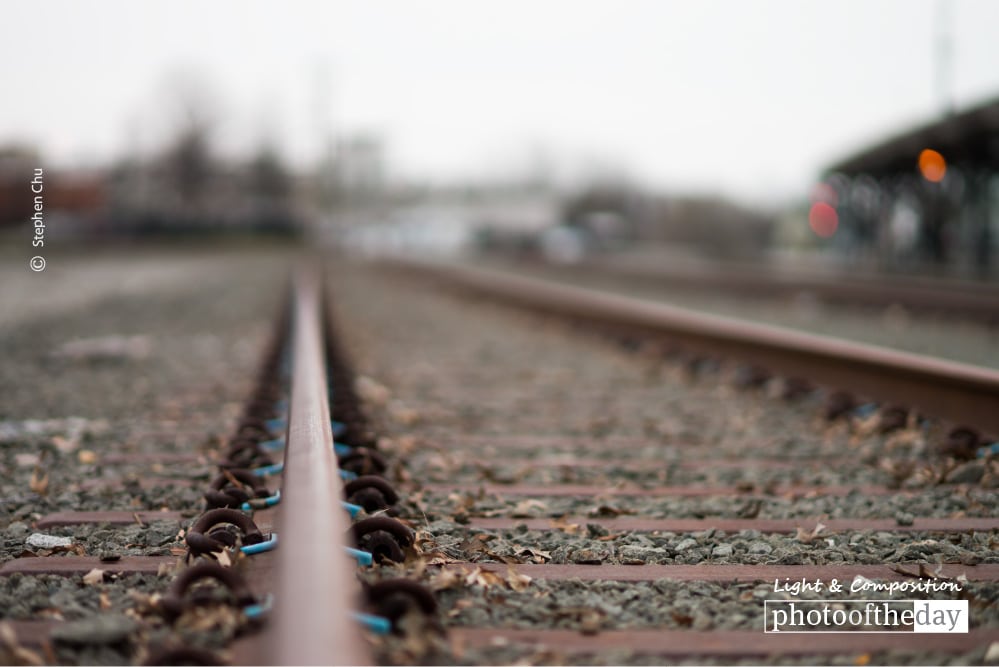
Captured along the train tracks in downtown Raleigh, this photograph highlights the fleeting beauty of an industrial landscape destined for redevelopment. The photographer was drawn to the striking contrast of bright blue steel components embedded within the weathered rails, finding a compelling visual narrative in the intersection of decay and revitalization. By utilizing a wide aperture of f/1.4, the photographer isolated these vibrant metallic details, rendering the surrounding environment in a soft, atmospheric blur. This deliberate technical choice emphasizes the subject's texture and color, transforming a mundane piece of infrastructure into an award-worthy study of urban geometry and serendipitous discovery.
Stephen Chu
A Toronto native who spent many years living in the United States before returning to Canada in 2016, Stephen Chu is a dedicated observer of the human experience. As a seasoned photography club organizer and lifelong student of the world, he approaches his craft with a deep curiosity for the quirks and emotions that define society. His work is characterized by a commitment to raw, authentic storytelling, capturing fleeting moments that reflect the beauty and complexity of life. Through his lens, Chu strives to document the world with compassion, continually honing his skills to imbue his images with profound humanity.
Resonance Score Breakdown
Transparency Note: The resonance score (11.2/20) is calculated based on social engagement metrics collected before the award announcement.
Expert Photography Reviews · 5
The Weight of Iron
In the nineteenth century, the expansion of the rail network was often spoken of as a conquest of geography. We laid down iron veins across the soft, yielding earth, convinced that we were mastering the landscape, pinning it down so it could no longer shift beneath our feet.
Read the reflection →The Path We Leave Behind
I was walking home from the grocery store this afternoon when I took a wrong turn down an old alleyway. It was quiet, filled with rusted metal scraps and overgrown weeds pushing through the cracks in the pavement.
Read the reflection →Reviews & Comments
Share your thoughts about this award-winning photograph. Your reviews contribute to the community engagement score.
A wide aperture at the tracks is a bold gamble, though it feels a bit like a shortcut. One wonders if the photographer stood there until the light turned, or if they simply snapped the first blue bolt that caught their eye. I’ve spent enough freezing mornings waiting for the right shadow to know that depth of field shouldn’t hide a lack of commitment. It’s pretty, certainly, but I’m left wanting more grit and less blur.
Most industrial studies I’ve seen this year rely on heavy-handed grit, but Chu’s choice to isolate those blue steel shards at f/1.4 is a masterstroke of restraint. By blurring the decay into a soft, painterly haze, he forces us to confront the geometry rather than the rust. It’s a quiet, elegant document of transition. Looking at it, I actually feel a sense of relief; it’s a rare, honest pause in a city rushing toward erasure.
The steel glows with a quiet, stubborn blue against the rusted decay. Stephen didn’t just capture a scene; he waited for the tracks to exhale. At f/1.4, the world dissolves into a soft, melancholic hum, leaving only that sharp, vibrant geometry. It’s a lonely, beautiful stillness. I find myself holding my breath, feeling the cooling air of a Raleigh afternoon. He stood there, listening to the iron, until the light finally surrendered its secret to him.
Blue steel bites into the rusted rail, a violent, synthetic intrusion upon the decay. It’s an aggressive geometry, yet I’m unsettled by how the f/1.4 blur swallows the surrounding tracks into a void. Heidegger argued that truth happens in the clearing, but here, the truth is buried in the bokeh. It’s a cold, lonely isolation. I’ve stared at these blue shards for an hour, and honestly, the encroaching darkness feels like a threat I can’t escape.
At f/1.4, the focal plane is razor-thin, forcing the lens to resolve the blue steel’s micro-texture against a chaotic, swirling bokeh. It’s a delicate dance with the diffraction limit. I’m genuinely moved by how the light bleeds across those weathered rails; it’s not just decay, it’s a precise optical capture of entropy. Most wouldn’t push the glass this hard, but here, the physics of the blur creates a haunting, atmospheric depth I find utterly captivating.