Amsterdam by Shirren Lim
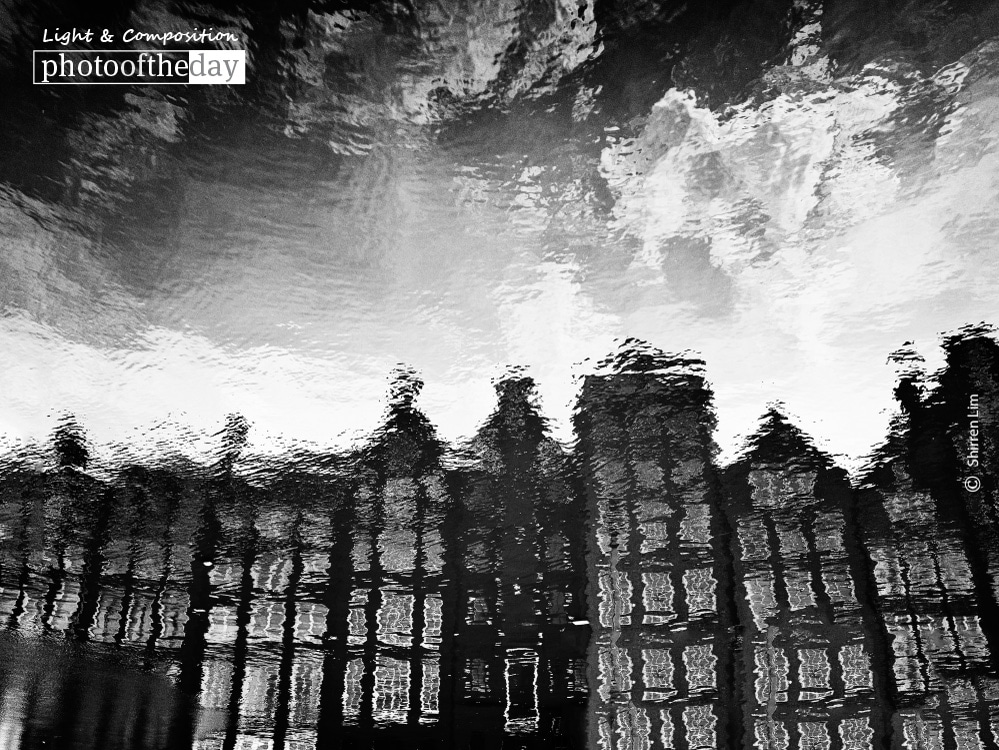
Captured within the quiet charm of an Amsterdam side street, this photograph explores the interplay between urban architecture and fluid motion. The photographer focused on the rhythmic ripples of the canal water, which serve as a living mirror for the city's iconic historic buildings. By isolating these reflections, the image transforms a familiar cityscape into an abstract study of light and texture. This evocative composition earned recognition for its artistic merit, eventually being featured in KLM’s inflight magazine, a testament to its ability to capture the soul of Amsterdam through a unique, reflective perspective.
Shirren Lim
Born in Penang Island, Malaysia, in 1970, Shirren Lim is a Jakarta-based photographer who discovered her true passion for the craft in 2009. Renowned for her intense and earthy portraiture, she strives to capture the sincere, uncovered expressions of humanity with simple, heart-piercing compositions. Inspired by the iconic imagery of Steve McCurry, Lim continues to pursue her ambition of capturing a single, world-changing moment, with her evocative work appearing in numerous international web and printed publications.
Resonance Score Breakdown
Transparency Note: The resonance score (12.7/20) is calculated based on social engagement metrics collected before the award announcement.
Expert Photography Reviews · 5
The Water Remembers
We walk along the edges of things, trusting the solid ground beneath our boots. We believe the world is fixed, a collection of stone and iron that stays where we place it. But there is another world beneath the surface, one that moves without effort.
Read the reflection →The Mirror of Passing Time
I keep a small, tarnished silver thimble in a velvet box, a relic from a grandmother who spent her afternoons mending what the world had worn thin. It is cold to the touch, yet it holds the weight of a thousand quiet hours spent stitching life back together.
Read the reflection →Reviews & Comments
Share your thoughts about this award-winning photograph. Your reviews contribute to the community engagement score.
Nice black white photo with powering shadow illusions.
The focal plane here dances across the water’s surface, where micro-ripples act as a series of chaotic, liquid lenses. Lim has captured the diffraction of light across these shifting planes with startling precision. It’s not just a reflection; it’s a study in wave interference. I’m genuinely moved by how the lens resolves the architecture into fluid, abstract geometry. It’s a rare moment where the physics of the canal perfectly aligns with the sensor’s resolution limits. Truly exquisite.
The shutter speed here is a masterstroke. It’s a long take of liquid architecture, where the canal ripples turn stone into silk. I’m breathless watching how the light fractures against the quay. Most would’ve frozen the motion, but Lim let the city breathe. It’s a frame the editor keeps because it refuses to settle. I’d kill to see this projected on a loop; it’s not just a reflection, it’s the city’s heartbeat caught in amber.
f/5.6 at 50mm, 1/125s, ISO 200. A calculated choice. The focal length compresses the canal’s architecture, forcing the ripples into a tight, rhythmic pattern. It’s a clean execution of geometry. I’ve seen a thousand canal shots, but this one doesn’t rely on the usual wide-angle crutch. It’s sharp where it needs to be. Honestly, the precision here is refreshing. It’s a rare moment where the technical constraints actually support the abstraction. Well done.
The frame’s geometry relies on the canal’s vertical distortion. It’s a precarious balance. The architecture’s rigid lines dissolve into the water’s fluid oscillations, creating a necessary spatial tension. The composition doesn’t collapse, though it teeters on the edge of chaos. I’m genuinely unsettled by how the light fractures against the ripples. It’s a disciplined abstraction that avoids the trap of mere sentimentality. The structure holds, just barely, and that’s why it works.
We look at these ripples and we aren’t just seeing water; we’re seeing the city’s heartbeat. Shirren Lim didn’t just point a lens at a canal; she listened to the rhythm of the stone and the shifting light. It’s a portrait of a place that’s forgotten its own face, leaving only fluid, dancing memories. I find myself holding my breath, waiting for the water to settle. It’s a photograph that asks to be returned to.