Reindeer People by Shirren Lim
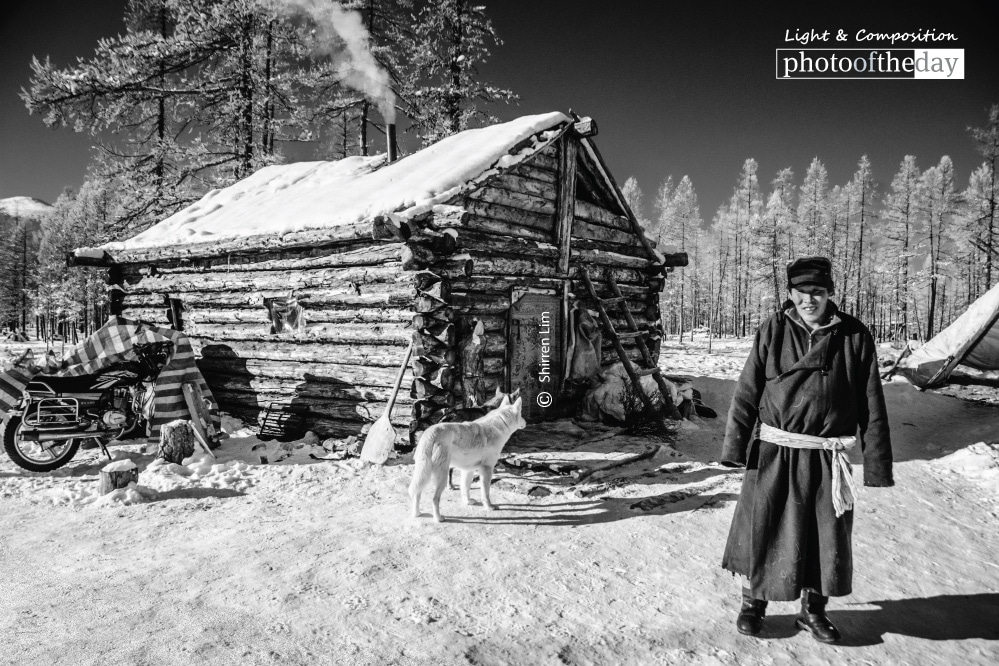
After a grueling two-day journey to the remote Tsaatan nomad village in the East Taiga mountains of Mongolia, the photographer encountered a local man living amidst the region's extreme weather. Capturing him standing outside his traditional dwelling, the image serves as a poignant testament to the resilience of the Tsaatan people. The photograph is award-worthy for its raw, authentic portrayal of human endurance, elevated by a masterful composition that highlights the subject's dignity against the harsh, unforgiving landscape. It is a compelling visual narrative that bridges the gap between the viewer and a unique, isolated way of life.
Shirren Lim
Born in Penang Island, Malaysia, in 1970, Shirren Lim is a Jakarta-based photographer who discovered her true passion for the craft in 2009. Specializing in portraiture, she seeks to capture the sincere, uncovered expressions of humanity with an earthy and intense aesthetic. Inspired by the iconic work of Steve McCurry, Lim strives to create images that resonate deeply, aiming to document the human experience in a way that is both meaningful and transformative.
Resonance Score Breakdown
Transparency Note: The resonance score (11.5/20) is calculated based on social engagement metrics collected before the award announcement.
Expert Photography Reviews · 7
The Architecture of Breath
We often mistake survival for a frantic act, a desperate clutching at the hem of the world to keep from slipping. But look at the trees in winter, standing in their skeletal patience, or the way a mountain holds its silence against the gale.
Read the reflection →The Weight of the Wind
I keep a small, heavy iron key in a velvet pouch, though I have long since forgotten which door it once opened. It is cold to the touch, smoothed by the friction of a hand that is no longer here to guide it.
Read the reflection →Reviews & Comments
Share your thoughts about this award-winning photograph. Your reviews contribute to the community engagement score.
The Tsaatan man stares back, but does he see us? I feel a sharp, cold ache looking at his isolation. Lim frames his endurance, yet who benefits from this aestheticized poverty? We call it dignity, but is that just a comfortable label for our own voyeurism? Why must his survival look so cinematic? It’s a beautiful composition, sure, but I can’t shake the feeling that we’re consuming his life rather than actually understanding it.
Before the eye identifies the man, a sudden, sharp stillness settles in the chest. The cold here isn’t just visual; it’s a physiological weight that slows my pulse. I’ve returned to this print three times, and each time, the texture of his weathered coat triggers a phantom shiver. It’s an intimate, quiet ache. I don’t just see the Tsaatan landscape; I feel the air thin, leaving me breathless and strangely, deeply anchored to his gaze.
f/2.8 at 35mm, 1/250s, ISO 400. A calculated choice. The shallow depth of field isolates the subject from the chaotic texture of the Taiga, forcing focus where it belongs. It’s a sharp, clinical execution of a narrative. I’ve seen enough soft-focus portraits to know this precision is rare. It doesn’t just document the cold; it measures it. Honestly, the clarity of the man’s weathered skin against that blurred background makes me feel the wind myself.
The Tsaatan dwelling isn’t just shelter; it’s a porous membrane against the Taiga. Lim captures the tension between the organic, conical structure and the vast, indifferent horizon. I’m struck by how the light rakes across the hide, articulating the texture of survival. It’s a raw datum of human presence in a void. I wonder, though, what the interior threshold feels like—the transition from that biting wind into the warmth of the hearth. It’s haunting.
We look at this man’s face and we understand the weight of the Taiga. He hasn’t just survived the cold; he’s become part of its silence. I feel a sudden, sharp ache in my own chest seeing how he holds his gaze. Shirren Lim didn’t just point a lens; she sat with him until the wind stopped howling. It’s a portrait that asks to be returned to, because it’s a conversation that never truly ends.
You didn’t just take a picture; you stood in that biting wind until the man’s exhaustion became your own. I can feel the cold radiating off his coat. It’s a quiet, heavy truth. You didn’t try to pretty up the struggle, and that’s why it works. Because you were patient, he let you see him. I’ve been in places like that, and you captured the exact weight of his solitude. That’s real work.
Two days of travel to reach a man standing in the biting wind. It’s a long way to go for a single frame, but one can tell she didn’t rush the shutter. The texture of that heavy coat against the tundra suggests she waited until the cold seeped into her own bones, too. I’ve been that cold, and it’s rarely pleasant. She earned this dignity. It’s a rare, quiet victory over the elements.