Lagundo by Mauro Squiz Daviddi
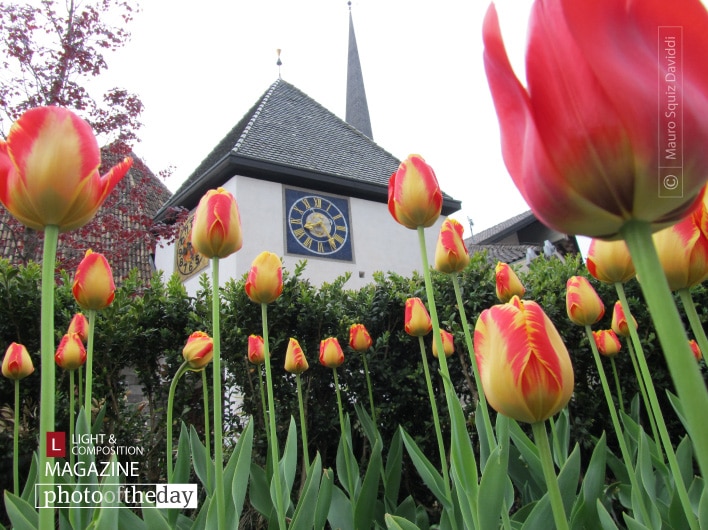
In this striking capture from Lagundo, Italy, Mauro Squiz Daviddi turns his lens toward the delicate resilience of nature amidst an urban landscape. Drawn to the upward reach of the flowers, the photographer meticulously frames the scene to emphasize their vertical growth against the backdrop of the surrounding architecture. The image serves as a poignant visual metaphor for the persistent vitality of the natural world. Its award-worthy quality lies in the thoughtful composition and the photographer's ability to transform a simple botanical observation into a compelling narrative of contrast and aspiration.
Mauro Squiz Daviddi
Born in Ozzano dell'Emilia, Italy, Mauro Squiz Daviddi began his photographic journey in 1976 using his father's Vitoret Voigtländer. After earning a Master of Art degree from the Art Institute of Bologna in 1986, he established a distinguished career marked by numerous exhibitions, including showcases at the Museum of Wax Anatomical Bologna. His work is characterized by a deep, lifelong passion for the medium, frequently exploring the intersection of history, art, and the natural world through a refined and artistic lens.
Resonance Score Breakdown
Transparency Note: The resonance score (12.6/20) is calculated based on social engagement metrics collected before the award announcement.
Expert Photography Reviews · 7
The Architecture of Breath
We are taught that roots belong to the dark, that they must remain hidden beneath the weight of the earth to earn their right to climb.
Read the reflection →The Architecture of Persistence
In the quiet corners of a city, where stone and mortar dictate the rhythm of our days, something else is always happening beneath the surface.
Read the reflection →Reviews & Comments
Share your thoughts about this award-winning photograph. Your reviews contribute to the community engagement score.
Of the thousands of nature shots I’ve reviewed, most wither within a year. Daviddi’s work survives because he didn’t just photograph flowers; he framed a struggle. The vertical tension between the delicate petals and the rigid, man-made stone creates a genuine narrative of defiance. It’s rare to see such intent from a point-and-shoot. Honestly, it makes me feel a bit hopeful for the future of urban wildness. That’s why it’s still relevant eight years later.
The light here isn’t shouting; it’s a quiet, diffused glow that settles softly on the petals. I’ve stood in such gardens, waiting for the wind to hold its breath. Mauro didn’t rush. He watched these flowers reach toward the stone, finding a sacred verticality in the mundane. It’s a gentle reminder that life persists even in the shadows of our walls. Looking at it, I feel a sudden, sharp ache for the stillness of that Italian morning.
At f/4, the PowerShot’s small sensor struggles against the diffraction limit, yet the focal plane captures a surprising intimacy. The chromatic aberration along the petals’ edges reveals the lens’s physical constraints, but it’s precisely this imperfection that draws me in. It’s a fragile, honest rendering of light. I’m genuinely moved by how the optics resolve these stems against the urban blur; it’s a quiet, scientific triumph of capturing life’s resilience where we least expect it.
You’ve found a quiet defiance in these flowers. It’s easy to walk past a bit of green pushing through concrete, but you stopped. I can feel the stillness you held while framing that vertical reach against the cold stone. It’s not just a plant; it’s a small, stubborn victory. I’ve spent enough time in grey cities to know that feeling. You didn’t just take a picture, you recognized a pulse in the pavement. That’s good work.
The ochre of these walls, reminiscent of a weathered Morandi still life, anchors the composition, yet it’s the sudden, piercing violet of the petals that truly arrests one’s pulse. I’m breathless at how that bruised, twilight-shadow purple vibrates against the sun-baked stone, creating a chromatic tension that feels like a secret whispered in the heat. It’s not merely nature; it’s a delicate, shivering dialogue between the permanence of architecture and the fleeting, liquid intensity of bloom.
One suspects the light cooperated on the first attempt. It often does, for the patient. Using a PowerShot for this suggests a casual stroll rather than a calculated vigil. I’ve spent enough mornings shivering in the Dolomites to know that nature’s resilience deserves more than a point-and-shoot convenience. It’s a pleasant enough composition, but I’m left wondering if the photographer ever returned when the weather turned foul. It’s pretty, but it wasn’t earned.
The vertical axis here is a masterclass in spatial tension. Daviddi anchors the frame with a rigid 1:3 ratio, pitting the organic, chaotic vectors of the flora against the brutal, horizontal grid of the architecture. It’s a precise collision of geometry. I’m genuinely thrilled by how the petals disrupt the negative space, forcing the eye into a calculated ascent. It’s not just nature; it’s a perfectly solved equation of growth against the relentless stability of stone.