The Resilient Trees by Masrur Ashraf
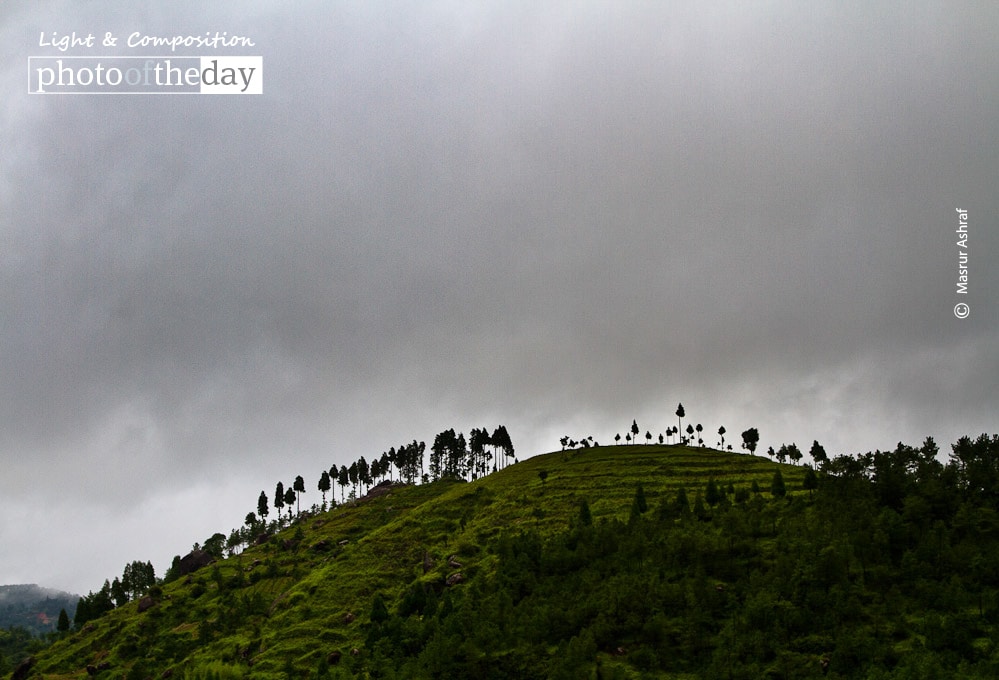
Captured amidst the rolling green hills of Shillong, this photograph highlights the stoic presence of trees perched high above the valley floor. The photographer was drawn to the mysterious resilience of these specimens, which stand as silent observers overlooking the fields below. By framing these trees against the expansive landscape, the image invites viewers to contemplate the challenges of nature and the quiet beauty found in isolated growth. This award-winning composition is celebrated for its evocative storytelling, successfully transforming a simple rural scene into a profound meditation on endurance and the mystifying allure of the natural world.
Masrur Ashraf
Born in Dhahran, Saudi Arabia, to Indian parents, Masrur Ashraf is a multifaceted professional who balances a career in investment promotion with a deep-seated passion for photography. His artistic journey began with his father’s vintage Canon AE-1, eventually evolving into a dedicated pursuit of landscape and portraiture. Drawing inspiration from his roots in West Bengal, Ashraf focuses his lens on the humble beauty of rural life, striving to share the richness of the Indian countryside with a global audience through his evocative and narrative-driven imagery.
Resonance Score Breakdown
Transparency Note: The resonance score (12.6/20) is calculated based on social engagement metrics collected before the award announcement.
Expert Photography Reviews · 8
The Architecture of Endurance
I once sat with an old stonemason in a village tucked into the folds of the Pyrenees. He spent his days repairing walls that had been battered by wind and frost for centuries. I asked him why he bothered with the loose stones when the mountain itself seemed to be crumbling.
Read the reflection →The Architecture of Standing
There is a specific silence left behind when a forest is cleared, a hollow space where the wind used to catch and tangle.
Read the reflection →Reviews & Comments
Share your thoughts about this award-winning photograph. Your reviews contribute to the community engagement score.
Shillong’s hills aren’t for the faint of heart, and these trees certainly didn’t grow there by accident. One wonders how many damp, shivering mornings Ashraf spent waiting for that specific, moody light to break across the valley. It’s a quiet, stubborn piece of work. I’ve spent enough time in similar terrain to know the ache in the knees required to find this vantage. He didn’t just take a picture; he clearly earned the view.
Most landscapes I review are merely pretty, but this one holds a stubborn gravity. The way those trees cling to the ridge against the vast, indifferent valley floor isn’t just a scene; it’s a quiet defiance. I’ve stared at these hills for ten minutes, and I actually feel a sense of relief knowing they’re still there. It’s the tension between the fragile branches and the immense, rolling space that ensures this will matter in thirty years.
The light here isn’t forced; it’s a soft, diffused breath clinging to the Shillong hills. I’ve stood in such damp, quiet air, waiting for the mist to reveal the trees’ true posture. They don’t just grow; they endure. Looking at how they cling to that ridge, I feel a sudden, sharp ache in my own chest. It’s a lonely, beautiful patience. He didn’t rush this. He listened until the valley finally let him see.
In these Shillong hills, the verdant expanse breathes with the muted, chalky greens of a Morandi still life, where the foliage doesn’t merely exist but vibrates against the sky’s bruised, atmospheric indigo. It’s a chromatic ache, really; I’ve found myself mesmerized by how the light clings to those lonely branches like damp velvet. One feels the quiet, heavy humidity of the valley, a tonal symphony that makes my own heart swell with a sudden, sharp, aching solitude.
Shillong’s hills look picturesque, but whose land are we romanticizing here? Ashraf frames these trees as isolated survivors, yet he ignores the human labor that keeps this landscape habitable. I find the aestheticization of rural struggle deeply unsettling. Why must we turn indigenous geography into a metaphor for resilience? It’s a pretty composition, but it feels hollow. Does the photographer see the people who actually tend these slopes, or are they just inconvenient clutter in his frame?
The camera pans across the Meghalaya ridges, then locks. It’s a wide shot that demands silence. Those trees aren’t just growing; they’re holding their ground against the valley’s vast, indifferent pull. I’ve spent hours staring at this frame, and honestly, it makes me feel small in the best way. The composition doesn’t need a cut. It’s a perfect, static sequence where the wind is implied in every branch. This is the frame the editor keeps.
In Shillong, we find these trees clinging to the ridge like elders guarding a secret. They don’t just occupy the landscape; they hold it. I’ve spent hours looking at their gnarled limbs, and I feel a sudden, sharp ache for the quiet strength we often overlook in our own lives. Masrur listened to the wind before he clicked the shutter. It’s a portrait of endurance, and honestly, it’s a photograph that asks to be returned to.
The frame’s architecture relies on the vertical thrust of the trees against the horizontal expanse of the Shillong valley. It’s a precarious balance. The negative space above the canopy creates a necessary vacuum, preventing the composition from collapsing into mere sentiment. I’ve grown tired of landscapes that lack this geometric discipline, yet here, the spatial tension holds. It doesn’t falter. The fulcrum of the frame is precise. It’s a rare, cold clarity I actually admire.