Neophyte by Ryszard Wierzbicki
Captured in the serene surroundings of Myanmar's Inle Lake, this portrait highlights a young neophyte monk draped in the iconic dark saffron robes that symbolize the 2007 Saffron Revolution. The photographer utilized a telephoto lens to isolate the subject, creating a shallow depth of field that draws the viewer’s eye directly to the monk’s contemplative expression. This image is award-worthy for its poignant cultural resonance and the intimate, respectful connection established between the photographer and the subject, effectively capturing the quiet dignity of monastic life within the region's historic spiritual landscape.
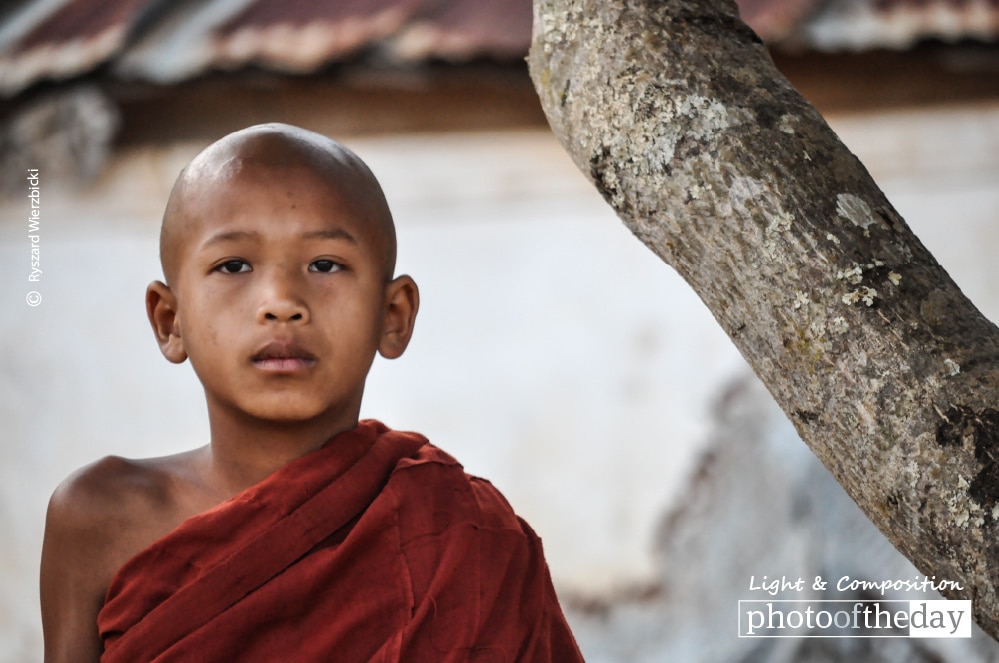
Exposure 1/250sec @ f/5.3 | ISO 450 | Focal Length 160mm
Ryszard Wierzbicki
Born in 1963, Ryszard Wierzbicki is a Polish-born photographer and educator currently based in Swindon, United Kingdom. After a diverse career spanning social sciences, marketing, and IT, he transitioned into a life dedicated to travel, scuba diving, and photography. His work is deeply influenced by his extensive explorations of South-East Asia and his commitment to humanitarian efforts, including volunteering with orphanages in Thailand and Myanmar. Through his platforms, Instant Travelling and World Around, he shares his passion for documenting the world's cultures with an international audience.
Resonance Score Breakdown
Transparency Note: The resonance score (11.2/20) is calculated based on social engagement metrics collected before the award announcement.
Expert Photography Reviews · 6
The Weight of Silence
In the quiet hours of the morning, before the kettle whistles or the house begins its slow, creaking wakefulness, there is a stillness that feels almost heavy. It is not an empty silence, but one packed with the density of things unsaid.
Read the reflection →The Weight of Silence
We are taught that to grow is to add. We collect years, possessions, and the heavy debris of our own histories. Yet, there is a different way to exist.
Read the reflection →Reviews & Comments
Share your thoughts about this award-winning photograph. Your reviews contribute to the community engagement score.
It’s a shame the jury obsessed over the shallow depth of field. By isolating the monk, Wierzbicki missed the chance to let the lake’s atmosphere bleed into the saffron robes. I’m genuinely frustrated by the clinical sharpness here; it’s far too safe. Why not let the motion of the water dissolve the subject? This approach is closer to Hiroshi Sugimoto’s long-exposure theatres than to conventional portraiture. What did he choose not to resolve?
The frame’s compression is its primary virtue. By isolating the subject at 160mm, Wierzbicki forces a claustrophobic intimacy that demands attention. The saffron robe’s mass anchors the lower quadrant, providing a necessary fulcrum against the blurred, indistinct background. It’s a rigid, disciplined geometry. I’ve grown weary of soft portraiture, but the structural tension here holds. The negative space doesn’t bleed; it confines. It’s a rare instance where the composition actually earns its keep.
At 160mm and f/5.3, the lens compresses the background into a soft, creamy bokeh, isolating the monk with surgical precision. The focal plane is razor-thin, catching the fine texture of the saffron robes against the soft blur of Inle Lake. I’m genuinely moved by how the light catches the iris; it’s a sharp, crystalline detail that the naked eye would miss. It’s a beautiful, quiet collision of physics and human spirit.
The monk’s saffron robes act as a vibrant datum against the blurred, watery void of Inle Lake. By compressing the depth with a 160mm lens, Wierzbicki flattens the threshold between the subject and his environment, turning the landscape into an abstract wash of light. It’s a beautiful, quiet isolation. I find myself aching to see the structure he inhabits, to understand the solid mass that anchors this fleeting, contemplative moment in such a vast, fluid space.
The frame holds its breath. That telephoto compression flattens the Inle Lake background into a soft, painterly blur, forcing the monk’s gaze into the foreground. It’s a tight, cinematic close-up where the saffron robes bleed into the stillness. I’ve seen a thousand portraits, but this one hits me—it’s the quiet weight of the eyes. The cut would’ve been a mistake. Wierzbicki knew exactly when to lock the shutter. This is the frame the editor keeps.
We look at this young monk and we don’t just see saffron robes; we hear the silence of Inle Lake. Ryszard didn’t rush this. He listened to the stillness before he pressed the shutter. I’m struck by the boy’s eyes—they’re heavy with a wisdom that shouldn’t belong to someone so small. It’s a quiet, aching reminder that even the youngest souls carry the weight of history. This is a portrait that asks to be returned to.