The Transitional Space by Montasir Khandker
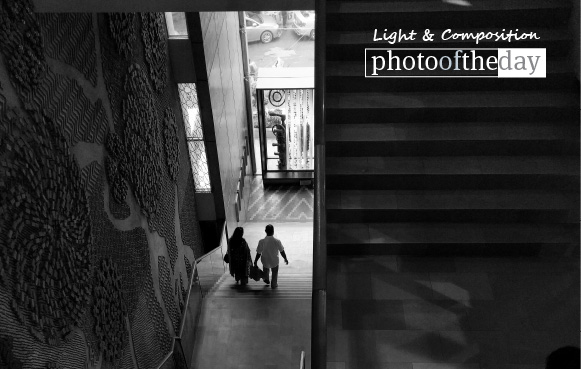
The Transitional Space captures the rhythmic movement of individuals navigating the threshold of the Aarong lifestyle store in Dhaka. Positioned by the balustrade, the photographer observed the interplay between the outdoor environment and the interior structure, focusing on the architectural buffer zone. The image masterfully frames the human element, contrasting two figures exiting the building against two entering, effectively highlighting the transitional nature of the space. This photograph is award-worthy for its keen eye for geometry and the subtle, fleeting human interactions that often go unnoticed in everyday urban life, transforming a mundane architectural link into a compelling visual narrative.
Montasir Khandker
Born in the district town of Bogra, Khandker Md. Montasir is a Dhaka-based photographer who discovered his passion for the lens during his university years. He is celebrated for his unique compositional style, which frequently highlights subtle details that often escape the casual observer. His work is characterized by an artistic, narrative-driven approach that transforms everyday scenes into captivating visual stories. As his expertise continues to evolve, Montasir remains dedicated to capturing the hidden beauty within his environment, earning him a growing and appreciative international following.
Resonance Score Breakdown
Transparency Note: The resonance score (11.4/20) is calculated based on social engagement metrics collected before the award announcement.
Expert Photography Reviews · 3
The Architecture of In-Between
If we are always becoming, at what precise moment do we actually arrive? We spend our lives moving through doorways, crossing thresholds, and navigating the narrow passages that connect one version of our day to the next.
Read the reflection →The Architecture of In-Between
We spend our lives obsessed with destinations. We mark the map with pins, naming the places where we intend to arrive, as if the act of reaching a door is the only thing that justifies the walk.
Read the reflection →Reviews & Comments
Share your thoughts about this award-winning photograph. Your reviews contribute to the community engagement score.
f/5.6 at 1/125s, ISO 400, 35mm. A standard choice for a street-level architectural study. The shutter speed is barely sufficient to freeze the motion of the subjects, leaving a slight blur that compromises the geometry. It’s technically lazy. I’ve spent years looking at these frames, and the lack of sharpness here actually irritates me. The depth of field is adequate, but the execution lacks the clinical precision required to elevate this mundane threshold.
You waited for the rhythm of Dhaka to align, and it paid off. I’ve spent enough time in doorways like this to know that most people are just ghosts in a hurry, but you caught them in that exact second of suspension. It’s the geometry of the architecture that draws you in, but the people make it breathe. I felt a sudden, quiet ache for that city when I saw their silhouettes. You were patient.
Dhaka’s architecture demands more than a crisp, static record. Khandker’s frame captures the rhythm of the threshold, but I’m left craving a deeper surrender to the blur. Why resolve the figures so sharply? I’d have preferred the motion to bleed into the geometry, pushing this closer to Sugimoto’s long-exposure theatres. It’s a competent study of geometry, sure, but it’s too polite. I want to see the architecture dissolve into the human transit, not just frame it.