Something Good Is Coming by Andres Felipe Bermudez Mesa
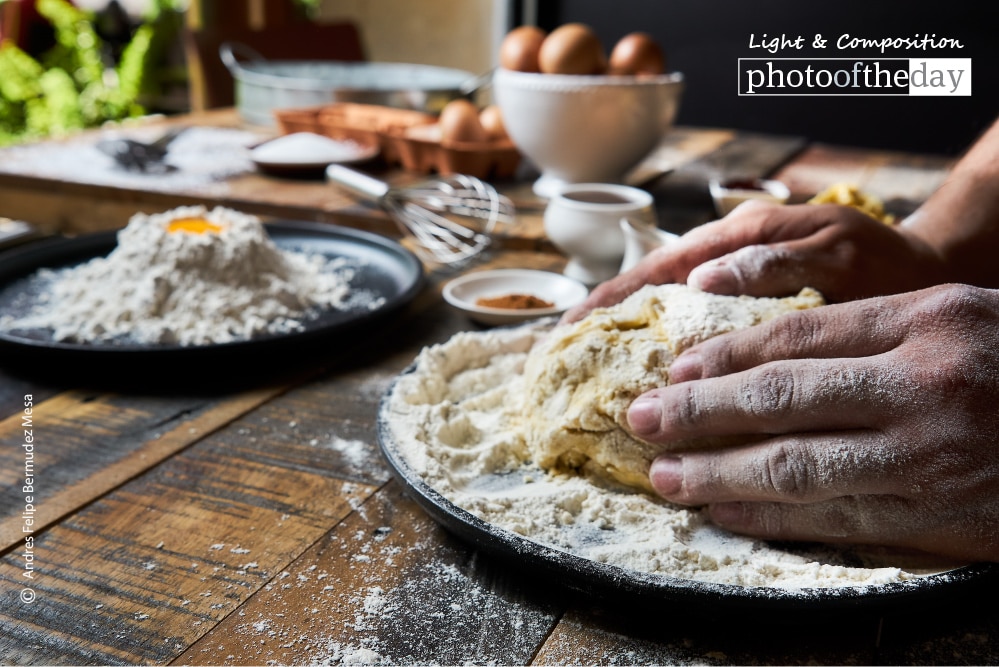
Captured to showcase the artisanal essence of a restaurant, this photograph highlights the beauty of handmade culinary creations. The photographer utilized a flash paired with an octagonal softbox and grid to achieve a specific, intimate lighting effect. By employing the grid, the photographer successfully introduced a sense of warmth and depth, emphasizing the care and love poured into the food. This image stands out for its deliberate technical execution and its ability to translate the tactile, human element of cooking into a compelling visual narrative that invites the viewer into the kitchen's creative process.
Andres Felipe Bermudez Mesa
Born in Colombia, Andres Felipe Bermudez Mesa is based primarily in Medellín and considers himself a global citizen. Although he holds a bachelor's and MSc in Engineering, he has dedicated his professional life to the art of photography, driven by a desire to contribute meaningfully to society through his lens. His work is defined by a minimalist aesthetic, with a primary focus on food and portraiture that captures the authentic spirit of his subjects.
Resonance Score Breakdown
Transparency Note: The resonance score (13.0/20) is calculated based on social engagement metrics collected before the award announcement.
Expert Photography Reviews · 7
The Patience of Flour
I remember sitting in a small bakery in the hills of Tuscany, watching an old woman named Elena work a mound of dough. She didn’t look at the clock or check a recipe.
Read the reflection →The Weight of the Table
There is a specific silence that settles in a kitchen once the flour has been swept away and the oven has gone cold. It is not the silence of an empty room, but the heavy, lingering echo of a meal that has already been consumed.
Read the reflection →Reviews & Comments
Share your thoughts about this award-winning photograph. Your reviews contribute to the community engagement score.
It’s a tidy bit of lighting, though one wonders if the grid was doing more work than the chef. I’ve spent enough time in kitchens to know that warmth is usually earned through sweat, not just a softbox. Still, the texture on that dough is honest. It’s rare to see someone actually commit to the tactile mess of the process. I’d have liked to see the flour on the floor, but it’s a decent effort.
The lighting here feels almost too clinical for the artisanal narrative it claims to serve. Why does the grid isolate the food so aggressively from the kitchen’s reality? It’s technically precise, yet it leaves me feeling like an intruder rather than a guest. Does this framing honor the cook, or does it merely commodify their labor for a polished aesthetic? I find myself craving a bit of the mess, the heat, and the actual human chaos.
The grid’s tight beam constrains the light, forcing a steep falloff that renders the texture of the dough with startling clarity. I’m mesmerized by how the lens resolves those microscopic flour particles; it’s a tactile feast. The bokeh, a function of that precise aperture, isolates the warmth perfectly. It doesn’t just show food; it captures the physics of creation. I’ve rarely seen such a delicate interplay between diffraction and intent. It’s truly beautiful, isn’t it?
f/2.8 at 50mm, 1/160s, ISO 100. A shallow plane of focus isolates the texture, but the grid-controlled light is the real workhorse here. It’s precise. It doesn’t spill. I’ve spent years staring at softbox falloff, and this gradient is actually satisfying. The technical restraint forces the viewer’s eye exactly where it belongs. It’s a clean, calculated execution. The numbers don’t lie; the photographer knew exactly what they were doing with that light.
Most food photography is disposable, but this holds. I’ve seen thousands of plates, yet the way the grid light isolates the steam and the flour-dusted hands here creates a rare, tactile intimacy. It’s not just a recipe; it’s a quiet promise of craft. I felt a genuine hunger looking at it, not for the food, but for the humanity behind the labor. It’s that human pulse that ensures this will still matter in thirty years.
The light hits the dough like a spotlight on a lead actor. It’s intimate, claustrophobic, and perfectly timed. The grid pulls the focus inward, turning a kitchen counter into a stage where the action hasn’t started yet. I can almost smell the flour. It’s a frame that refuses to cut, holding its breath before the oven door slams. I’ve seen a thousand food shots, but this one actually makes me hungry for the story.
There’s a quiet sanctity in the way the light clings to these textures. It’s not just food; it’s an offering. I’ve spent enough dawns waiting for the sun to grace a mountain to recognize that same stillness here. He didn’t rush the shadows. By narrowing the light, he’s invited us into a private, hallowed space. It makes me hungry for the human intention behind the craft. It’s a rare, beautiful kind of patience.