Simply Delicious by Andres Felipe Bermudez Mesa
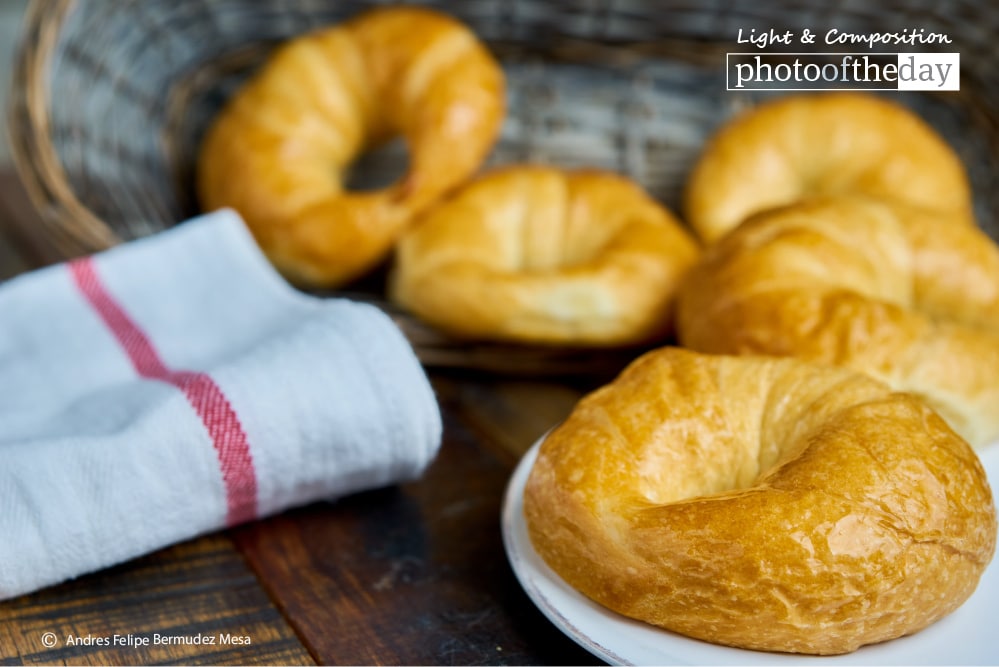
In this evocative food photograph, the artist captures a subject that is, quite literally, simply delicious. By utilizing a tight close-up perspective, the photographer emphasizes the intricate textures of the food, while a soft, blurred background isolates the subject to create a harmonious and balanced composition. This deliberate technical choice draws the viewer’s eye directly to the sensory details of the dish. The image stands out for its clean, minimalist aesthetic, demonstrating how a focused approach to lighting and depth of field can elevate a simple culinary subject into a compelling piece of visual storytelling.
Andres Felipe Bermudez Mesa
Born in Colombia, Andres Felipe Bermudez Mesa is a Medellín-based photographer who views himself as a citizen of the world. Though he holds a bachelor's and MSc in Engineering, he has dedicated his professional life to the pursuit of photography, specializing in food and portraiture. His work is defined by a commitment to simplicity and a deep-seated passion for visual storytelling, through which he seeks to make a meaningful contribution to society.
Resonance Score Breakdown
Transparency Note: The resonance score (12.9/20) is calculated based on social engagement metrics collected before the award announcement.
Expert Photography Reviews · 8
The Geography of the Table
We often speak of the city as a collection of buildings, but the true urban document is written in the rituals of consumption. Every meal eaten in public is a negotiation of space and status. Who has the time to sit?
Read the reflection →The Memory of Salt
The first thing I remember is the sting of salt on a split lip, a sharp, metallic tang that bloomed like a secret in the back of my throat. It is a flavor that demands attention, pulling the body into a sudden, rigid awareness.
Read the reflection →Reviews & Comments
Share your thoughts about this award-winning photograph. Your reviews contribute to the community engagement score.
Texture is a trap. Bermudez Mesa lures us into the grain of the food, yet he’s terrified of the void. Where is the hunger? It’s all surface, all light, lacking the necessary violence of a deep, encroaching shadow. I’ve stared at this plate for an hour, and it doesn’t haunt me; it merely exists. It’s a polite, well-lit lie. Without the weight of darkness, the soul of the subject simply evaporates into the blur.
You’ve captured the texture of that meal so well I can almost taste the salt. It’s clean, sure, but I’m looking for the person who cooked it or the hands that held the plate. You’ve got the technical side down, but photography is about the pulse behind the lens. And honestly? I’m hungry for the story, not just the garnish. You’ve got a sharp eye, but don’t forget to look for the life.
The focus pulls tight, locking onto the grain and glaze. It’s a macro sequence where the movement is all in the texture. I’m hungry just looking at it; it’s the kind of frame an editor keeps because it’s the only one that tells the whole story. The depth of field is a razor’s edge, isolating the subject like a lead actor in a spotlight. It doesn’t need a wider shot. The cut would’ve been a mistake.
The composition functions on a strict rule of thirds, with the primary subject anchored in the lower-right quadrant. Its circular geometry creates a powerful gravitational pull, perfectly balanced by the soft, out-of-focus negative space above. I’m genuinely struck by how the diagonal light vectors slice through the texture, solving the spatial tension with elegant precision. It’s a clean, calculated equation where every pixel earns its place. Honestly, it’s just a beautifully solved geometric problem.
It’s a curious exercise to view a plate as a built environment. Here, the food acts as the solid, the blurred background its void. I’m struck by how the light mimics the soft, diffused glow of a clerestory window hitting a textured concrete wall. It’s a tactile, intimate scale, yet I find myself craving the context of the room. Where is the threshold? Without the datum of the table, the space feels untethered, almost lonely.
Most food photography is disposable, destined for a menu and then oblivion. Of the thousands I’ve reviewed, this one lingers because of the way the light catches those specific, glistening droplets. It’s not just a dish; it’s a tactile memory. I’d argue the shallow depth of field is what saves it from being a mere catalog shot. It makes me hungry, honestly. It’s a rare, honest moment of sensory clarity that’ll actually endure.
We look at this plate and we don’t just see a meal; we see the hands that prepared it. There’s a quiet intimacy here, a conversation between the cook and the ingredients. It’s not just food; it’s a memory of Medellín’s warmth. I find myself hungry, not for the dish, but for the story behind it. It’s a photograph that asks to be returned to, reminding us that every bite holds a human history.
Before the eye identifies the texture of the crust, something in the throat tightens. It’s a sudden, visceral hunger that bypasses the mind entirely. I’ve spent years studying how light triggers desire, but this simple Medellín dish catches me off guard. It’s not just food; it’s a phantom memory of a kitchen I’ve never visited. Returning to it, I still feel that same sharp, quiet ache—a reminder that we eat with our nerves first.