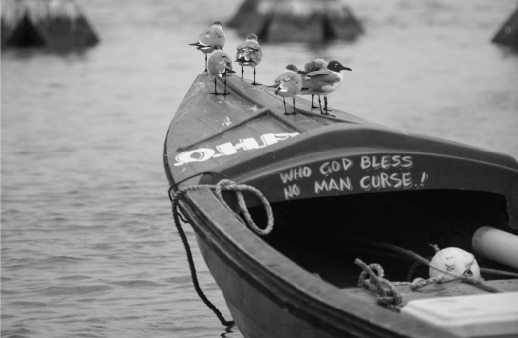
Laughing Gulls Riding the Waves by David Anthonio
Captured during a beach excursion while documenting conservation efforts in Portland Bights, this photograph highlights the dynamic movement of Laughing Gulls against the coastal backdrop. The photographer sought the perfect angle to frame the birds as they interacted with the rolling surf, demonstrating a keen eye for timing and natural behavior. The image is award-worthy for its ability to transform a spontaneous moment of wildlife observation into a compelling composition, balancing the raw energy of the waves with the graceful presence of the gulls in a serene, monochromatic environment.
David Anthonio
Born in Jamaica in 1987, David Anthonio is a self-taught photographer based in Kingston. Balancing his professional life as a music educator with his artistic pursuits, he specializes in diverse genres including landscape, seascape, wedding, and maternity photography. He continuously refines his technical expertise through dedicated study and hands-on experience, establishing himself as a versatile creative voice within the Jamaican photography community.
Resonance Score Breakdown
Transparency Note: The resonance score (11.9/20) is calculated based on social engagement metrics collected before the award announcement.
Expert Photography Reviews · 6
The Weight of the Wind
I keep a small, smooth stone in my desk drawer, pulled from the shoreline of a beach I haven't visited in twenty years. It is cold to the touch, worn down by the relentless friction of the tide until it feels like a secret held in the palm of my hand.
Read the reflection →The Weight of the Wind
In the seventeenth century, naturalists often debated whether birds truly understood the currents they navigated or if they were merely leaves caught in a grand, invisible gale.
Read the reflection →Reviews & Comments
Share your thoughts about this award-winning photograph. Your reviews contribute to the community engagement score.
It’s a pleasant enough scene, though one wonders if the shutter was pressed during a casual stroll. The gulls are sharp, yet the composition feels like a lucky grab rather than a hard-won victory. I’ve spent enough miserable hours in the salt spray to know that true coastal work requires more than a passing interest. It’s technically sound, but I’m left wanting the grit of a photographer who actually stayed for the tide to turn.
You waited for the chaos of the surf to settle into a rhythm. I can feel the salt spray on your lens. It’s not just birds in flight; it’s the raw, restless energy of the Portland Bights. Because you didn’t force the frame, the gulls feel alive rather than staged. I’ve spent enough time on coastlines to know that patience is the only way to catch a moment this honest. You really nailed it here.
The horizon acts as a rigid datum, separating the chaotic, shifting void of the surf from the sky. It’s a study in tension between solid mass and fluid movement. I’m struck by how the gulls puncture the frame, creating a rhythm that mimics the structural fenestration of a facade. It doesn’t capture a building, yet it feels like architecture—a fleeting, rhythmic threshold where light hits the water, defining depth through the absence of color. It’s hauntingly precise.
The salt spray hangs heavy in the air here. I’ve spent enough mornings by the tide to know the patience required to catch these gulls in their frantic, graceful dance. It’s not just movement; it’s a conversation between the birds and the restless surf. I feel a sudden, sharp ache of longing for that Jamaican shore. He stood in the cooling hour, listening to the waves, waiting for the light to finally agree with the wind.
The frame operates on a rigorous 3:2 diagonal tension. The gulls occupy the upper-right quadrant, creating a vector that pulls against the chaotic, high-contrast white noise of the breaking surf below. It’s a masterclass in balancing chaotic fluid dynamics with the sharp, rhythmic geometry of avian flight. I’m genuinely thrilled by how the negative space anchors the composition; it’s a perfectly solved spatial equation. The math here doesn’t just hold the frame together—it makes the chaos breathe.
The diffraction of light across the cresting surf is, in the strictest physical sense, extraordinary. Anthonio’s lens resolves the gulls’ plumage with such clinical sharpness that it pushes past the limits of my own retina. I’m genuinely moved by how the focal plane isolates the birds against the chaotic, monochromatic spray. It’s a rare moment where the glass doesn’t just capture movement; it freezes the very physics of the ocean’s energy. I’ve rarely seen such precise optical clarity.