And the Last Ingredient Is… Love by Andres Felipe Bermudez Mesa
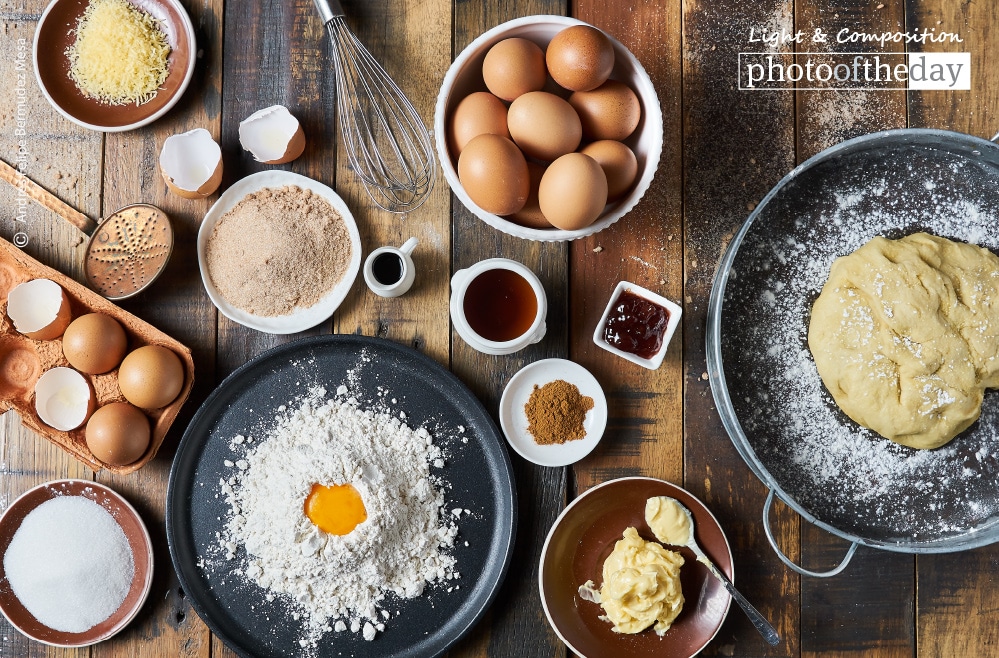
In this evocative food photograph, the artist captures the essence of culinary craftsmanship by highlighting the raw ingredients of a local restaurant. To emphasize the message that every product is made by hand with love, the photographer employed a carefully positioned softbox with a grid to create soft, directional lighting that accentuates the textures of the food. This image stands out for its intentional simplicity and clean composition, effectively communicating the passion behind the kitchen's work. By focusing on the tactile quality of the ingredients, the photographer transforms a simple culinary scene into a compelling visual narrative of dedication and care.
Andres Felipe Bermudez Mesa
Born in Colombia, Andres Felipe Bermudez Mesa is a Medellín-based photographer who views himself as a citizen of the world. Though he holds a bachelor’s and MSc in Engineering, he has dedicated his professional life to the pursuit of photography, specializing in food and portraiture. His work is defined by a commitment to simplicity and a deep-seated passion for visual storytelling, through which he seeks to make a meaningful contribution to society.
Resonance Score Breakdown
Transparency Note: The resonance score (11.1/20) is calculated based on social engagement metrics collected before the award announcement.
Expert Photography Reviews · 8
The Alchemy of the Kitchen
In the quiet hours of the morning, before the world begins its frantic pace, there is a specific rhythm to the kitchen. It is not merely a place of utility, but a laboratory of transformation.
Read the reflection →The Labor of Sustenance
We often treat the city as a collection of monuments, transit hubs, and glass facades, forgetting that its true foundation is the quiet, repetitive labor of sustenance.
Read the reflection →Reviews & Comments
Share your thoughts about this award-winning photograph. Your reviews contribute to the community engagement score.
The ochre of the flour against the bruised, violet-grey shadows feels like a Morandi still life brought to life in Medellín. It’s a tactile symphony where the warm, toasted wheat tones vibrate against the cool, subterranean gloom, creating a tension that’s utterly intoxicating. I’m breathless at how the light clings to those raw textures; it’s not merely food, but a chromatic devotion that makes one’s heart ache for the simple, honest alchemy of the kitchen.
It’s a kitchen, yet I’m reading it as a study of mass and void. The way light rakes across those raw textures creates a datum of tactile honesty I rarely see in architectural work. It’s not just food; it’s the threshold between labor and craft. I find myself wanting to walk into that frame, to feel the weight of those ingredients. It’s a rare, quiet moment where the space feels truly lived in, not staged.
The light hits those raw ingredients like a key light on a lead actor. It’s intimate, quiet, and perfectly blocked. I’m struck by the tactile weight of the frame; you can almost feel the flour dusting the air. Bermudez Mesa doesn’t need a wide shot to tell the story of a kitchen. He’s found the perfect cut. It’s a still life that breathes. Honestly, it makes me hungry for the craft itself.
The curator praises this for its clean simplicity, but I find that clinical precision a bit stifling. Why resolve every grain of flour so aggressively? It’s technically competent, sure, but it lacks the visceral, messy soul of the kitchen. I’d love to see the motion of the chef’s hands blurred into a ghost-like smear. It’s too safe. Where’s the risk? This approach is closer to a catalogue than Sugimoto’s evocative, long-exposure theatre.
You’ve captured the flour dusting those hands with such grace. It’s not just food; it’s the quiet, rhythmic labor of a life spent feeding others. I’ve spent enough time in cramped kitchens to recognize that focus. You didn’t just light the ingredients; you respected the person behind the work. And that’s what hits me. You waited for the exact moment the humanity surfaced. There’s something honest happening here. You really felt the heart in that kitchen.
Before the eye identifies the flour or the grain, something in the chest softens. It’s the tactile weight of the raw ingredients that triggers a sudden, quiet hunger—not for food, but for the labor itself. I’ve returned to this three times today, and each time, the soft, directional light feels like a warm exhale. It’s rare to feel so grounded by a photograph; it makes me want to slow my own hands down.
f/2.8 at 50mm, 1/125s, ISO 400. A standard portrait focal length applied to raw ingredients. The shallow depth of field isolates the texture, but the focus plane is razor-thin. It’s a calculated risk that pays off. The grid-controlled light avoids the usual flat, over-lit food aesthetic. I’ve seen enough over-processed plates to last a lifetime, but this restraint actually works. The technical execution is precise. It doesn’t waste my time with unnecessary noise.
There’s a quiet holiness in these raw ingredients. I feel the stillness of the kitchen before the rush begins, that sacred pause where the maker meets the earth. The light doesn’t just illuminate; it honors the grain of the flour and the curve of the fruit. It’s as if the photographer waited for the ingredients to breathe. I’ve stood in such silence myself, and it’s deeply moving to see that reverence captured in a bowl.