Sister Mom by Ryszard Wierzbicki
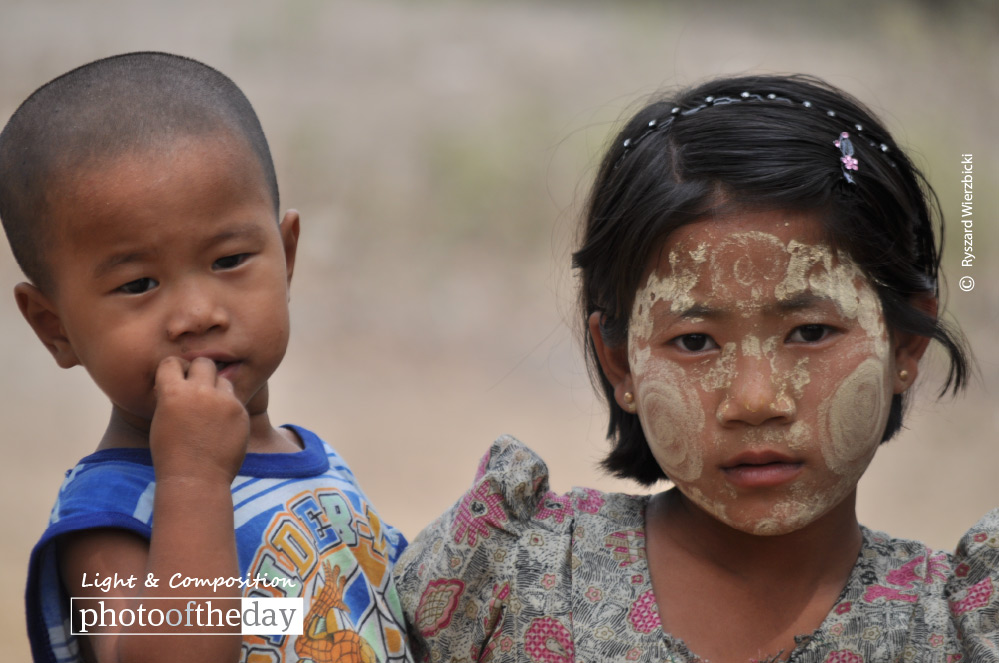
Captured in the serene yet demanding environment of Inle Lake, this portrait highlights the profound responsibility shouldered by elder siblings in Myanmar. The photographer documents a poignant moment where a young girl assumes the role of a caregiver, a necessity while parents labor in the fields. Through a sensitive lens, the image explores the themes of childhood maturity and familial devotion. It is award-worthy for its authentic storytelling and the photographer's ability to capture the quiet dignity of his subject, transforming a daily domestic reality into a compelling visual narrative of cultural resilience and human connection.
Ryszard Wierzbicki
Born in 1963, Ryszard Wierzbicki is a Polish-born photographer and educator currently based in Swindon, United Kingdom. A graduate of the University of Gdansk with a master's degree in Social Sciences, he transitioned from a diverse career in child care and marketing to pursue his passion for travel and photography after relocating to the UK in 2006. Wierzbicki frequently explores South-East Asia, where he combines his artistic practice with humanitarian work for orphanages, documenting the lives of those he encounters with a deep sense of empathy and cultural curiosity.
Resonance Score Breakdown
Transparency Note: The resonance score (12.8/20) is calculated based on social engagement metrics collected before the award announcement.
Expert Photography Reviews · 4
The Weight of Small Hands
There is a quiet transition that happens in the marrow of a child. It is not marked by a calendar or a celebration. It arrives in the stillness of an afternoon, when the heavy work of the world is placed into hands that have not yet grown to fit it.
Read the reflection →The Architecture of Care
We often mistake the city for its hard surfaces—the concrete, the glass, the infrastructure that dictates movement. But the true geography of a place is found in the invisible labor that keeps it functioning.
Read the reflection →Reviews & Comments
Share your thoughts about this award-winning photograph. Your reviews contribute to the community engagement score.
The focal plane here is razor-thin, isolating the girl’s gaze with surgical precision. Wierzbicki’s choice of aperture renders the background bokeh as a soft, creamy wash, preventing the chaotic textures of the lake from bleeding into the subject. I’m genuinely moved by how the light catches the moisture in her eyes; it’s a perfect resolution of human vulnerability. The diffraction of light across her skin is, in the strictest physical sense, extraordinary. It’s a quiet, optical triumph.
The weight of the child’s gaze pulls at the frame. She holds the infant, yet the space around them remains vast. It’s a heavy stillness. I’ve spent minutes watching the way the light touches her shoulder, leaving the rest to shadow. Nothing here is accidental. The empty corner is not empty. It’s the breath between her duties. I feel a sudden, sharp ache in my chest. She doesn’t need to move. She is already enough.
Why must we insist on the clinical sharpness of a portrait? Wierzbicki’s capture of this young girl’s burden feels far more honest when the edges soften into the humid haze of Inle Lake. It’s closer to the ethereal, time-dilated atmosphere of Sugimoto’s theatres than a standard documentary shot. I’m genuinely moved by what he chose not to resolve here; the blur isn’t a failure, it’s the weight of her responsibility dissolving into the frame.
The composition hinges on a rigid vertical axis, bisected by the subject’s gaze. I’m struck by the 1:2 ratio between the girl’s focused posture and the negative space of the background. It’s a beautifully solved spatial equation. The diagonal vector formed by her arm creates a perfect tension against the frame’s edge. It’s mathematically precise, yet the emotional weight of her responsibility pulls at me. Wierzbicki has balanced the geometry so well; it’s truly elegant work.